
By Kristen Ziccarelli
Pope Leo XIV’s recent address to the diplomatic corps accredited to the Holy See featured a warning of a “subtle form of religious discrimination against Christians” spreading even in countries where Christianity remains the majority faith—especially across Europe and the Americas—where believers are increasingly restricted from proclaiming Gospel truths for “political or ideological reasons.”
The Holy Father went further, diagnosing the deeper pathology behind this trend. What is often justified in the name of freedom of expression, he said, in fact produces the opposite effect. As language is hollowed out and detached from truth, genuine freedom of conscience and expression collapses. In its place arises a new, “Orwellian-style language” that claims inclusivity while systematically excluding those who refuse to conform to reigning ideologies. In a subsequent X post, Pope Leo described this dynamic as a “short circuit of human rights,” where religious freedom, freedom of expression, and even the right to life is restricted in the name of novel, self-referential “rights” severed from reality, nature, and truth itself.
Spain’s Valle de los Caídos—the Valley of the Fallen—is a perfect example of this persecution, and indeed a rejection of human rights. The Valley is the site of the world’s largest cross, sitting above a monumental basilica carved into a mountain. It was originally commissioned by Gen. Francisco Franco as a place of reconciliation after Spain’s civil war. Since its completion in 1941, the valley has long functioned as a site of prayer, remembrance, and national penitence. Now, under the banner of “pluralism” and historical reinterpretation, the Spanish government is systematically stripping the site of its Catholic meaning.

Last year, Spanish Prime Minister Pedro Sánchez advanced plans to “resignify” the valley by convening an international jury to review proposals—some of which openly recommended altering the basilica and even the monumental cross itself, despite earlier assurances that the cross would remain untouched. On November 11, the winning proposal was announced – it is a plan that will materially diminish the religious identity, architectural integrity, and historical purpose of the site.
The project envisions cutting a “great crack”—a horizontal rupture—across the valley’s esplanade, transforming a sacred landscape into a state-defined “space of dialogue and plurality.” The historic staircase leading to the basilica will be eliminated, replaced with a large lobby and an “interpretation center” designed to reframe the valley’s meaning according to contemporary ideological criteria. A place built for prayer and reconciliation will become a museum of political pedagogy.
This is precisely the phenomenon Pope Leo described: religious freedom restricted by government-led linguistic, and cultural manipulation. Christianity is not formally banned at the Valley of the Fallen; it is simply and unacceptably subordinated to a new ideological narrative imposed by the state. As is frequently the case with Leftism, the language of inclusion is invoked, while the most visible and substantive expressions of Christian belief are excluded.
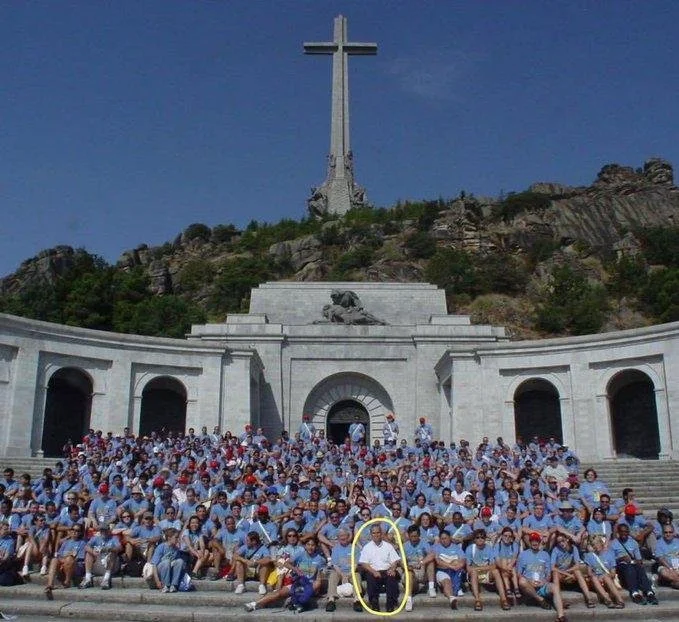
Fr. Robert Prevost visiting the Valley of the Fallen in 2003
The Pope’s remarks were refreshing, though action remains. Save for a few exceptions, Western leaders—particularly within the European Church—have limited their reactions to the Valley for instance, with strong words at best, and full-on appeasement at worst. This instinct is not only wrong for our current time, but it is alien to Europe’s deeply Christian past, which forged a civilization capable of resisting invasion, tyranny, and ideological conquest through action and battle.
Pope Leo’s warning should dispel any illusions we have that complacency will work and our freedoms will carry on without defense. A civilization that severs freedom from truth does not become freer; it becomes coercive. A society that neutralizes the Cross does not achieve reconciliation; it loses the very symbol that made reconciliation possible.
For that reason, in Pope Leo’s visit to Madrid later this year, there is a keen opportunity to act. The Holy Father should go to the Valley of the Fallen itself. The Pontifical Basilica, crowned by the largest cross in the world, is a visible proclamation of the very truths Pope Leo has warned are being muted across the West. A papal visit would affirm that this is not a relic to be “resignified” by the state, but a living sacred site under the spiritual authority of the Church.
Such a visit would speak more powerfully than any speech, and it would make clear that religious freedom does not mean the quiet domestication of faith, nor its confinement to museums and interpretation centers. It would declare that Christian symbols are not negotiable artifacts of history.
If the Holy Father wishes to show the world what it means to resist the “short circuit” of human rights he has described—where religious freedom is sacrificed in the name of ideological conformity—there is no more fitting place to do so than beneath the largest cross in Christendom.
At the Valley of the Fallen, Pope Leo XIV could demonstrate that the Cross still stands while the world turns—and that the Church will not abandon it to those who would empty it of meaning.
Kristen Ziccarelli is a Catholic professional living in Washington DC