What is Truth? Sin and Black Lives Matter

105898586_602758083696863_4358144906898261164_o.jpg

To say this is a difficult article to write is an understatement. On one hand, my motive is simple: I reject the narrative pushed by far left activists, who are strongly supported by the mainstream media in their condemnation of whites everywhere as a collective of historically guilty parties. However, I know that it is easy to be misunderstood on this, especially when this same media has created a climate where any rigorous argument of self defense of whites is quickly labelled as racist, for wider political means than because of any truth.

The recent death of George Floyd sparked riots in Minneapolis, which then spread to several other US cities. The media, political class, and remarkably, even Corporate America limply excused the destruction, pillaging, and even murders which resulted from these riots, as an acceptable outlet for the perceived injustices which African Americans face from a culture deemed “systemically racist”. Aside from the fact that discussion of the treatment Floyd received just before his death was complicated by the fact that it complies with the policies of the Minneapolis Police Department, it was shocking how rapid America declined into anarchy, with several Districts Attorney refusing to indict anyone arrested by police during the riots.

What was even more remarkable was how many American civic and religious groups eagerly bought into the far-left narrative that the death of a complicated figure like George Floyd is incontrovertible proof that white America is racist, whether they know (or believe) it or not.

One priest on a popular Catholic YouTube channel remarked (twice, in case you misheard him the first time) that “George Floyd was murdered”, despite the famous “innocent until proven guilty” dictat of American law. He then relayed a story about how a black woman challenged him that he never once preached on “diabolical racism”, which showed him about “how much more he needs to listen and learn”.

When a priest preaches a homily on the sins of lying, greed, covetousness, blasphemy, or lack of charity, we understand that we are ALL liable to commit such sins, given man’s fallen nature. Human nature is immutable, and we know that everyone from children, clergy and everyone in between, are subject to the vagaries of such sin.

However, preaching on the sin of racism is an entirely different matter, given the lack of any objectively clear definition on what racism actually is.

According to Wikipedia, it is the belief that groups of humans possess different behavioral traits corresponding to physical appearance and can be divided based on the superiority of one race over another.[1][2][3][4] It may also mean prejudice, discrimination, or antagonism directed against other people because they are of a different race or ethnicity.

By this definition, a racist is therefore anyone who believes that West Africans are genetically inclined to be the best sprinters in the world, notwithstanding the fact that the Olympic winners of the 100 meter sprint are practically all of this ethnicity. It could even apply to someone such as Cardinal Sarah who has spoken against the perils of mass migration for native cultures.

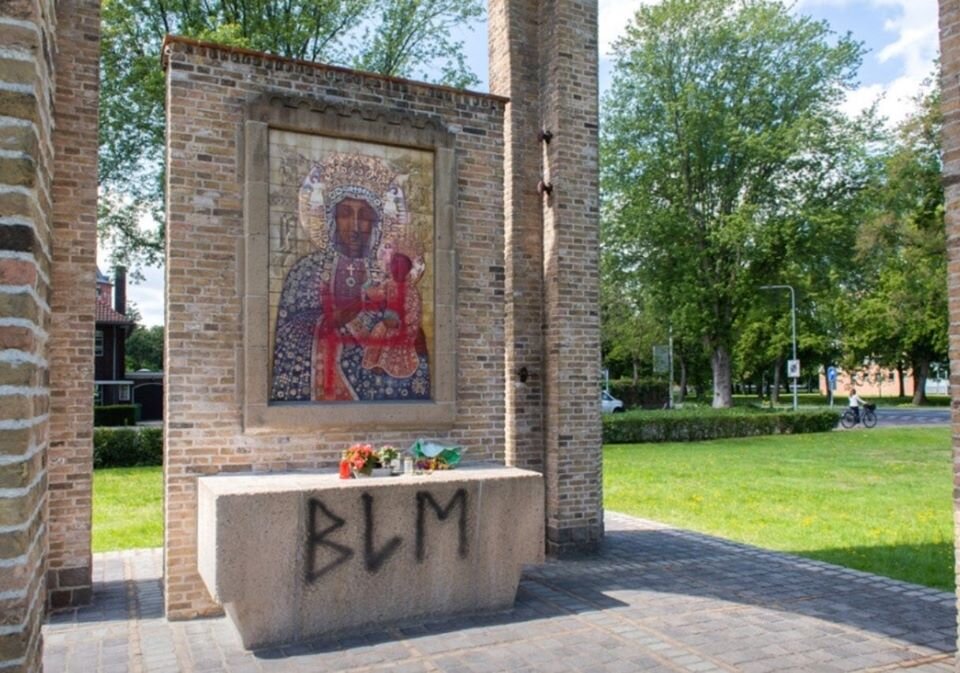
It may seem like I’m being facetious, however, perhaps the problem is in the definition, in that it is entirely subjective and so broad that is open to be applied to an alleged racist upon the slightest perceived pretext. It is therefore, counterproductive and alienating as a genuine way to deal with actual injustice or discrimination for no other reason than the race of a person suffering this injustice or discrimination.  Further, racism is for all practical purposes, an emotional rather than logical construct of leftists, and as in so many idols of the left, it has no logical end at which there is no racism, save for the elimination of the so called oppressor group. Another critical point to note is that leftists are by and large extremely intolerant (if not outright hateful) of Christianity, so pandering to such people in a vain attempt to be seen as an ally, is frankly a fools errand. This has been seen quite noticeably in the attacks on Catholic churches which have been committed by those under the banner of Black Lives Matter.

So getting back to the priest in the example above, what is the actual sin that is being committed? The danger is that many in the Church, eager not to be perceived as an aggressor in a game framed by its ideological enemies, seemed to have abandoned the very concept of truth in a desperate attempt to win favour from those who will always regard you with derision if not outright hostility.

Without a very clear definition of terms, and a specific explanation of the sin being committed, which does not condemn men for taking reasonable actions based on measurable data and experience, the Church risks taking on the nihilistically blasé persona of Pontius Pilate in his response to our Lord when He declared, “For this I was born and for this I came into the world, to testify to the truth. Everyone who belongs to the truth listens to my voice”. Pilate’s dismissive response was “What is Truth?”

Irish Bishops have recently stated in a conference with the pope, that “the evil of racism is not simply an American phenomenon.“ This is quite a slanderous fait accompli to make about white Americans, and by now it should be clear to any clear headed serious observer, that it is white people who are implied to be the solitary guilty party in any accusation of racism. This simplistic rationale does no favours to anyone, least of all those poor and needy of all races who must bear the brunt of America’s poverty, crime and drugs crises.

At the risk of speaking above my lowly station as a mere Christian, I humbly posit that Church leaders should direct their efforts on leading as many of its flock to heaven, by preaching on the dangers of specific sin, while fearlessly and volubly defending the rights of its adherents to participate in the Holy Sacraments, and defending the unborn and the holy institution of marriage from an onslaught which delights the devil. Both George Floyd and the officer involved were sinners, we should want both of them to get heaven, rather than getting caught up in a world condemning one or the other to damnation.

Submitted by: Jerome de Stridon.

If you have a piece that you would like to submit to Catholic Arena, please forward to editor@catholicarena.com


How Should We View The Despair of Judas?

Photo by gabrielabertolini/iStock / Getty Images

Photo by gabrielabertolini/iStock / Getty Images

Since we're near the end of the Holy Week, I thought to share my reflections on the Good Friday, with a special focus on Judas and the controversial topic of suicide.

Recently, we have witnessed a tendency of rehabilitating Judas' suicide, and suicide in general, by some contemporary theologians. Among them, you can find even Vatican's officials, including Pope Francis, who controversially stated: “How did Judas end up? I don’t know.

Through the analysis of this topic, I see the necessity of saying a few words on the nature of sin, hope, and mercy.

In our secularized era, the aforementioned concepts might sound as outdated or even meaningless. So, we should start by questioning the definition of sin. According to the Compendium of the Catholic Catechism, sin is defined as the deliberate action which separates one from God. So basically, sin is a 'sui generis' apostasy, and understanding the pain of despair, our weak human nature, it is natural to show a kind of compassion. Because at a certain moment of our lives, we have been like Judas; and all of us seek for [God's] mercy. But can we agree with the rehabilitation of it? What would be its effect on the faithful? Would this mean watering down the faith? Or even a total misleading thought, heresy!?

There's no need of repeating it,  the story of Judas is familiar to each of us. He betrayed Christ for 30 silver coins, gave him a false kiss, later after realizing what he had done, he felt in despair and committed suicide. With righteousness, his name has become synonymous with betrayal.

   But as Pope Benedict XVI wrote in his magnum opus, Jesus of Nazareth: Holy Week, Judas' greatest sin was falling into despair. That was the stubborn refusal of seeing the light of hope, forgiveness, Christ. That's why he chose the other way: suicide. This is a fact which shouldn't be ignored.

The very opposite of Judas is Simon Peter, the man who not only repent but accepted his weakness; dared to believe and hope of forgiveness, despite his heavy sin of "apostasy“. The best explanation of the Catholic understanding of it, I believe, has shown us the Pope emeritus in his encyclical Spe Salvi: "The one who has hope lives differently; the one who hopes has been granted the gift of a new life." This is an essential thing which we should not forget. Faith in Christ, despite the burden of pain, gives us hope in forgiveness and redemption. Suffering while having hope is what makes us Christians. In the end, as Pope Ratzinger says, that suffering is the only way of to the true conversion.

Therefore, despite the secular critiques, it's quite understandable why the Church has traditionally considered suicide as a mortal sin and should maintain as such. It does not matter what liberal theologians say, it's Biblical – "Thou shall not kill!"

Going through the darkness is difficult, but by absolving [Judas] suicide in the name of the 'mercy', we jeopardize the very essence of Christianity. Such action at the end leads to corrupting the original meaning of mercy. This is the serious problem of the postmodern understanding of mercy, because it defines it in an indifferent way, without the necessity of faith or hope, only for the sake of emotive “niceness”. But without hope, it's impossible to expect mercy, because in the Christian sense, giving up hope is equal to apostasy, it means refusing Christ as saviour, his cross and his glorious light: resurrection! That’s why charity can be found only in the Truth.

- Albert Bikaj

Homeschooling to escape the Murder Machine

‘ A soulless thing cannot teach ; but it can destroy. A machine cannot make men, but it can break them . . A machine, vast, complicated, with a multitude of far-reaching arms, with many ponderous presses, carrying out myster ious and long drawn processes of shaping and moulding, is the true image of the Irish education system. It grinds day and night, it obeys immutable and predetermined laws ; it is as devoid of understanding, of sympathy, of imagination, as is any other piece of machinery that per forms an appointed task

In 2013, the Irish Minister for Education Ruairi Quinn made a bold statement. He stated that it was up to Historians to prove that their subject had any place in the nation’s secondary schools. The left wing politican was perhaps thinking of how often the names Fianna Fail, Fine Gael and Sinn Fein appear in History books. Possibly he was thinking also of how little his own party featured in those textbooks. Or even of how they would be written about in future textbooks given their commitment to Europhilic austerity.

Most likely however, the Minister was concerned with trimming the fluff so that only skills based education could be pursued.

This is something which has marred education in Ireland and elsewhere for some time.

In 1912, Padraig Pearse delivered a speech which was later published as a pamphlet under the title ‘The Murder Machine’. In this, Pearse laid his reasons for regarding the Irish education system as a mill for reducing personality and emphasising a production line of ‘rapid and cheap manufacture of readymades’. For him, it was important to foster individuals rather than break them to fit a mould for a life of work and secular conformity.

Catholicism offered the best route to this. This might seem counter intuitive to many adults who went to Catholic schools in the later decades when corporal punishment was in vogue, but Pearse was of a stock that was forgotten about, one that was revolutionary and capable of thinking of a new Ireland that was attached to nothing of the past that was not of value. Pearse did not see potential employees in front of him when he taught as his famous school in St. Enda’s, he saw people. People with souls and eternal destinies that depended upon how they were nurtured in this life,  Education is as much concerned with souls as religion is. Religion is a Way of Life, and education is a preparation of the soul to live its life here and hereafter; to live it nobly and fully.

Pearse’s revolutionary ideas on education never really took root. There was simply not enough money to be gained from them for any government or education board to want to be invested in such a thing. But with the outbreak of coronavirus, a strange thing is happening. Parents who would otherwise have their kids sitting exams are now having to figure out how to educate or at least occupy their children from home, for a period that could last up to six months. For the parents, there will undeniably be some stress involved. There are over 200,000 children in Ireland being raised in creches while their parents work. There are over 200,000 also raising children in single parent households. While various circumstances lead to both of those, they have become the norm since the legalisation of divorce in 1995. Along with the complete erosion of the personality of teenagers though excessive use of technology (many teenagers in rural Ireland now speak with American accents), there is no doubt that society has devolved to a state where these kids are in an undesirable environment before they even set foot in the school.

Parents have an opportunity now to spend quality time with their children and to teach them in the best way possible, by conversing with them, by passing on their own skills, by listening to them and encouraging them. There is a small but not insignificant group of Catholics in Ireland who homeschool. So far it has been the exception here, but Ireland is not far behind the United States in its social problems. Around 2 million students in the States are homeschooled. And why wouldn’t they be? School shootings, drugs and social pressures all acting as reasons to be sceptical of the value of their version of the Murder Machine, where some schools have up to 8,000 students.

In these past few weeks, the veneer of the modern world’s invincibility has been wiped away by the fragility of the human body. Whereas homeschooling was once unthinkable, perhaps our students and parents are waking up to a new world where they realise that the state is not the only authority in this world. The Church are one and the family are certainly another. In these uncertain times, and in spite of attacks on them from within and without in recent decades, they are the two units that remain the best refuges for our children.

Pearse’s words about education in 1912 are as true about education in 2020. Perhaps teachers, students and families can ponder on them over these next six months.

Education should foster; this education is meant to repress. Education should inspire; this education is meant to tame. Education should harden; this education is meant to enervate.


The untold story of how 16th Century Milan overcame plague with devotion

One word that has been repeated in countless news stories covering the outbreak of coronavirus in Europe : unprecedented.

In the modern world, the current predicament seems to be an unprecedented set of circumstances.

Compared to history however, the spread of this contagious disease has many parallels with other crises from the past, even if it has its own peculiar character and idiosyncrasies like any major event in history.

One parallel that has been drawn between these past few weeks and those of the past, is with regards to how Medieval society confronted the spectre of the plague which ripped through the continent for much of the Middle Ages. Medieval Europe was , as we know, Catholic. And Catholic in a way that we have certainly forgotten how to be since, by letting their vibrant faith shape the imaginations of community, architecture and annual festivals.

When plague hit the city of Milan in 1576, it infested the the city right up until the feast of St. Sebastian in January 1578. 15% of its population died during this time, a sum total of 17,000 people. Shops were closed, hospitals filled up, the economy faced ruin. Sound familiar?

The seminal figure during these troubled times was Carlo Borromeo, the famous cardinal later to be declared a saint. Showing true leadership, he sold his possessions in order to help the sick and more importantly, he risked his own life by visiting them to tend to their needs. Perhaps most memorable however, were his provocative processions through the streets of Milan. Leading the faithful, a barefoot Borromeo wore a noose around his neck as a sorrowful penitential. The town was filled with those who were inspired by his example and wanted to follow him through the city. Some whipped themselves in penance as they processed. At one point, Borromeo cut his bare toe on a railing made of iron and kept walking as it dripped blood, desiring as he did to set an example to the sinners who looked on.

His public displays of brutal piety were not the only acts of this holy man. The spiritual elements were incredibly important too. The Holy Nail, the relic of Christ’s crucifixion, was processed to the various Churches in the city. Believing that Christ had truly become flesh and dwelt among us, this is something that has the power to transform us if we allow it to, especially in our own time. One can see the transformative power of Christ’s humanity in the spiritual wonderlands found everywhere from the healing waters at Lourdes to the field hospitals of missionaries in the depths of Africa.

Like many saints, Borromeo called on Our Lady’s help during this bleak and trying time. He sung the Ave Maria during the seven canonical hours and instructed the people of Milan to respond in kind to the bells of the same prayer, either with musical instruments or through spoken prayer. Loud enough for all to hear. The vibrancy and imagination of these actions are alien to the Church of 2020, which has grown accustomed to recoiling and hiding her true face for fear of the world’s scoffing. Without pointing fingers, most can agree that such consideration of beauty has been forgotten in the past number of years. On St. Patrick’s Day this year, many churches in Ireland rung their bells to honour St. Patrick and to honour God at a time when many cannot attend Mass. A small gesture, but one that nonetheless carried with it a reminder that bringing Christ to people need not always involve arguments or dramatic examples, just faithful witness to our own faith.

Of all these bold and sincere statements of public faith, the boldest of all was in bringing forth a visible public faith. Borromeo had seen Milan deserted by the wealthy who fled elsewhere and had been disappointed by the merchants who were more concerned with profits than with their fellow citizens. Ignoring advice to withhold processions for fear of contagion, Borromeo decided that it was more important to bring a sense of community and togetherness about, without which the plague could not be defeated. He organised food for those in need, spared no expense in selling his own possessions to make sure that people had sufficient supplies. One doctor who has initially warned against marching in the processions was so inspired by the brash display of faith that he wrote:

Those who are not in favour [of processions] think that it will avoid a great unruly multitude of people in the midst of this highly dangerous contagion. But I am of the opinion that we should not abandon the idea for that reason… Who could think, as a faithful Christian, that if the people go to worship the Holy Sacrament with devotion, weeping and praying for grace, that they would succumb to plague?

The public authorities were warning against the dangers but for the faithful, showing fidelity to Christ took precedence. There was more than one authority in this world, certainly one higher than temporal powers who come and go with the years. Publicly bringing together people like this was not done in some impulsive religious fervour, the aforementioned prayers would be assisted during quarantine from the windows by clergy, in between distributing prayer books and song sheets to follow the prayer. What transpired was a rising in spirit, a city slowly transformed by the example of their priests, from the smallest scale to the largest. As one account at the time put it:

When the plague began to grow, this practice [of singing the litanies in public] was interrupted, so as not to allow the congregations to provide it more fuel. The orations did not stop, however, because each person stood in his house at the window or door and made them from there

Just think, in walking around Milan, one heard nothing but song, veneration of God, and supplication to the saints, such that one almost wished for these tribulations to last longer.

The whole city eventually became enraptured with this hopeful spirit.

Milan might at this time have been not unfitly compared to a cloister of religious of both sexes serving God in the inclosure [sic] of their cells, an image of the heavenly Jerusalem filled with the praises of the angelic hosts

In essence, this was a simple set of decisions to perform simple acts of faith and to perform them well. Carrying relics, marching in procession and helping the faithful to pray and partake. What made it extraordinary was the faith behind it, Borromeo really believed that these actions could make a difference. The entire city was transformed by action, by prayer and by the examples set to them. During this time of great uncertainty, what is needed more than ever is a sense that the Church believes in the extraordinary healing of Christ and in the power of being a Church who prays together. We are already hearing reports of priests dying in Italy while tending to their parishioners. Footage has circulated of priests carrying the Blessed Sacrament through the streets. The strength is there and the faith is there, with Holy Week approaching, bishops and priests need not be afraid to show dramatic examples that fortify the faithful.

When the plague broke out once again in 1630, the Milanese dug up the body of Borromeo and brought it on procession with them. While we should probably refrain from that this time, there is no reason as to why we should not resurrect the spirit of Milan from the 1500s. Let our streets sound like ones filled with joyful people of faith, let our clergy resemble apostles of Christ and let our relics and holy objects be treated as they are, as physical proof of the world transformed by the Word made flesh dwelling among us.

Catholics should never be passive in the face of a crisis. Help your neighbours, feed those in need and most importantly, pray for the help of God in this hour. The same one who created both you and the world around you from nothing.

Seek ye therefore first the kingdom of God, and his justice, and all these things shall be added unto you.


3369_-_Milano,_Duomo_-_Fiammenghino,_Si_reca_in_processione_con_il_santo_chiodo_(1602)_-_Foto_Giovanni_Dall'Orto,_6-Dec-2007.jpg


Rallying for Life after Repeal

Rallying for Life after Repeal

“The supreme adventure is being born. There we do walk suddenly into a splendid and startling trap... When we step into the family, by the act of being born, we do step into a world which is incalculable, into a world which has its own strange laws, into a world which could do without us, into a world we have not made. In other words, when we step into the family we step into a fairy-tale.”

Archbishop Martin Gets It Half Right

‘There is a growing polarisation within the Catholic Church and by certain groups who seem to think that they have a right, self-righteously, to proclaim threats in the name of how they understand the truth. We have seen examples in our own days. The truth will only be attained in love. Error will only be refuted in love. Nastiness and hatred betray the message of love’.

6 Prolife warnings about Ireland have already come true

6 Prolife warnings about Ireland have already come true

Before the Referendum to remove the right to life of the unborn child, prolife supporters repeatedly warned of the consequences of living in a country where the unborn had no rights.

Warning after warning were arrogantly mocked by pro abortion supporters and by those who naively believed that the referendum was merely about medically necessary procedures, not abortion by choice.

Ireland's Holy Innocents

Ireland's Holy Innocents

No aborted child deserves to have been killed.

That those children are alive from the moment of conception is without doubt, that they have a right to live independent of the will of any human being is without doubt and that they are as dignified as those humans who emerge from the womb without suffering their brutal fate is also without doubt.

Why then, are they treated with the disdain and debasement normally reserved for criminality?