Reginald Garrigou-Lagrange on the Immaculate Conception

[Because of] the nobility of Mary's title, Mother of God, it is . . . appropriate to examine the meaning and implications of the words spoken to her by the Angel Gabriel on the day of the Annunciation: 'Hail, full of grace, the Lord is with thee: Blessed art thou among women' (Luke 1: 28). As a help to understanding these words spoken in God's name we shall consider: 1st-----the different plenitudes of grace; 2nd-----the privilege of the Immaculate Conception; 3rd-----the sublimity of Mary's first grace.

Article I
THE DIFFERENT PLENITUDES OF GRACE

According to the usage of Holy Scripture, which becomes more and more explicit in the New Testament, it is grace in the strict sense of the term which is implied in the term 'fulness of grace'-----that is to say, grace which is really distinct from nature, both human and Angelic, grace which is a free gift of God surpassing the natural powers and exigencies of all nature, created or creatable. [l] Habitual or sanctifying grace makes us participate in the very nature, in the inner life of God, according to the words of St. Peter (2 Peter 1: 4): 'By whom he hath given us most great and precious promises: that by these you may be made partakers of the divine nature.' By grace we have become adopted children of God, heirs and co-heirs with Christ (Rom. 8: 17); by grace we are 'born of God' (John i, 13). It prepares us to receive eternal life as a heritage and as a reward of the merits of which it is itself the principle. It is even the germ of eternal life, the semen gloriae as Tradition terms it, since by it we are disposed in advance for the face to face vision and the beatific love of God.

Habitual grace is received into the very essence of the soul as a supernatural graft which elevates and deifies its vitality. From it there flows into the faculties the infused virtues, theological and moral, and the seven gifts of the Holy Ghost, all of which supernatural organism constitutes a sort of second nature of such a kind as to enable us to perform connaturally the supernatural and meritorious acts of the infused virtues and the seven gifts. We have, too, by habitual grace the Blessed Trinity dwelling within us as in a temple where They are known and loved, even as it were experimentally. And at times we do know Them in this quasi-experimental fashion when by a special grace They make Themselves known to us as the life of our life, for '. . . you have received the spirit of adoption of sons, whereby we cry Abba [Father]' (Rom. 8: 15). Then does the Holy Ghost inspire us with filial love, and in that sense '. . . the Spirit Himself giveth testimony to our spirit, that we are the sons of God' (Rom. 8: 16).

While habitual grace makes us thus children of God, actual or transitory grace first of all disposes us for adoptive childhood, and subsequently makes us act, through the infused virtues and gifts working separately or both together, in a manner becoming God's children. This new life of grace, virtues and gifts, is none other than eternal life begun on earth, since habitual grace and charity will outlive the passage of time.

Grace-----call it, if you will, a participation in the Divine nature-----was no less gratuitous for the Angels than for us. As St. Augustine says (De Civ. Dei, XII, c. 9): 'God created them, at the same instant forming their nature and endowing them with grace.' When creating the Angels God conferred grace on them, to which grace their nature, richly endowed though it was, could lay no claim. The Angels, and man also, could have been created in a purely natural condition, lacking the Divine graft whence issues a new life.

The grace intended in the words 'Hail, full of grace' addressed to Our Lady is therefore something higher than nature or the exigencies of nature, created or merely possible.

It is a participation in the Divine nature or in the inner life of God, which makes the soul to enter into the kingdom of God, a kingdom far surpassing all the kingdoms of nature-----mineral, vegetable, animal, human, and even Angelic. So elevated is grace that St. Thomas could say: 'The good of the grace of one soul is greater than the good of the nature of the whole universe.'

The least degree of grace in the soul of a newly Baptized child is worth more than all created natures, including those that are Angelic. Being a participation in the inner life of God, grace is something greater than all miracles and exterior signs of Divine revelation or of the sanctity of God's favoured servants. And it is of this grace, germ and promise of glory, that the Angel spoke when he said to Mary: 'Hail, full of grace.' Gazing at Mary's soul, he saw that, though he himself was in the possession of the Beatific Vision, Mary's grace and charity far surpassed his for she possessed them in the degree required to become at that instant the Mother of God.

Mary, of course, had received from the Most High natural gifts of body and soul in wonderful perfection. Judged even from the natural level, the soul of Jesus united in itself all that there is of beauty and nobility in the souls of the great poets and artists, of men of genius and of men of generosity. In an analogous way the soul of Mary was a Divine masterpiece because of the natural perfection of her intelligence and will and sensibility. There is no shadow of doubt that she was more gifted than anyone who has ever struck us as remarkable for penetration and sureness of mind, for strength of will, for equilibrium or harmony of higher and lower faculties. Since she had been preserved from Original Sin and its baneful effects, concupiscence and darkness of understanding, her body did not weigh down her mind but rather served it. When forming the body of a Saint, God has in mind the soul which is to vivify it: when forming Mary's body He had in mind the Body and the infinitely holy Soul of the Word made flesh. As St. Albert the Great loves to recall, the Fathers of the Church say that Mary, viewed even naturally, had the grace of Rebecca, the beauty of Rachel, and the gentle majesty of Esther. They add that her chaste beauty never held the gaze for its own sake alone, but always lifted souls up to God.

The more perfect these gifts of nature in Mary, the more elevated they make her grace appear, for it surpasses them immeasurably.

When speaking of fulness of grace it is well to note that it exists in three different degrees in Our Lord, in Mary, and in the just. St. Thomas explains this a number of times.

There is, first of all, the absolute fulness of grace which is peculiar to Jesus, the Saviour of mankind. Taking into consideration only the ordinary power of God, there can be no greater grace than this. It is the eminent and inexhaustible source of all the grace which all men have received since the Fall, or will receive till the end of time. It is the source also of the beatitude of the elect, for Jesus has merited all the effects of our predestination.

There is, in the second place, the fulness of superabundance which is Mary's special privilege, and which is so named since it is like a spiritual river which has poured of its abundance upon the souls of men for almost two thousand years.

There is finally the fullness of sufficiency which is common to all the just and which makes them capable of performing those meritorious acts-----they normally become more perfect in the course of years-----which lead them to eternal life.

These three fullness have been well compared to an inexhaustible spring, to the stream or river which flows from it, and to the different canals fed by the river, which irrigate and make fertile the whole region they traverse-----that is to say, the whole Church, universal in time and space. The river of grace proceeds from God through the Saviour, as we read 'Drop down dew, ye heavens, from above, and let the clouds rain the just: let the earth be opened, and bud forth a saviour' (Is. 14: 8). And then finally it rises once more to God, the Ocean of peace, in the form of merits, prayers, and sacrifices.

To continue the image: the fulness of the spring has not increased; that of the river, on the contrary, which flows from it has increased. Or, to speak in plain terms, the absolute fulness of Our Saviour knew no increase, for it was sovereignly perfect from the first instant of His conception by reason of the personal union with the Word. For, from the first instant, the lumen gloriae and the Beatific Vision were communicated to Jesus's soul, so that the second Council of Constantinople could say (Denz. 224) that Christ did not grow more perfect by reason of His meritorious acts: 'Ex profectu operum non melioratus est.' Mary's fulness of grace, however, did not cease to increase up to the time of her death. For that reason theologians usually speak of, 1st-----her initial fullness or plenitude; 2nd-----the fulness of her second sanctification at the instant of the conception of the Saviour; 3rd-----the final fulness [at the instant of her entry into glory], its extent, and its superabundance.

Article II
THE PRIVILEGE OF THE IMMACULATE CONCEPTION

The initial fulness of grace in Mary presents two aspects. One is negative, at least in its formulation: her preservation from Original Sin. The other is positive: her conception, absolutely pure and holy by reason of the perfection of her initial sanctifying grace in which were rooted the infused virtues and the gifts of the Holy Ghost.

The Dogmatic Definition

The definition of the dogma of the Immaculate Conception, made by Pius IX on December 8th, 1854, reads as follows: 'We declare, announce, and define that the doctrine which states that the Blessed Virgin Mary was preserved, in the first instant of her conception, by a singular grace and privilege of God Omnipotent and because of the merits of Jesus Christ the Saviour of the human race, free from all stain of Original Sin, is revealed by God and must therefore be believed firmly and with constancy by all the faithful' (Denz. 1641).

This definition contains three especially important points: 1st-----It affirms that the Blessed Virgin was preserved from all stain of Original Sin from the first instant of her conception. The conception meant is that known as passive or consummated-----that in which her soul was created and united to her body-----for it is then only that one can speak of a human person, whereas the definition bears on a privilege granted to the person of Mary. The definition states also that the Immaculate Conception is a special privilege and an altogether singular grace, the work of Divine Omnipotence.

What are we to understand by Original Sin from which Mary has been preserved? The Church has not defined its intrinsic nature, but she has taught us something about it by telling us its effects: the Divine hatred or malediction, a stain on the soul, a state of non-justice or spiritual death, servitude under the empire of Satan, subjection to the law of concupiscence, subjection to suffering and to bodily death in so far as they are the penalty of the common sin. These effects presuppose the loss of the sanctifying grace which, along with integrity of nature, Adam had received for us and for himself, and which he lost by sin, also for us and for himself.

It follows therefore that Mary was not preserved free from every stain of Original Sin otherwise than by receiving sanctifying grace into her soul from the first instant of her conception. Thus she was conceived in that state of justice and holiness which is the effect of the Divine friendship as opposed to the Divine malediction, and in consequence she was withdrawn from the slavery of the devil and subjection to the law of concupiscence. She was withdrawn too from subjection to the law of suffering and death, considered as penalties of the sin of our nature, [8] even though both Jesus and Mary knew suffering and death in so far as they are consequences of our nature [in carne passibili] and endured them for our salvation.

2nd-----It is affirmed in the definition, as it was already affirmed in 1661 by Alexander VIII (Denz. 1100) that it was through the merits of Jesus Christ, the Saviour of the human race, that Mary was preserved from Original Sin. Hence the opinion held by some 13th-century theologians-----that Mary was immaculate in the sense of not needing to be redeemed, and that her first grace was independent of the future merits of her Son-----may no longer be admitted. According to the Bull Ineffabilis Deus, Mary was redeemed by the merits of her Son in a most perfect way, by a redemption which did not free her from a stain already contracted, but which preserved her from contracting one. Even in human affairs we look on one as more a saviour if he wards off a blow than if he merely heals the wound it inflicts.

The idea of a preservative redemption reminds us that Mary, being a child of Adam and proceeding from him by way of natural generation, should have incurred the hereditary taint, and would have incurred it in fact had not God decided from all eternity to grant her the unique privilege of an immaculate conception in dependence on the future merits of her Son.

The liturgy had already made this point in the prayer proper to the Feast of the Immaculate Conception, which was approved by Sixtus IV (1476): 'Thou hast preserved her [Mary] from all stain through the foreseen death of this same Son.' The Blessed Virgin was preserved from Original Sin by the future death of her Son, that is to say, by the merits of Christ dying for us on the Cross.

It is therefore clear that Mary's preservation from Original Sin differs essentially from that of the Saviour. Jesus was not redeemed by the merits of another, not even by His Own. He was preserved from Original Sin and from all sin for two reasons: first because of the personal or hypostatic union of His humanity to the Word in the very instant in which His sacred soul was created, since it could not be that sin should ever be attributed to the Word made flesh; secondly, since His conception was virginal and due to the operation of the Holy Ghost, so that Jesus did not descend from Adam by way of natural generation. [9]

These two reasons are peculiar to Jesus alone.

3rd-----The definition proposes the doctrine of the Immaculate Conception as revealed, that is, as contained at least implicitly in the deposit of Revelation-----in Scripture and Tradition, or in one at least of those two sources.

The Testimony of the Scriptures

The Bull Ineffabilis Deus quotes two texts of Scripture, Genesis 3: 15, and Luke 1: 28, 42.

The privilege of the Immaculate Conception is revealed as it were implicitly or confusedly in the book of Genesis in the words spoken by God to the serpent, and thereby to Satan: 'I will put enmities between thee and the woman, and thy seed and her seed: she shall crush thy head and thou shalt lie in wait for her heel.' The pronoun we translate as 'she' in 'she shall crush thy head' is masculine in the Hebrew text, and stands for the posterity or seed of the woman; this is true also of the Septuagint and the Syraic versions. The Vulgate however has the feminine pronoun 'ipsa', referring the prophecy directly to the woman herself However there is no essential difference of meaning between the two readings since the woman is to be associated with the victory of Him Who will be the great representative of her posterity in their conflict with Satan throughout the ages.

Taken by themselves these words are certainly not sufficient to prove that the Immaculate Conception is revealed. But the Fathers of the Church, in their comparison of Eve and Mary, have seen in them an allusion to it, and it is on that account that the text is cited by Pius IX.

To the naturalist exegete the text means no more than the instinctive revulsion man experiences towards the serpent. But to the Jewish and Christian tradition it means much more. The Christian tradition sees in that promise-----it has been termed the protoevangelium-----the first sketch of the Messiah and His victory over the spirit of evil. For Jesus is pre-eminently the posterity of the woman in conflict with the posterity of the serpent. But if Jesus is termed the posterity of the woman, that is not because of His remote connection with Eve, who was able to pass on to her descendants only a fallen and wounded nature, deprived of the Divine life. Rather is it because of His connection with Mary, in whose womb He took a stainless humanity. As Fr. F. X. Le Bachelet says, in col. 118 of the article referred to already, 'We do not find in Eve the principle of that enmity which God will put between the race of the woman and the race of the serpent; for Eve, like Adam, is herself fallen a victim to the serpent. It is only between Mary, Mother of the Redeemer, that enmity ultimately exists. Hence the person of Mary is included, though in a veiled manner, in the protoevangelium, and the Vulgate reading 'ipsa' [she] expresses something really implied in the sacred text, since the victory of the Redeemer is morally, but really, the victory of His Mother.'

For that reason early Christianity never ceased to contrast Eve who shared in Adam's sin by yielding to the serpent's suggestion with Mary who shared in the redemptive work of Christ by believing the words of the Angel on the morning of the Annunciation.

The promise of Genesis speaks of a victory that will be complete: 'She shall crush thy head.' And since the victory over Satan will be complete, so also the victory over sin which makes the soul slave and the devil master. But as Pius IX teaches in the Bull Ineffabilis Deus, the victory over Satan would not be complete if Mary had not been preserved from Original Sin by the merits of her Son: 'De ipso (serpente) plenissime triumphans, illius caput immaculato pede (Maria) contrivit.'

The Immaculate Conception is contained therefore in the promise of Genesis as the oak is contained in the acorn. A person who had never seen an oak could never guess the value of the acorn, nor its final stage of development. But we who have seen the oak know for what the acorn is destined, and that it does not yield an elm nor a poplar. The same law of evolution obtains in the order of progressive Divine revelation.

The Bull Ineffabilis quotes also the salutation addressed by the Angel to Mary (Luke 1: 28): 'Hail, full of grace . . . blessed are thou among woman', as well as the similar words uttered by St. Elizabeth under Divine inspiration (Luke 1: 42). Pius IX does not state that these words are sufficient by themselves to prove that the Immaculate Conception is revealed; for that, the exegetic tradition of the Fathers must be invoked.

This tradition becomes explicit with St. Ephrem the Syrian (d. 373). Among the Greeks it is found on the morrow of the Council of Ephesus (431), especially in the teaching of two bishop-opponents of Nestorious, St. Proclus who was a successor of St. John Chrysostom in the chair of Constantinople (431-446) and Theodore, bishop of Ancyra. Later we find it in the teaching of St. Sophronius, Patriarch of Jerusalem (634-638), Andrew of Crete (d. 740), St. John Damascene [d. towards the middle of the 8th century]. These different testimonies will be found at length in the article Marie of the Dict. Apol., cols. 223-231.

Understood in the light of this exegetic tradition, the words of the Angel to Mary 'Hail, full of grace'-----that is 'Hail, thou art fully pleasing to God and loved by Him'-----are not limited temporally in their application in such a way as to exclude even the initial period of Mary's life. On the contrary, the Blessed Virgin would not have received complete fulness of grace had her soul been even for an instant in the condition of spiritual death which follows on Original Sin, had she been even for an instant deprived of grace, turned away from God, a daughter of wrath, in slavery to the devil. St. Proclus says that she was 'formed from stainless clay'. Theodore of Ancyra says that 'the Son of the Most High came forth from the Most High'. St. John Damascene writes that Mary is the holy daughter of Joachim and Anne 'who has escaped the burning darts of the evil one', that she is a new paradise 'to which the serpent has no stealthy access', that she is exempt from the debt of death which is one of the consequences of Original Sin, and that she must therefore be exempt from the common fall.

If Mary had contracted Original Sin her fulness of grace would have been diminished in this sense that it would not have extended to the whole of her life. Thus, Our Holy Mother the Church, reading the words of the Angelic salutation in the light of Tradition and with the assistance of the Holy Ghost, saw revealed implicitly in it the privilege of the Immaculate Conception. The privilege is revealed in the text not as an effect is in a cause which could exist without it, but as a part is in a whole; the part is actually contained in the whole at least by way of implicit statement.

The Testimony of Tradition

Tradition itself affirms the truth of the Immaculate Conception more and more explicitly in the course of time. St. Justin, St. Irenaeus, Tertullian, contrast Eve, the cause of death, and Mary, the cause of life and salvation. This antithesis is constantly on the lips of the Fathers and is found also in the most solemn documents of the Church's magisterium, especially in the Bull Ineffabilis Deus. It is presented as perfect and without restriction; thus, Mary must always have been greater than Eve, and most particularly at the first moment of her life. The Fathers often say that Mary is stainless, that she has always been blessed by God in honour of her Son, that she is intemerata, intacta, impolluta, intaminata, illibata, altogether without spot.

Comparing Mary and Eve, St. Ephrem says: 'Both were at first simple and innocent, but thereafter Eve became cause of death and Mary cause of life.' Speaking to Our Blessed Lord, he continues: 'You Lord and Your Mother are the only two who are perfectly beautiful under every respect. In You there is no fault, and in Your Mother there is no stain. All other children of God are far from such beauty.'

In much the same way St. Ambrose says of Mary that she is free from every stain of sin 'per gratiam ab omni integra labe peccati'. St. Augustine's comment is well known: 'The honour of the Lord does not permit that the question of sin be raised in connected with the Blessed Virgin Mary.' If however the question be put to the Saints 'Are you sinless?' he affirms that they will answer with the Apostle St. John (1 John, 1: 8): 'If we say that we have no sin, we deceive ourselves, and the truth is not in us.' There are two other texts which seem to show that St. Augustine meant his words to be understood in the sense of the Immaculate Conception. Many other texts of the Fathers will be found in the works of Passaglia, Palmieri and Le Bachelet.

It should not be forgotten that the Feast of the Conception of the Blessed Virgin Mary has been celebrated in the Church, especially in the Greek Church, since the 7th and 8th centuries. The same Feast is found in Sicily in the 9th, in Ireland in the 10th, and almost everywhere in Europe in the 12th century.

The Lateran Council, held in the year 649 (Denz., 256) calls Mary 'Immaculate'. In 1476 and 1483 Pope Sixtus IV speaks favorably of the privilege in connection with the Feast of the Conception of Mary (Denz., 734 sqq.). The Council of Trent (Denz., 792) declares, when speaking of Original Sin which infects all men, that it does not intend to include the Blessed and Immaculate Virgin Mary. In 1567 Baius is condemned for having taught the contrary (Denz., 1073). In 1661 Alexander VII affirmed the privilege, saying that almost all Catholics held it, though it had not yet been defined (Denz., 1100). Finally, on December 8th, 1854, we have the promulgation of the solemn definition (Denz., 1641).

It must be admitted that in the 12th and 13th centuries certain great doctors, as, for example, St. Bernard, St. Anselm, Peter Lombard, Hugh of St. Victor, St. Albert the Great, St. Bonaventure, and St. Thomas Aquinas appear to have been disinclined to admit the privilege. But this was because they did not consider the precise instant of Mary's animation, or of the creation of her soul, and also because they did not distinguish, with the help of the idea of preservative redemption, between the debt to contract the hereditary stain and its actual contraction. In other words, they did not always distinguish sufficiently between ' debebat contrahere' and contraxit peccatum'. We shall see later that there were three stages in St. Thomas's doctrine and that though he appears to deny the Immaculate Conception in the second, he admits it in the first, and probably in the third also.

Theological Reasons for Admitting the Immaculate Conception

The principal argument ex convenientia, or from becomingness, for the Immaculate Conception, is an elaboration of the one which St. Thomas (IIIa, q. 27, a. I) and others give for Mary's sanctification in her mother's womb before birth. 'It is reasonable to believe that she who gave birth to the Only-begotten of the Father, full of grace and truth, received greater privileges of grace than all others . . . We find however that to some the privilege of sanctification in their mother's womb has been granted, as for example to Jeremias . . . and John the Baptist. . . . Hence it is reasonable to believe that the Blessed Virgin was sanctified before birth.' In a. 5 of the same question we read also: 'The nearer one approaches to the source of all grace the more grace one receives; but Mary came nearest of all to Christ, Who is the principle of grace.'

But this argument ex convenientia needs to be expanded before it will prove the Immaculate Conception.
It is Scotus's glory [Thomists should consider it a point of honour to admit that their adversary was right in this matter] to have shown the supreme becomingness of this privilege in answer to the following difficulty which St. Thomas and many other theologians put forward: Christ is the universal Redeemer of all men without exception (Rom. 3: 23; 5: 12, 19; Gal. 3: 22; 2 Cor. 5: 14; 1 Tim. 2: 16); but if Mary did not contract Original Sin she would not have been redeemed; hence, since she was redeemed, she must have contracted Original Sin.

Duns Scotus answers this objection [36] by referring to the idea of a redemption which is preservative, not liberative. He shows how reasonable this idea is, and in some places at least does not link it up with his peculiar doctrine concerning the motive of the Incarnation, so that it can be admitted independently of what one thinks about the second matter.

This is his line of argument.

It is becoming that a perfect Redeemer should make use of a sovereign mode of redemption, at least in regard to the person of His Mother who was to be associated more closely with Him than anyone else in the work of salvation. But the sovereign mode of redemption is not that which liberates from a stain already contracted, but that which preserves from all stain, just as he who wards off a blow from another saves him more than if he were simply to heal a wound that has been inflicted. Hence it was most becoming that the perfect Redeemer should, by His merits, preserve His Mother from Original Sin and all actual sin. This argument can be found in embryo in Eadmer.

The Bull Ineffabilis gives this argument, in a somewhat different form, along with others. For example, it states that the honour and dishonour alike of parents affect their children, and that it was not becoming that the perfect Redeemer should have a mother who was conceived in sin. Also, just as the Word proceeds eternally from a most holy Father, it was becoming that He should be born on earth of a mother to whom the splendour of sanctity had never been lacking. Finally, in order that Mary should be able to repair the effects of Eve's fall, overcome the wiles of the devil, and give supernatural life to all, with, by, and in Christ, it was becoming that she herself should never have been in a fallen condition, a slave to sin and the devil.

If it be objected that Christ alone is immaculate, it is easy to answer: Christ alone is immaculate of Himself, and by the double title of His Hypostatic Union and His virginal conception; Mary is immaculate through the merits of her Son.

The consequences of the Immaculate Conception have been developed by the great spiritual writers. Mary has been preserved from the two baneful fruits of Original Sin, concupiscence and darkness of understanding.

Since the definition of the Immaculate Conception we are obliged to hold that concupiscence has been not only bound, or restrained, in Mary from the time she was in her mother's womb, but even that she was never in any sense its subject. There could be no disordered movement of her sensitive nature, no escape of her sensibility from the previous control of reason and will. Her sensibility was always fully subject to her rational powers, and thereby to God's Will, as obtained in the state of original innocence. Thus Mary is virgin of virgins, most pure, 'inviolata, intemerata', tower of ivory, most pure mirror of God.

Similarly, Mary was never subject to error or illusion. Her judgment was always enlightened and correct. If she did not understand a thing fully she suspended her judgment upon it, and thus avoided the precipitation which might have been the cause of error. She is, as the Litanies say, the Seat of Wisdom, the Queen of Doctors, the Virgin most prudent, the Mother of good counsel. All theologians realize that nature spoke more eloquently to her of the Creator than to the greatest poets. She had, too, an eminent and wonderfully simple knowledge of what the Scriptures said of the Messiah, the Incarnation, and the Redemption. Thus she was fully exempt from concupiscence and error.

But why did the Immaculate Conception not make Mary immune from pain and death since they too were consequences of Original Sin?

It should be noted that the pain and death which Jesus and Mary knew were not consequences of Original Sin as they are for us. For Jesus and Mary they were consequences of but human nature, which, of itself, and like the animal nature in general, is subject to pain and death of the body: it was only because of a special privilege that Adam had been exempt from them in the state of innocence. As for Jesus, He was conceived virginally in passible flesh in order to redeem us by dying, and when the time came He accepted suffering and death, its consummation, freely for love of us. Mary, for her part, accepted suffering and death voluntarily in imitation of Him and to unite herself to Him; she was one with Him in His expiation and in His work of redemption.

There is one wonderful thing, one delight of contemplatives, which we should not overlook. It is that the privilege of the Immaculate Conception and the fullness of grace did not withdraw Mary from pain, but rather made her all the more sensitive to suffer from contact with sin, the greatest of evils. Precisely because she was so pure, precisely because her heart was consumed by the love of God, Mary suffered pains to which our imperfection makes us insensible. We suffer if our self-love is wounded, or our pride, or our susceptibilities. Mary, however, suffered from sin, and that in the measure of her love of God Whom sin offends, and her love of Her Son Whom sin crucifies; she suffered in the measure of her love of us, whom sin wounds and kills. Thus the Immaculate Conception increased Mary's sufferings and disposed her to bear them heroically. Not one of them did she squander. All passed through her hands in union with those of her Son, thus to be offered up for our salvation.

St. Thomas and the Immaculate Conception

As certain commentators have suggested, three periods may be distinguished in St. Thomas's teaching.
In the first-----that of 1253-1254, the beginning of his theological career-----he supports the privilege, probably because of the liturgical tradition which favoured it, as well as because of his pious admiration for the perfect holiness of the Mother of God. It is in this period that he wrote (I Sent., d. 44, q. I, a. 3, ad 3): 'Purity is increased by withdrawing from its opposite: hence there can be a creature than whom no more pure is possible in creation, if it be free from all contagion of sin: and such was the purity of the Blessed Virgin who was immune from Original and actual sin.' This text states therefore that Mary was so pure as to be exempt from all Original and actual sin.

During the second period St. Thomas, seeing better the difficulties in the question-----for the theologians of his time held that Mary was immaculate independently of Christ's merits-----hesitated, and refused to commit himself. He, of course, held that all men without exception are redeemed by one Saviour (Rom. 3: 23; 5: 12, 19; Gal. 3: 22; 2 Cor. 5: 14; 1 Tim. 2: 6). Hence we find him proposing the question thus in IIIa, q. 27, a. 2: Was the Blessed Virgin sanctified in the conception of her body before its animation? For, according to him and many other theologians, the conception of the body was to be distinguished from the animation, or creation of the soul. This latter [called today the consummated passive conception] was thought to be about a month later in time than the initial conception.

The holy doctor mentions certain arguments at the beginning of the article which favour the Immaculate Conception-----even taking conception to be that which precedes animation. He then answers them as follows: 'There are two reasons why the sanctification of the Blessed Virgin cannot have taken place before her animation: 1st-----the sanctification in question is cleansing from Original Sin . . . but the guilt of sin can be removed only by grace [which has as object the soul itself] . . . 2nd-----if the Blessed Virgin had been sanctified before animation she would have have incurred the stain of Original Sin and would therefore never have stood in need of redemption by Christ. . . . But this may not be admitted, since Christ is Head of all men (1 Tim. 2: 6).'

Even had he written after the definition of 1854 St. Thomas could have said that Mary was not sanctified before animation. However, he goes further than that here, for he adds at the end of the article: 'Hence it follows that the sanctification of the Blessed Virgin took place after her animation.' Nor does he distinguish, as he does in many other contexts, between posteriority in nature and posteriority in time. In the answer to the second objection he even states that the Blessed Virgin 'contracted Original Sin'. [38] However, it must be recognized that the whole point of his argument is to show that Mary incurred the debt of Original Sin since she descended from Adam by way of natural generation. Unfortunately he did not distinguish sufficiently the debt from actually incurring the stain.

Regarding the question of the exact moment at which Mary was sanctified in the womb of her mother, St. Thomas does not make any definite pronouncement. He states that it followed close on animation-----cito post are his words in Quodl. VI, a. 7. But he believes that nothing more precise can be said: 'the time of her sanctification is unknown' (IIIa, q. 27, a. 2, ad 3).

St. Thomas does not consider in the Summa if Mary was sanctified in the very instant of animation. St. Bonaventure had put himself that question and had answered it in the negative. It is possible that St. Thomas's silence was inspired by the reserved attitude of the Roman Church which, unlike so many other Churches, did not celebrate the Feast of the Conception (cf. ibid., ad 3). This is the explanation proposed by Fr. N. del Prado, O.P., in Santo Tomas y la lmmaculada, Vergara, 1909, by Fr. Mandonnet, O.P., Dict. Theol. Cath., art. Freres Precheurs, col. 899, and by Fr. Hugon, O.P., Tractatus Dogmatici, t. II, ed. 5, 1927, p. 749. For these authors the thought of the holy doctor in this second period of his professional career was that expressed long afterwards by Gregory XV in his letters of July 4th, 1622: 'Spiritus Sanctus nondum tanti mysterii arcanum Ecclesiae suae patefecit.'

The texts we have considered so far do not therefore imply any contradiction of the dogma of the Immaculate Conception. They could even be retained if the idea of preservative redemption were introduced. There is however one text which cannot be so easily explained away. In III Sent., dist. III, q. 1, a. 1, ad 2am qm, we read: 'Nor (did it happen) even in the instant of infusion of the soul, namely, by grace being then given her so as to preserve her from incurring the original fault. Christ alone among men has the privilege of not needing redemption.' Frs. del Prado and Hugon explain this text as follows: The meaning of St. Thomas's words may be that the Blessed Virgin was not preserved from Original Sin in such a way as not to incur its debt, as that would mean not to stand in need of redemption. However, one could have expected to find in the text itself the explicit distinction between the debt and the fact of incurring the stain.

In the final period of his career, when writing the Exposito super salutatione angelica----which is certainly authentic ----in 1272 or 1273, St. Thomas expressed himself thus: 'For she [the Blessed Virgin] was most pure in the matter of fault (quantum ad culpam) and incurred neither Original nor mental nor venial sin.'

Based French Catholics Protect Church From Secular Concert

On the even of the Feast of the Immaculate Conception, a group of based French Catholics successfully defended their church in Nantes from being used to make money for a secular pop musician.

Echoing the Gospel story of the money changers in the Temple, these brave Catholics successfully orchestrated to sing hymns and show solidarity outside the Notre Dame de bon Port church in the city of Nantes.

The Mayor of Nantes, Bassem Asseh, has had the gall to condemn Catholics for defending their own church, stating that it impinged ‘freedom of expression’.

The booking of Swedish singer Anna von Hausswolff to play a Catholic church on the even of the Feast of the Immaculate Conception is really quite bizarre, considering her music features such lyrics as:

These pills keep me alive
Oh my love
I'm holding it
Caressing it.
Oh, I'm sick
The heat and cold.
The presence of a dual code.
I'm on the floor constantly, intensivley,
Making love.
I made love
I made love
With the devil
With the devil.
Oh I, I made love with the devil
With the devil.
Oh I, I made love with the devil
With the devil.
Oh I, I made love with the devil
With the devil.
Oh I, I made love with the devil
With the devil.
Devil
With the devil.
Devil.
With the devil.
Devil.
With the devil.

There is no reason to think that the civic authorities could not have arranged a more suitable non religious venue for this concert and had it pass off without trouble. To arrange it in a church on a normal day is offensive, to do so on the Feast of the Immaculate Conception is an act of war.

French media outlets, panicked since the rise of politician Eric Zemmour, have condemned the Catholics, with Le Monde calling them ‘fundamentalist Catholics’ and others calling them ‘integralists’.

Mostly however, they were just young men and women who did not want to see their churches desecrated.

Dublin Puts Christ Back Into Christmas

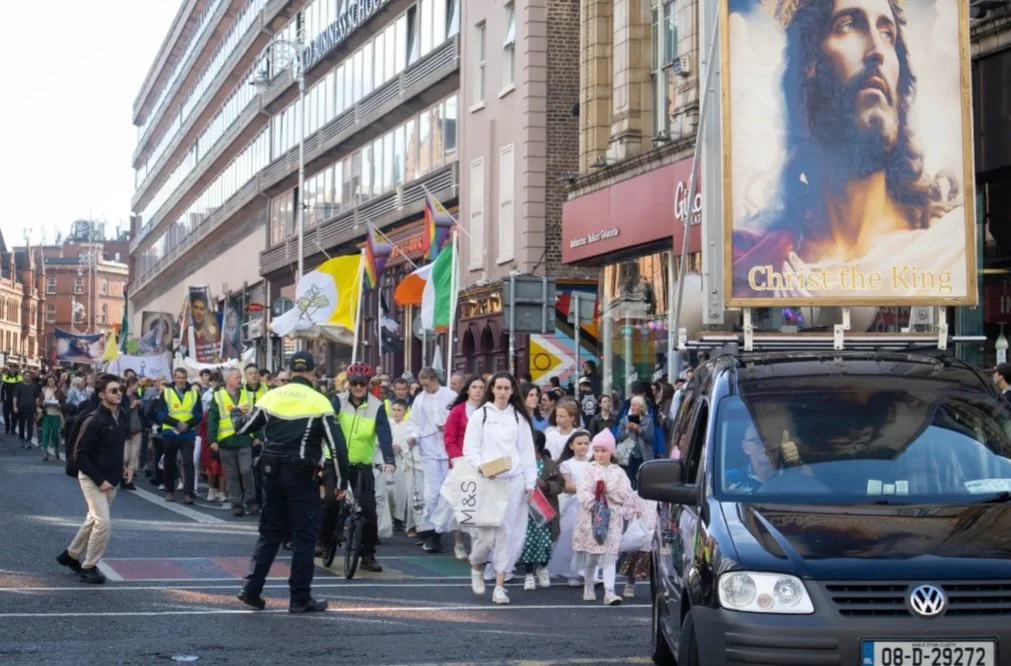
On the 4th of December near The Spire in Dublin, Irish Society for Christian Civilisation held Christmas Carols and a Rosary near the Crib on O’Connell Street.

If you watch the video below of the event, there is also the explanation of the story behind a famous Christmas song.

It is great to see a public demonstration of faith like this, especially at a time where commercial interests are diluting the Catholic faith from the Christmas season.

Seville Hosts STUNNING Procession

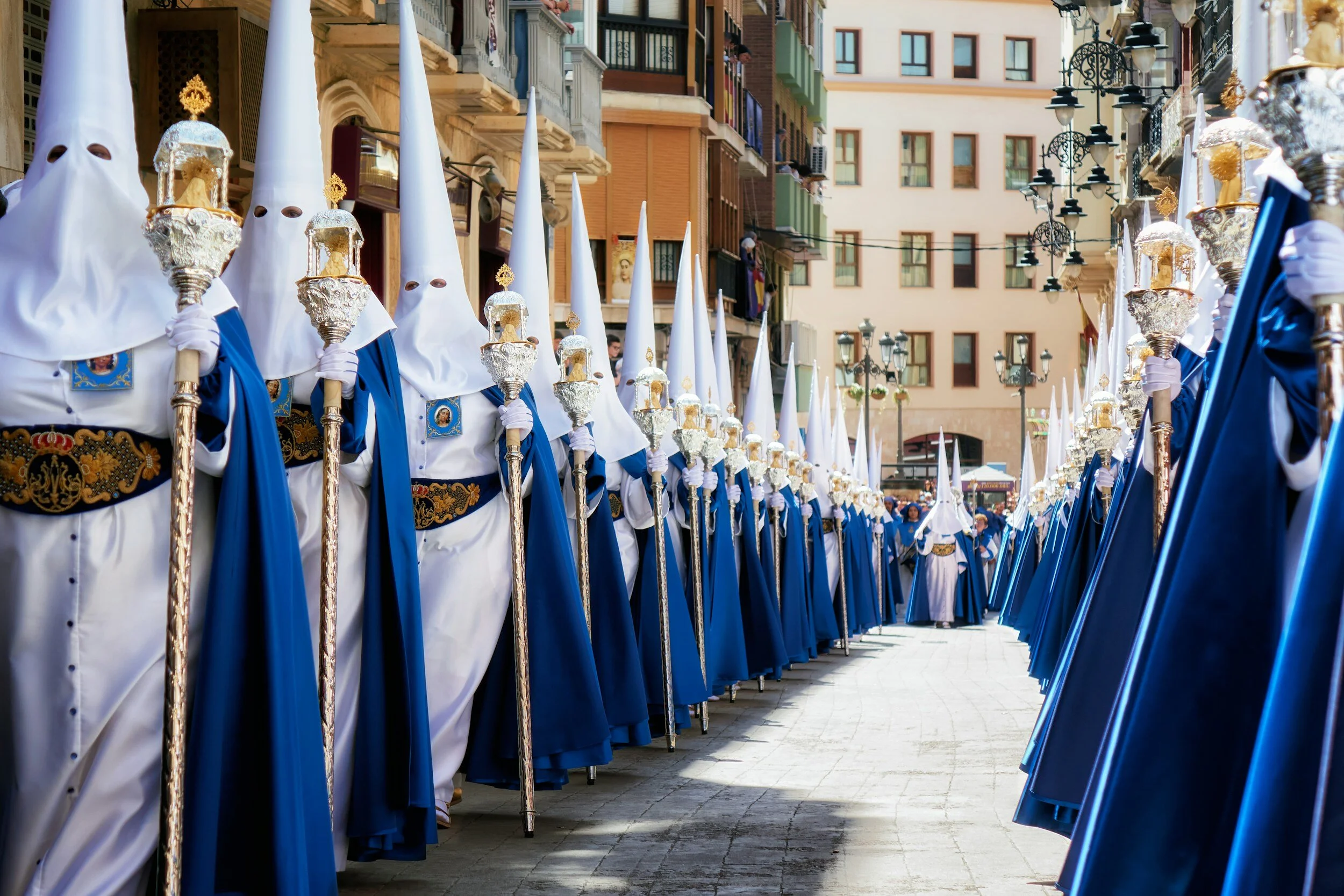
One of the most stunning jewels in the crown of European Catholicism is the majestic series of processions which occur each year in Spain.

On the 75th anniversary of its official recognition by the Holy See, Spanish in the city of Seville honoured the patronage of the Virgen de los Reyes.

There are a number of stories regarding the origin of the icon, including a donation to King Ferdinand III of Castile by King Louis IX of France after a dream, and that it played a part in the Reconquista of Seville in 1248.

In 1946, the Vatican officially recognised the long standing devotion with a ceremony that took place involving Pope Pius XII.

In celebration of that event, thousands took to the streets of Seville today, including marching bands, priests and public officials.

The rich beauty of Spanish Catholicism is something that has been attacked in recent months by members of the White Anglo Saxon Catholic American Blogosphere, with attacks on everyone from Saint Junipero Serra to Christopher Columbus to Queen Isabella to even statues of and stained glasses of the Reconquista. Yet the incredible videos of the Seville processions speak for themselves. Perhaps the ailing European continent can love to learn to herself and feel young once more by reengaging with these treasured traditions and the faith that they venerate.

Irish Group to Host Webinar on Upcoming Synod

Family Solidarity will host a webinar with Sr Nathalie Becquart, under-secretary of the Synod of the Bishop in Rome, and Dr Vincenzo Bassi, president of the European Federation of Catholic Families Organisations (FAFCE).

In October, Pope Francis called the Catholic Church to embark on the synodal journey, asking for a broad participation, particularly at the local level. Sr Nathalie will talk about the role of the family, and of family organisations, in this process of spiritual discernment.

“Synodality is a call for mutual listening between all the members of the Church, and inspired by the Holy Spirit. Encouraged by the opening of the Synod, family associations wish to become protagonists of the synodal movement initiated by Pope Francis. In the same way that family members care for each other and move forward in a common understanding of unity, family associations wish today to work within the Church to create a true path of unity and communion for the common good.”, said Vincenzo Bassi of FAFCE.

He added: “This webinar is a way that FAFCE and Family Solidarity have to raise awareness about the responsibility that Christians and, specifically, our organisations have in this goal in the first instance, by working to create a network of encounters between families and by developing Family Associations. In fact, as Pope Francis said at the opening of the synodal path, “As we initiate this process, we too are called to become experts in the art of encounter. Not so much by organizing events or theorizing about problems, as in taking time to encounter the Lord and one another“.”

The webinar will take place on Thursday 9th December at 7.00 pm (Irish time) and it will be moderated by journalist Jason Osborne (Irish Catholic). Dr Angelo Bottone, chairman of Family Solidarity, will make the closing remarks.

The event will be livestreamed on the FAFCE Youtube and Facebook pages.

For ZOOM registration and more details, see https://familysolidarity.org/synodality/


Pope Compares EU to Communist and Nazi Dictatorships

Pope Francis launched a stunning rebuke of the European Union’s recent discriminatory attitudes towards Christianity.

In a recent communique from the EU, its ‘Commissioner for Equality’ Helena Dalli, had instructed her staff not to wish one another a ‘Happy Christmas’.

This came despite Dalli regularly wishing people a ‘Happy Eid’ in celebration of the Islamic festival.

After a backlash at the bigoted suggestions, Dalli withdrew them, but stopped short of apologising.

Now, in his pre flight press conference on the way back from Greece, Pope Francis has spoken out strongly against the aggressive suggestions from Ms. Dalli and from the European Union.

He compared her initiative to the worst excesses of Communism and other secular leaderships like Nazism and Napoleon.

Pope Francis stated:

You refer to the European Union document on Christmas... this is an anachronism. In history many, many dictatorships have tried to do so. Think of Napoleon: from there... Think of the Nazi dictatorship, the communist one... it is a fashion of a watered-down secularism, distilled water... But this is something that throughout hasn’t worked.

But this makes me think of something, talking about the European Union, which I believe is necessary: the European Union must take in hand the ideals of the founding fathers, which were ideals of unity, of greatness, and be careful not to take the path of ideological colonisation. This could end up dividing the countries and [causing] the European Union to fail. The European Union must respect each country as it is structured within, the variety of countries, and not want to make them uniform. I don't think it will do that, it wasn't its intention, but be careful, because sometimes they come, and they throw projects like this one out there and they don't know what to do; I don't know what comes to mind... No, each country has its own peculiarity, but each country is open to the others. The European Union: its sovereignty, the sovereignty of brothers in a unity that respects the individuality of each country. And be careful not to be vehicles of ideological colonisation. That is why [the issue] of Christmas is an anachronism.

The European Union caused further distress to Catholics this past week when one of its ambassadors mocked Our Lady by dressing up as here with a beard, suggesting that she may well have had one.

The EU is yet to apologise for that offensive gesture either.

Irish Men's Rosary Draws Huge Crowds Again

Although there are many in the Irish church who prefer to mourn the loss of faith among many, there are others who are willing to do far more than merely ‘manage the decline’ of the faith in Ireland.

One prominent example of those unwilling to merely allow the faith to disappear with the next generation has been evident in the successful men’s Rosary Rallies of recent months.

Following on from the successes of similar events in Poland, Irish Catholics have drawn hundred to events in Derry and Newry and now they have brought their biggest one yet with yesterday’s rally in Belfast.

On Facebook, Męski Różaniec Święty w Irlandii (Men’s Holy Rosary Ireland) wrote:

Another Public Male Holy Rosary behind us and what a huge success. We started the day with a Mass in Classic Roman Rhythm (Trydenck) at The Church of the Immaculate Heart of Mary ICKSP. Today we were in the very centre of Belfast, where together with the rest of the Irish we prayed the rosary in the intention of rewarding the Immaculate Heart of Mary

With a repentance :

- For all the ways the Irish nation has turned away from the Gospel and the teaching of the Catholic Church

- for the sins of abortion, birth control and all forms of impurity.

In His mercy we ask:

- the end of covid virus

- The end of the signs of growing tyranny on our nation

- Restoring our nation back to God.

Another Men's Rosary will be held in Armagh, Main Square, Market Street next to the library

January 1, 2022 at 1pm

The next event on New Year’s Day in Armagh is sure to draw large crowds again. It shames the naysayers and prophets of doom to see such a positive event, drawing men onto to the streets to publicly and boldly proclaim their love of the Most Holy Rosary of The Blessed Virgin Mary.

We pray that this idea may be adopted by others in parts of Ireland and play its part in reviving the faith across the island.

EU Ambassador Says Virgin Mary 'Had Beard'

The increasingly fraught relationship between Christians and the European Union hit new lows in recent weeks.

Firstly, there were calls to remove the term ‘Happy Christmas’ from official documentation, per a request from an EU Minister.

Now, a European Union Ambassador has claimed that Our Lady had a beard, while mocking Catholics with a deliberately offensive photoshoot where he dressed up as Our Lady.

The photoshoot was taken for German magazine Siegessäule, who went out of their way to offend Christians during Advent with the deliberately blasphemous set of pictures.

Earlier this year, Riccardo Simonetti was made an LGBTQ Goodwill Ambassador for the European Parliament. Sharing the images on his social media, he wrote:

If we ignore the fact that Jesus wasn’t white, we could as well believe the Virgin Mary had a beard, why not? 🧔‍♀️

The shocking images and lack of reaction stand as yet another example of the European Union’s soft stance on anti Christian sentiments within its ranks.

There has been strong condemnation of the provocative attacks, with one MEP calling for Simonetti to be removed from his ambassador position.

Jorge Buxadé of the VOX party, has demanded that the EU removes him from his ambassador role.

You can read their open letter to the EU below:

Lies, Damned Lies and Statistics

A newspaper has the prerogative of promoting an unpopular social or political agenda.

It does not have the right to tell lies to support that cause.

The Sunday Times Ireland, published the editorial: “Assisted dying law in Ireland needs to be done right, but it must be done” on November 28, 2021 and the editors thinks it is “an appropriate time to debate the issue.” Perhaps they didn’t get the memo about the 1400+ submissions to the Justice Committee of the Oireachtas? (Overwhelmingly opposed to the Dying with Dignity Act / An Bille um Bás Dínitiúil, 2020.)

The editors contend:

“We now know the “slippery slope” argument has little credibility. That’s because in states and countries where assisted dying is allowed, there has been no evidence of abuse. [my emphasis]

The Editorial team referenced Oregon as the paragon of safety in the provision of Assisted Suicide:

“In the American state of Oregon, for example, with a population of 4.2 million people and where the Death with Dignity Act was passed in 1997, there have been about 2,000 assisted deaths, and so far no wrongful ones have been reported or detected.[my emphasis]

If these 3 key assertions are refuted, their thesis fails.

The Sunday Times may claim innocence because the Oregonian agency collecting data on Assisted Suicide — the Department of Human Services — does not document or investigate cases of alleged abuse. (…has no authority to investigate individual Death with Dignity cases / The state law authorizing physician-assisted suicide neither requires nor authorizes investigations by DHS.”)

A quick Google search shows there are many cases of abuse even in Oregon but also Washington State, the Netherlands & Belgium. The best evidence of a precipitous “slippery slope” can be seen in Canada.

Their poor investigative skills aside, the editors miss the point: dead people don’t complain…

Oregon

In a letter to the editor of The Oregonian, Dr. Kenneth R. Stevens Jr. noted: “although the prescribing physician is to refer a patient for psychological evaluation if there may be depression or other conditions impairing patient judgment, only 4% of those dying from the drugs received such evaluation (only 0.5% in 2020). Recent changes in Oregon’s law have removed many safeguards from Oregon’s Death with Dignity law.”  In a group of people of whom 100% are trying to kill themselves, it beggars belief that only 4% merited a Psych Eval: Really?  

The seven quoted examples below are only a selection of those mentioned in an article by the Disability Rights Education & Defense Fund. The first two are also discussed in the BMJ’s Journal of Medical Ethics.  

The Netherlands

In the Netherlands, euthanasia of children under 1 year of age is still technically illegal, but was “decriminalized” in 2005 for those doctors following The Groningen Protocol.

A tragic case of a Dutch nun was reported in the Psychiatric Times, 2004. She was dying painfully of cancer and her physician felt her religion prevented her from agreeing to euthanasia, so felt “justified and compassionate” in ending her life — without telling her he was doing so.

In 2019, Judge Mariette Renckens ruled that, "all requirements of the euthanasia legislation" had been met in 2016 when an anonymous female doctor decided that the prior directive of an 80-year-old woman should be enacted. First, she attempted to sedate the elderly woman by slipping medication into her coffee. The lady woke up and resisted the doctor’s attempts to kill her and said “NO” repeatedly. The doctor then asked the family to hold the elderly woman down while she administered the fatal medication.

Belgium

The Journal of the Canadian Medical Association reported that the physicians in one area of Belgium, admitted that over 30% of the Voluntary Euthanasia/Assisted-Suicides occurred WITHOUT explicit request

Canada

Voluntary Euthanasia and Assisted Suicide [VE/AS] were legislated 2016 under the euphemistic term of Medical Assistance in Dying [MAiD]. Related legislation in 2021 immediately removed the requirement for natural death to be “reasonably foreseeable” and allows AS/VE for those suffering from mental illnesses alone by 2023.

In 2018, 42-year-old Roger Foley from Ontario wanted to live despite suffering from a progressive, neuro-degenerative disease. There were issues with home-care services and after being stuck in hospital, he recorded administrative staff offering him Euthanasia as an alternative to forced discharge or being billed $1,800 per day. 

Despite the Supreme Court of Canada specifying: “Nothing in this declaration would compel physicians to provide assistance in dying,” physicians in Ontario are mandated to provide an “effective referral” for MAiD/AS/VE by the provincial government, the medical College, the Divisional Court and the Court of Appeals.

(The courts admitted there was religious discrimination but over-ruled it saying, “The evidence in the record establishes a real risk of a deprivation of equitable access to health care, particularly on the part of the more vulnerable members of our society, in absence of the effective referral requirements of the policy.” Curiously, there is a perfectly effective self-referral system in Alberta which takes one phone call and it deprives nobody!)

Conclusion

Humanist, Dr. Donald Boudreau, McGill University noted: “My personal belief is that healing and euthanizing are simply not miscible.”

The Hippocratic Oath pre-dates Christianity, but again the Sunday Times verbalised their sad anti-religious sentiment while not providing any coherent rationale as to why a modern country like Ireland should introduce Euthanasia / Assisted Suicide. The emotive plea that “death should not be a trial or a trauma” and because ‘other countries are doing it,’ that basically Ireland ‘must do it too’ is a childish response. The platitude “This newspaper feels everyone should have the right to choose how they leave this world” is a trite response to a very difficult life-event — one which we will all face. 

Terms like ‘unbearable suffering’ are often used though physical pain (or even fear of pain) is an infrequent reason for people to request Assisted Suicide in Oregon. In the 2019 report, Oregon showed that the majority of requests arise from an existential crisis: “The most frequently reported end-of-life concerns loss of autonomy (87%), decreasing ability to participate in activities that made life enjoyable (90%), loss of dignity (72% ) and being a burden to family/caregivers 59%.

The treatment of physical pain is one of the remarkable advances in modern Palliative Care — never mind the careful attention paid to resolving people’s existential issues. A truly caring society would call for the provision of universal access to Palliative Care, long before any call for Assisted Suicide/Voluntary Euthanasia.

Universal access to Palliative Care will help vastly more people than Assisted Suicide to achieve a truly dignified, peaceful death. 


Dr. Kevin Hay

* “LIES, DAMNED LIES AND STATISTICS” is probably from Leonard H. Courtney, (1832-1918), later Lord Courtney, New York in 1895.

The Empire of Evil Nears Defeat

Let us pray for the salvation of all of those who live in that totalitarian darkness—pray they will discover the joy of knowing God. But until they do, let us be aware that while they preach the supremacy of the State, declare its omnipotence over individual man, and predict its eventual domination of all peoples on the earth, they are the focus of evil in the modern world .... So, in your discussions of the nuclear freeze proposals, I urge you to beware the temptation of pride—the temptation of blithely declaring yourselves above it all and label both sides equally at fault, to ignore the facts of history and the aggressive impulses of an evil empire, to simply call the arms race a giant misunderstanding and thereby remove yourself from the struggle between right and wrong and good and evil.

Ronald Reagan’s famous designation of the USSR as an ‘Evil Empire’ was no doubt an apt description of the Communist Totalitarian regime of the time. So apt, that it was not uncommon to contrast Communism with its opposite, the ‘Free World’.

For Reagan, the USSR embodied everything that impinged upon man’s freedom, it stifled creativity, it threatened violence without limits and posited a doomsday concept of permanent revolution and global control.

Yet Reagan could scarcely have foreseen the depraved moral descent of his United States at the turn of the Twentieth First Century. Illegal wars in the Middle East, as barbaric and unjustifiable as anything that Joseph Stalin committed, coupled with a permanent degeneration of basic morals with a concerted effort to corrupt every other nation in the process, have made the USA anything other than a shining city upon a hill. It is less a beacon of hope and more a bad example not be emulated.

As per Our Lady of Fatima’s warnings, the legalisation of abortion by Communists in Russia in 1917 set in motion events that would eventually lead to the Roe vs Wade ruling by the USA’s Supreme Court in 1973. Russia indeed spread her errors throughout the world in the Twentieth Century, but in the Twenty First, it is the United States that carries the heavy load of continuing the work of against the unborn that was started by Vladimir Lenin. It dangles money in front of poor countries if only they will abandon their family values and murder their own children in the womb. It asks of countries in Africa and South America, and one could say even Ireland, that they join the United States in killing their own babies in the womb. Its means of ‘asking’ are of the kind expected from a pimp or a drug dealer, it is the company sought by the miserable, it is the desire to unite the despondent by means of iniquity.

The USA’s love of abortion has seeped across the world, its prominence in the world has helped to make the violent act a staple of the West’s decline. Take for example the United Kingdom, where 1 in 4 pregnancies now ends in the destruction of the baby by the NHS. In nearby Ireland, the birth rate has completely collapsed with the advent of abortion, to the point now where it is well below replacement levels.

The numbers of abortions in the United States are simply staggering, they stand at almost one million per year. These depraved numbers recall the worst regimes in history, eclipsing even the worst crimes of the Americas under the human sacrifices of the Aztecs, both in volume and violence. That is not to even mention the depths to which some of these abortionists have sunk, such as mass murderer Kermit Gosnell who clipped the spines of babies with a scissors and kept their remains in jars that were found seeping onto the floor of his practice. One would be hard pressed to hear such stories on a guided tour of a concentration camp or a gulag. The excesses of violence that occurs in the abortion industry of the United States are of the sort which were predicted by Archbishop Fulton Sheen as being the logical result from the usage of the atomic bomb in 1945, with it the justification of unlimited evil as a means to an end. This is the evil that led to Abu Ghraib and other recent atrocities.

After almost a half century of genocide against their own unborn children, the first chink of light in trying to undo this great evil occurred in 2016, with the unexpected election of Donald Trump as the President of the United States. Much of the crazed and irrational overreaction and opposition to his term in office was motivated in both temporal and spiritual terms by opposition to his ability to elect Supreme Court Judges willing to put and end to Roe vs. Wade. Think of the many openly demonic forces who declared their opposition to his presidency in no uncertain terms, with many openly declaring their affinity for invoking occult practices in trying to bring about an end to it.

Now, despite the election of pro abortion Joe Biden and the mostly underwhelming contributions of apparent ultra Catholic Supreme Court Judges Brett Kavanaugh and Amy Coney Barrett, Roe vs Wade is close to being aborted. Instigated by recent prolife successes in Mississippi and Texas, the Supreme Court judges now appear ready to tell the US abortion industry that they are ready to exercise their choice over them. Abortions could very well be limited to the point of being virtually illegal.

It is safe to say that pro abortion campaigners in the United States are not taking this well, reduced to babbling humourless messes in their efforts to articulate opposition, such as this reprobate low IQ effort from a once popular tv show. Such depraved and unimaginative propaganda will be studied for centuries to come. Sin has stifled the creativity of the United States more than any Communist edict ever could.

After a half century of massacring innocent babies, the United States might finally be ready to grow up and behave like a civilised nation, rather than as an Evil Empire committed to the physical, moral and spiritual destruction of human beings, of the kind that Reagan could scarcely foresee.

Perhaps now, the scales with fall from their collective eyes and they will cherish their children, from womb to natural death. Perhaps now, they will save themselves trillions on blindly annihilating the children of the Middle East. Perhaps now, those who prayed and prayed for an end to this enduring crime will see this evil stopped.

Each of us is loved, willed and necessary from conception until we return to the hands of the same God who created us.

In Luke’s Gospel, it is an unborn baby that is the first to recognise Our Lord’s presence upon the Earth. God can use the weak to shame the strong.


EU Backs Down on Anti Christian Guidelines

In the past number of years, the European Union has become an increasingly menacing and pernicious force for anti Christian bias.

Despite being the product of the vision of many Catholics such as Robert Schuman, the European Union now chooses to try to destroy Catholicism in countries like Poland and Ireland, it chooses to try to help annihilating European children in the womb and it seeks to reduce the continent’s rich cultural heritage into a soulless bureaucracy.

In the past week, they doubled down on their searing hatred for Europe’s Christian heritage, with the ironically titled ‘EU Commissioner for Equality’ Helena Dalli calling for the erasure of Christianity in holiday greetings.

Despite Christian people remaining by far the most persecuted peoples in the world today, and despite attacks on peoples of the Christian faith in the past year such as in Nice and the killing of David Ames, Ms. Dalli chose to compound the persecution of Christians even more with her discriminatory decree that ‘Happy Christmas’ be outlawed in official European Union documentation.

This was particularly hypocritical, as Ms. Dalli has repeatedly used official European Union communications to wish people a Happy Eid Mubarak.

Dalli refused to apologise for the attack on Christians, instead issuing an impersonal statement claiming that the discriminatory and bigoted suggestions were merely ‘work in progress’.

Left wing Anglo newspaper The Guardian lamented the withdrawal of the discriminatory and bigoted proposals, with a headline stating:

EU advice on inclusive language withdrawn after rightwing outcry

Despite the many great things which can be said about the European Union, it is not worth gaining the whole world to sell one’s soul. It is becoming increasingly clear that there are those within power in the European Union who want to rid the continent of Christianity in order to remake the continent in their bland, cultureless image.

Christians should seriously consider whether such a malignant force is worthy of support or outright opposition.

Alternatively, you can wish Ms. Dalli a Happy and Holy and Joyous Commemoration of the Birth of Our Lord and Saviour Jesus Christ by contacting her office’s email:

cab-dalli-contact@ec.europa.eu

Advent by Patrick Kavanagh

Irish poet Patrick Kavanagh’s reflection on the beauty of Advent and the importance of fasting.

We have tested and tasted too much, lover-
Through a chink too wide there comes in no wonder.
But here in the Advent-darkened room
Where the dry black bread and the sugarless tea
Of penance will charm back the luxury
Of a child's soul, we'll return to Doom
The knowledge we stole but could not use.

And the newness that was in every stale thing
When we looked at it as children: the spirit-shocking
Wonder in a black slanting Ulster hill
Or the prophetic astonishment in the tedious talking
Of an old fool will awake for us and bring
You and me to the yard gate to watch the whins
And the bog-holes, cart-tracks, old stables where Time begins.

O after Christmas we'll have no need to go searching
For the difference that sets an old phrase burning-
We'll hear it in the whispered argument of a churning
Or in the streets where the village boys are lurching.
And we'll hear it among decent men too
Who barrow dung in gardens under trees,
Wherever life pours ordinary plenty.
Won't we be rich, my love and I, and
God we shall not ask for reason's payment,
The why of heart-breaking strangeness in dreeping hedges
Nor analyse God's breath in common statement.
We have thrown into the dust-bin the clay-minted wages
Of pleasure, knowledge and the conscious hour-
And Christ comes with a January flower.

Keeping The Spirit of Christmas by GK Chesterton

The following essay was first published by The Illustrated London News on St. Stephen’s Day in 1925 and it conveys GK Chesterton’s thoughts on commercial efforts at trying to create a Christmas without Christianity.

An article on "Christmas Old and New" appeared recently in a magazine, and said many things that many people are probably saying just now. I do not say they are very lucid things, but they revolve round a reality and something sincerely if vaguely felt.

They raise all the talk about tradition and change; about keeping the spirit but not the letter; about suiting something to modern conditions, and so on. We have heard a good deal about these things; unfortunately, we have not heard much sense about them.

For it has become a convention to say we must disregard conventions; and the demand for something new is already old enough to be in its dotage or (if we had luck) in its coffin. But I notice one rather queer paradox about all this talk of change or reform in customs like Christmas. People talk about sacrificing the letter and keeping the spirit; and then go and do exactly the opposite. They keep a few fragmentary letters (which no longer make a word) and then sacrifice the spirit altogether.

Now the difficulty in all talk about the letter and the spirit is that a man who goes by the spirit must be very sure that he does really understand the spirit. And in my little local experience, the man generally does not. To take a parallel, a sceptic might ask what is the permanent value of the particular forms of good manners that go to make up what is conventionally called a gentleman. He might say he wished to alter the letter of certain little observances, but keep the spirit of the social and historical type. He might say, "Need a gentleman take off his hat to a lady? Need he take it off on entering another man's house?" To which the universal philosopher will reply, "No, of course not. He might take off his boots. The Arabs already do it in the case of the house, when Arabs are so fortunate as to have any houses. And, although it would be tiresome to sit down on the pavement and unlace one's boots while an obliging lady stood still and patiently waited to be saluted, of course that symbol would do as well as any other symbol, if it were socially accepted as symbolising respect." That would be really to alter the letter but keep the spirit. But I do not observe that this is what the more casual or callous youths of the rising generation tend to do.

I do not observe many of them prostrating themselves on the pavement, or standing on their heads in the street (to show how completely the lady's beauty has bowled them over), or in any other fashion experimenting in new modes of expression for the chivalric sentiment. They are not inventing new forms for an old feeling; they are doing just the reverse. They are ignoring the old feeling, but preserving a few limp remains of the old forms.

Now suppose a man, when entering by his friend's front door, were to toss his hat off with a jerk and leave it lying in the middle of the floor. His gesture would not be, like the removal of his boots, a new gesture or antic to express respect. It would simply be the old antic without the respect. It would be going through the old arbitrary action in such a way as to make it mean the opposite of what it was supposed to mean. Suppose a young man were to stroll up to a lady with his hands in his pockets and tell her to take off his hat for him and hold it in the air for a few seconds before replacing it on his head. It would not be a new way of expressing courtesy, but an old way distorted to express discourtesy.

Now I do not say that the unconventional young man of fact and fiction is going quite so far as this; but what amuses me is that, so far as he goes, he is not repudiating the forms of courtesy to keep the soul of chivalry; he is rather repudiating chivalry and keeping a few of the merely mechanical and meaningless gestures of courtesy. Our latest romance of cocktails and rapid dramas is not unconventional; it is only languidly conventional. It is not a school of new manners; it is only old manners modified and softened by bad manners.

Now I notice the same contradiction about Christmas—and, indeed, about Christian traditions generally. It is apparent in the people who tell us, in the papers and elsewhere, that they have emancipated themselves from dogmas, and propose to live by the spirit of Christianity. To which I reply: "All right—go ahead," or words to that effect. But then I always find myself confronted with this extraordinary fact. They start out to live by the spirit of Christianity, and proceed to fling themselves with frenzy into preventing poor people from getting any beer, preventing oppressed nations from defending themselves against tyrants (because it might lead to war), tearing backward children away from their heart-broken parents and locking them up in some sort of materialistic madhouse, and so on. And then they are quite surprised when I tell them that I think they have far less of the spirit of Christianity than they have the letter of it, of the actual words and terminology of its dogmas.

In point of fact, they have kept some of the words and terminology, words like Peace and Righteousness and Love; but they make these words stand for an atmosphere utterly alien to Christendom; they keep the letter and lose the spirit. And as it is with Christendom, so it is with Christmas. If men knew exactly what they meant by Christmas, and then started out to make new symbols, new ceremonies, or new jokes, it might be a very good thing. Something of the sort may yet happen, very probably, in that world of modern men that does know what it means by Christmas. But most of the modern modifications which were discussed in the magazine and elsewhere were quite the reverse of this.

They were really ways in which men may keep the name of Christmas, and a few faded badges of Christmas, while doing something totally different. But what is meant by men like the magazine writer is simply this: that a few sprigs of a particular vegetation called holly and mistletoe should be stuck up in large, over-heated, homeless American hotels, where people shall forget all about Christmas, be bored with the very thought of Christmas, blaspheme the supreme and sacred soul of Christmas with their sophistication and their satiety and their despair. They are too tired to feel the spirit; they are too tired to improve the symbolism; only they are also too tired even to alter the name.

That sort of thing is nothing so creative as reform, just as it is nothing so tenacious as tradition. It is simply drifting, like a halfmelted iceberg which floats into warmer waters, without knowing why it differs from its surroundings, why it is changing, or how much of it is left. None of us should desire to see the noble snow man of the English Christmas melt in the meaningless fashion of that iceberg. It would be better that the snow man should be destroyed like an idol by iconoclasts like the Puritans.

It were better that those who know why they like it should have to defend it against those who know why they dislike it. I have very little fear that in the last resort the latter would ever be the majority. But the former would fight much better if they did know why they liked it, even at the expense of returning to some of the superstitions of their fathers. Anyhow, I know why I like it; and in the case of the Christmas of cocktails and central heating, I know why I dislike it.

I know that the reality is not relativity or progress or the mere passage of the ages. I know Father Christmas when I see him, even when he is in plain clothes. And I am not deceived by Father Time dressed up in holly and mistletoe.

Irish Anti Catholic Parties Lose Support in New Poll

This past week, two relics of the International Monetary Fund’s Irish based puppet government of 2011 disgraced themselves by trying to scapegoat religion for their failings.

One, a former Catholic school principal Aodhan O’Riordain made headlines around the world with an Ian Paisley like torrent of abuse that climaxed with a skin curling rallying cry of ‘LET’S GET THEM OUT!’

O’Riordain’s party had infamously brutalised Irish families with the IMF’s crushing austerity measures during the early 2010s, causing many women and children to become homeless.

Meanwhile, another relic of that government who did not have the decency to depart from politics afterwards, Roisin Shortall, became the laughing stock of Europe in the past fortnight when her efforts to remove God from the Presidential Oath were thrown out of the ECHR. Shortall’s party, the Social Democrats, have very little to offer the people of Ireland other than to badger Catholics and to blame them for problems that Shortall’s government created in 2011. In recent years, they have suggested government regulation of the Sacrament of Confession and of sexual education, but only in Catholic schools.

In a new poll published today by Red C, the Social Democrats have fallen 1% from 6% to 5% support. Labour have fallen from 5% to 4%. While these may seem like small numbers, micro parties such as these can lose some of the very limited numbers of seats based upon such differences.

What these polls show is that the public see through the efforts of Alan Kelly and Roisin Shortall to rewrite recent Irish history. They also show that ordinary Irish people are aware of the extensive damage to the education system by the IMF’s puppet government and do not trust its legacy politicians who are still trying to use the church as a scapegoat for their own mistakes.

Modernist Plot to Wreck Notre Dame Revealed

When Notre Dame was mysteriously set on fire in 2019, few Catholics could have imagined a scenario worse than seeing the historic cathedral in flames.

Yet it appears as though France’s Modernists have had other ideas, with their plans to wreck Notre Dame proving more horrifying than losing the church itself.

In a shocking exclusive from The Telegraph, it has been revealed that Modernists will perform vicious iconoclastic wreckovation on the historic church, as has been done to deter millions from the faith in the West over the past half century. The destruction of the church’s Catholic heritage will include:

  • Removing Confessionals

  • Sound and Light Effects

  • Ugly Modern Art

  • ‘Emotional Spaces’

  • Scrapping of Traditional Altar and Statues

In boasting of these plans, Paris Archbishop Michael Aupetit stated:

bring the Cathedral into the 21st Century while preserving its own identity in the spirit of the Christian Tradition.

Media reports this week have suggested that Aupetit is under investigation after reports of a ‘relationship’ with a woman emerged, which he readily admits were ‘suggesting the existence between us of an intimate relationship and sexual relations’.

He has today submitted his resignation to Pope Francis after admitting to having had an ‘ambiguous’ relationship with the woman in 2012. No wonder he wanted to get rid of confessionals!

The man who he entrusted to to carry out the plans, Father Gilles Drouin, must now do the right thing and step aside from the project also. Father Drouin said of the wreckovation plans:

let's take the opportunity to reread the space. With a clear principle: we want a place that is liturgical and open to all.

French Traditionalism has been organised, vocal and effective in recent years. It must raise its voice to stop this architectural terrorism from mocking the memories of the generations who worked on Notre Dame for centuries. A renovation aimed at renewing faith rather than taking it as an abstract pretext for architectural experimentation could work wonders for the faith in France and for wider French society.

It is quite remarkable architect Maurice Culot has seen the plans and has had the good sense to call them ‘Disney entering Notre Dame….very childish and trivial given the grandeur of the place’.

If only the clerics who have given the go ahead for such clerical monstrosities over the past half century could see things through Monsieur Culot’s eyes.

Priest, Catholic Children Injured in Christmas Parade Massacre

A Christmas parade in Waukesha, Wisconsin turned to tragedy last night as a crazed murderer ploughed through a crowd, killing 5 and injuring dozens and dozens more.

Left wing media created a bizarre conspiracy theory in the wake of the attack, in which it was falsely claimed that the suspect (who has a conviction for pimping children) was merely fleeing the scene of a crime and happened to drive through dozens of people.

The Catholic Community of Waukesha wrote on their Facebook page:

Thank you all for your prayers and offers of help. We have confirmed that several parishioners have been injured and are hospitalized.

Despite this horrific event, we will call on the Holy Spirit and come together as a community with Fr. Matthew and Fr. Chuck leading the Rosary tonight (8:30pm) on Facebook. Please join us to pray for those who were injured.

A prayer service is being planned for tomorrow night. We will continue to update you as we know more.

Monica Cardenas

Director of Stewardship and Communication

The Archdiocese of Milwaukee released a statement which said:

Our prayers are with the people who have been injured and killed during the tragic incident in Waukesha. Among the injured are one of our Catholic priests, as well as multiple parishioners and Waukesha Catholic school children.

Despite what many left wing outlets claimed, the attack was not accidental but completely intentional. He also stated that it was a ‘rumour’ that police were in pursuit of him.

A prayer vigil will take place for the victims later this evening on the parish’s Youtube page.

Catholic Community of Waukesha - YouTube

Serenity Now

Dr. Kevin Hay

Serenity in a tumultuous world — what a dream!

We juggle the demands of work and family in this hectic life, ever more pressured by the constant connectedness. We stress out over minor issues, like getting that perfect holiday ‘selfie’ in that perfect exotic location: Smile! The world is now entering a third year of contagion from COVID19 as we struggle with the backlog of other problems — for me that includes colleagues who want to be the Bringers of Death, instead of providing comfort to the body and soul of their patients. Often, we leave our deepest issues as an after-thought: those personal failings — our “brokenness.”

Humans often seek respite in the wrong places. Laziness; anger; avoidance; withdrawal; gluttony; prognostication, etc. Some get trapped in the very destructive elements of “Sex, Drugs and Rock’n Roll” while seeking a false promise of escape. So, where do we find serenity? There are many ‘retreats’ which can relieve the hassles of daily life briefly. Some get pampered in a health spa, while others focus on healthy eating or returning to nature. There are ‘detox’ retreats ranging from “Colon Cleanse Retreats” (yowzer!) to those which help people with serious alcohol & drug issues. Meditation retreats give a sense of inner peace and self-awareness, but I would suggest that most of these are only respites from the fray: we need a proper antidote to the toxic mixture in our modern life!

My choice has been for a silent retreat at Mount St. Francis [MSF] Retreat Centre at Cochrane, Alberta, in view of the Canadian Rockies. The Centre has been run by Franciscan Friars since 1949 and they bring a welcoming, inclusive, tolerant attitude to their retreats. Director Susan Campbell, notes that a silent retreat ‘helps us to hear that inner voice’ which is often drowned-out in the cacophony of daily living. The Franciscans believe our ‘brokenness’ can only be healed through spiritual healing: a.k.a. finding or ‘meeting’ God.

Most retreats at MSF are for weekends, but some go up to 6-7 days. MSF provides several types of retreat, the commonest being silent weekends which can be for men alone, women alone, or mixed. “Serenity” retreats are for those challenged by addiction. Then there are youth & Anglican retreats and the Centre is sometimes used by other groups (Buddhists come for meditation retreats) or individuals who come for non-structured retreats: all are welcome!

On the silent weekends, Retreatants must be quiet after dinner/supper Friday to lunch on Sunday. The Friars or the Retreat Director give talks on the ‘theme’ of the retreat (such as Forgiveness or “wHoliness.”) For those who wish, there is individual spiritual counselling, prayers in the peace-filled chapel, Mass, Communion, Reconciliation and access to their extensive library. The sacraments are provided ‘in-house’ because some of the Friars are also Priests. (Who knew?!) Accommodations are basic but very comfortable and clean. Each room has a bed, sink and a small reading table, with a Bible. The meals are good, solid food and for those of us with insomnia there are snacks, fruit and hot beverages available 24/7. One of the things which has brought me back to MSF is the stunning view of the Rockies and the 500 acres of pristine woodland. MSF recommends a donation to cover their expenses but will gladly retreat anyone for whatever they can afford, or for free if they cannot.

The area surrounding Mt. Saint Francis Retreat Centre

The November Men’s retreat was hampered by the COVID restrictions so was much smaller than normal — even better for us retreatants. I had some meals with a retired Anglican doctor and a Lutheran minister who was taking a solo retreat to write his memoirs: pity there was not more time to chat. (One noted his satisfaction with the individualized menu accommodating his lactose & gluten-free diet.) The retreat house has no Wi-Fi, no TV and retreatants are gently encouraged to turn off their mobiles/cell phones.

 So who should consider going on a retreat?  Everyone!

More-so, if you perceive something is missing in your life, or if you know it is time to listen to that inner voice, or if you struggle with some significant problem — though perhaps it is just the right time to to reconnect with God.

People should also consider what they need from a retreat. Many Catholics are hurt and angry with the Church and have not been to Mass in a long, long time. If lapsed, you might want the option of attending the sacraments. Similarly, if you suspect that you need individual counselling or Reconciliation, choose a retreat where these are available. Most will be surprised how fast the time flies when silent, but perhaps start with a short retreat, just in case! You can always come back.

So, what of the Serenity? Definitely the retreat has given me a glimpse of Peace. Hopefully that leads me to being a wee bit kinder, or tad more Christian, especially when others are in need.

Pax.

Follow Dr. Kevin Hay on Twitter


Irish Anti God Proposal REJECTED By ECHR

In December 2010, the Irish people were subjected to a ruthless bailout agreement for ‘their’ banks after a deal was struck by their government with the International Monetary Fund.

Once the agreement was made, the Irish people had to begin to have their lives viciously inflicted with cutbacks in order to service their international banking masters.

The government of Fianna Fail and the Green Party fell not long after, with an election taking place subsequently in 2011.

One of those made a minister in the government formed from that election was Roisin Shortall. Shortall never spoke out against the wickedness of these laws. Instead, she served as Minister for Primary Care, as the health service deteriorated extensively due to cutbacks.

As their deference to the IMF and overall treason began to take its toll, the government, led by British Royal Family associate Enda Kenny, turned the public’s ire on the church instead. They shut the Vatican Embassy, concocted a ludicrous conspiracy theory about babies in septic tanks and blamed the church for a woman dying of sepsis in their poorly run health service.

The tendency to attack the church in lieu of fixing problems that the government of 2011 created has continued, not just from members of Fine Gael, but from Stephen Donnelly and Roisin Shortall’s party the Social Democrats. The Social Democrats are the most bland political party in Ireland, offering essentially a Fine Gael lite, but with added anti Catholicism, including one TD who threatened to murder one of her own unborn children for each moment devoted to the 2013 conclave on television.

Rather than focusing on the homeless crisis created by her government in 2011, or on the high levels of emigration that Ireland still has as a result of said government or even on any of the other social ills currently taking place, Shortall’s party decided this week to attack God instead.

The pro austerity politician, like her fellow pro austerity Aodhan O’Riordain of Labour last week, has clearly realised that attacking the Catholic faith is a much quicker way of gaining headlines than actually doing anything to improve the lot of those in need.

With this in mind, her ridiculous ‘political party’ wasted the money and time of the European Court of Human Rights this week with an absurd case whining about having to swear and oath to God in the Presidency. A co signatory of the case was David Norris, who once referred to Pope Benedict XVI as a ‘Nazi’ and who saw his 2011 Presidency campaign go down in flames.

What is really sad here is that the time and money spent on this ridiculous and childish case could have been better used in helping the many homeless created by Shortall’s government in 2011.

Perhaps they can show humility for their actions by volunteering at their local Catholic run homeless shelter or soup kitchen this weekend?

You can read the ECHR’s rejection of this laughable case below.

Article 34

Victim

No evidence of a real risk of having to take an oath with a religious element in the absence of realistic prospects to become President or a member of the Council of State: inadmissible

Facts – The seven applicants are politicians and three of them are members of the lower and upper houses of the Irish legislature.

Pursuant to the Constitution, persons taking up office as President or as members of the Council of State, a body advising the President, must take an oath with religious element, “In the presence of Almighty God... May God direct and sustain me”, before they can take up office.

The applicants believe that, due to their political prominence, they have a realistic prospect of either being appointed to the Council, or of being elected to the Presidency, but claim that the religious elements of the declarations required by the Constitution would either prevent them from taking up these offices or require them to make a religious declaration against their conscience.

Law – Article 34:

1. The declaration for Council of State appointees

Under the Constitution, the President has “absolute discretion” to appoint seven members of the Council of State. The question of whether any of the applicants were directly affected  by the requirement for such members to make the declaration required by the Constitution would only arise if and when one of the applicants could show that his or her appointment had been a realistic possibility. However, none of the applicants had so far been invited to serve on the Council of State, and none had claimed that such an appointment had been under consideration. While the first, second and fourth applicants had suggested that their current or future experience had qualified them for service on the Council, or might qualify them in the future,   this could only be a matter of speculation, given the purely discretionary nature of appointments to this body. The third applicant had made no submissions as to the Council and the fifth had not addressed the likelihood of such an invitation. It followed that none of the applicants had produced reasonable and convincing evidence of the likelihood that a violation affecting any of them personally would occur; mere conjecture was insufficient to establish their victim status.

Accordingly, none of the applicants could claim to be “victims" of the alleged violation.

2. The Presidential declaration

Any Irish citizen who had reached thirty-five years of age might take active steps to seek the Presidency, but a candidate must be nominated by twenty members of the Houses of the Parliament or four local authorities to satisfy the requirements of the Constitution in order to run for office, and then submit to a popular vote.

 In certain cases, the class of persons at real risk of being directly affected by an impugned measure might indeed be very broad when, for example, applicants had complained about their ineligibility to stand for election on account of their Roma and Jewish origin and could claim to be victims of the alleged violations due to their “active participation in public life” (Sejdić and Finci v. Bosnia and Herzegovina [GC]).The applicants in the present case had complained about a requirement applicable only upon election to the highest office in the Irish State and the class of persons who could claim to be “victims” of such a violation necessarily had to be much narrower.. Therefore, in order for the present applicants to be “victims” within the meaning of Article 34 they would have had to provide the Court with reasonable and convincing evidence that they had a real intention of seeking the office of President and that they had some realistic prospects in that regard. None of the applicants, however, had sought to establish that they had a realistic prospect of successfully seeking that office with reference to their own particular political circumstances and the constitutional requirements to be nominated.

For the Court, the applicants were seeking to have their victim status accepted, not in the context of a clear, immediate and compelling factual matrix which would allow them to adduce reasonable and convincing evidence that they were at a real risk of being adversely affected by the impugned measure, but rather as a hypothetical outcome, without addressing the very many challenges they would potentially have to overcome to secure that office. Thus, the dilemma of conscience described by the applicants was neither immediate nor imminent. Their situation  therefore had to be distinguished from those of the applicants who faced the dilemma either of complying with the impugned legal provision, or refusing to do so, on account, respectively, of their religious belief or sense of professional ethics, and in so doing exposed themselves to sanction (S.A.S. v. France [GC] or Michaud v. France).

In the absence of reasonable and convincing evidence that the applicants were at real risk of being directly affected by the impugned requirement of the Constitution, the complaints of all five applicants could be rejected pursuant to Article 34.

Conclusion: inadmissible (victim).

The Dublin Martyrs

Outside of St. Mary's Pro Cathedral in Dublin, there is a statue of two individuals underneath a cross.

If you do not know already, Protestants have two beautiful Cathedrals in Dublin City, while the Catholic Church which allegedly controlled the country in the 1900s, has only a Pro Cathedral.

The two individuals portrayed in the statue are Margaret Ball and Francis Taylor.

Margaret Ball was a Catholic woman in the 1500s who hosted priests and bishops for dinner in secret when they had been banned by the Protestant authorities. Margaret's son, Walter, was an apostate who knew of his mother's Catholic faith but refused to return to it. When he later became Mayor, the evil child had his own mother arrested ans dragged through the streets to prison for being Catholic.

She was imprisoned by her Protestant son and died there aged 70, refusing to recant her faith.

A successor to her son as Mayor of Dublin, Francis Taylor, was imprisoned for refusing to accept the Act of Supremacy and also died in prison.

Beneath the statue it reads a quote from Pope John Paul II.

The quote from 1992 reads:

‘Faithful witnesses who remained steadfast in their allegiance to Christ and his Church to the point of extreme hardship and the final sacrifice of their lives.

All sectors of God's people are represented among these seventeen Servants of God: Bishops, priests both secular and religious, a religious brother and six lay people, including Margaret Bermingham Ball, a woman of extraordinary integrity who, together with the physical trials she had to endure, underwent the agony of being betrayed through the complicity of her own son.

We admire them for their personal courage. We thank them for the example of their fidelity in difficult circumstances, a fidelity which is more than an example: it is a heritage of the Irish people and a responsibility to be lived up to in every age’.

Dublin's Catholic martyrs are often forgotten in the city's history, in comparison to its political ones. With the city having become a shallow and dingy wasteland of American fast food and coffee outlets in recent years, the Archdiocese of Dublin are missing a valuable opportunity by not using these beautiful locations and stories to reinvigorate both the church and the city at large.