Saint Bartholomew
Feast Day: August 24
Today the Church celebrates Saint Bartholomew, one of the Twelve Apostles, whose life took him from an honest skepticism to an uncompromising faith in Christ—and, according to ancient tradition, to a particularly brutal martyrdom for the Gospel.
The New Testament tells us relatively little about Bartholomew. His name appears in the apostolic lists of Matthew, Mark and Luke, and again in the Acts of the Apostles. The name itself comes from the Aramaic Bar-Talmai, meaning “son of Talmai.”
An ancient and widespread Christian tradition identifies Bartholomew with Nathanael, the man brought to Jesus by Saint Philip in the first chapter of Saint John’s Gospel.
When Philip excitedly told Nathanael that he had found the one foretold by Moses and the prophets—Jesus of Nazareth—Nathanael responded with memorable bluntness:
“Can anything good come out of Nazareth?”
Philip’s answer was simple: “Come and see.”
When Nathanael approached, Christ greeted him with an extraordinary description:
“Behold, an Israelite indeed, in whom there is no guile!”
Nathanael was astonished that Jesus appeared to know him. Christ then revealed that He had seen him beneath the fig tree before Philip called him.
Whatever Nathanael understood in those words was enough to transform his skepticism into faith.
“Rabbi, you are the Son of God! You are the King of Israel!”
It is one of the earliest great confessions of faith in Saint John’s Gospel.
Bartholomew therefore offers a particularly attractive model of discipleship. His first reaction was not sentimental enthusiasm. He questioned. He doubted. Yet his skepticism was not rooted in pride or bad faith. Christ Himself praised him as a man without deceit.
When confronted with the truth, Bartholomew surrendered to it.
After the Resurrection and Pentecost, tradition remembers Bartholomew as a tireless missionary who carried the Gospel far beyond Palestine.
Ancient accounts associate his preaching with regions including India, Mesopotamia, Persia and Armenia. The Church historian Eusebius records a tradition that when the Christian scholar Pantaenus travelled to India, he found that the Apostle Bartholomew had preached there before him and had left behind a copy of Saint Matthew’s Gospel in Hebrew characters.
The precise routes of Bartholomew’s missionary journeys cannot now be reconstructed with certainty. But the many traditions surrounding him agree on the essential point: the Apostle who had once asked whether anything good could come from Nazareth spent the rest of his life proclaiming Jesus of Nazareth to others.
Tradition places Bartholomew’s final mission in Greater Armenia, where his preaching won converts and provoked the hostility of those opposed to the Christian faith.
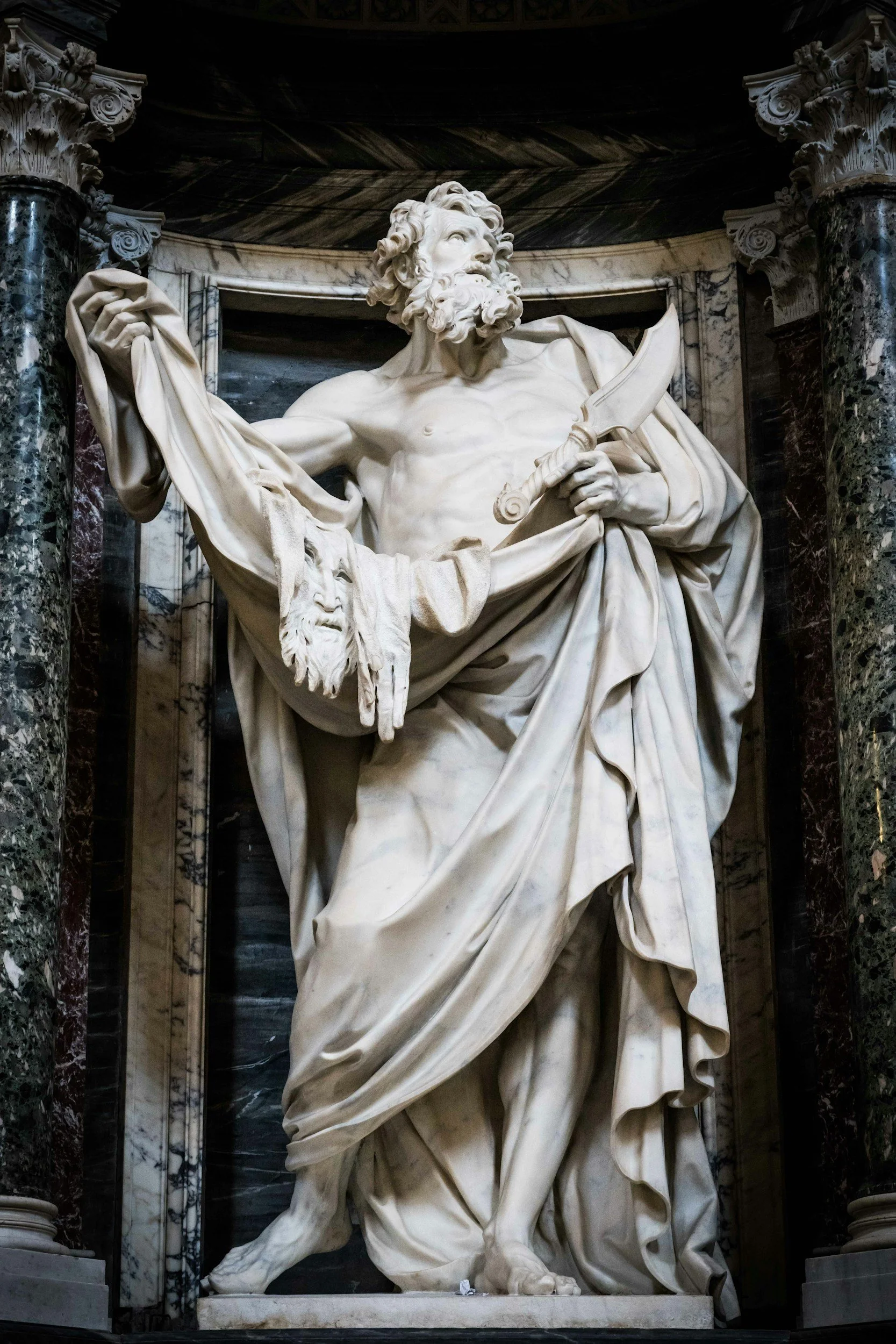
The best-known account of his martyrdom says that the Apostle was flayed alive and then put to death, often said to have been beheaded. Other ancient accounts differ on some details, but the tradition of his flaying became inseparably associated with Bartholomew in Christian memory.
For this reason he is frequently shown in sacred art holding a knife, the instrument of his martyrdom, or even carrying his own skin.
The most famous example is Michelangelo’s Last Judgment in the Sistine Chapel, where Saint Bartholomew appears holding the skin stripped from his body.
What could appear at first as gruesome imagery is, in Christian art, an image of victory. His persecutors could take even his skin from him, but they could not take his faith.
Saint Bartholomew has traditionally been invoked as a patron of tanners and leatherworkers, but his witness speaks especially powerfully to a culture marked by suspicion, cynicism and uncertainty.
He shows that honest questioning is not the enemy of faith. Nathanael was skeptical, but he was sincere. He did not pretend to believe before he believed, nor did he refuse the truth once he encountered it.
He also shows where genuine encounter with Christ can lead.
The man who once asked, “Can anything good come from Nazareth?” became an Apostle who travelled to distant lands proclaiming that the Messiah had indeed come from Nazareth.
And according to the tradition of the Church, he finally surrendered not only his homeland, comfort and security for Christ, but his very flesh.
His story begins with Philip’s simple invitation:
“Come and see.”
Saint Bartholomew, Apostle and Martyr, pray for us.