Fianna Fail Confirms Plan to Ban Prolife Prayer

Only weeks after her party colleague Conor Sheehan smeared Catholics praying the Rosary in Limerick, pro abortion politician Ivana Bacik asked a question in the Dail today which addressed her party’s desire to see Catholics and prolife demonstrators banned from their right to free speech in public.

Sheehan had abused his power as an elected representative to spread a now debunked theory which claimed that Catholic men had interrupted a ‘Vigil’ (which was actually an event organised by a pro abortion group, who brought pro abortion signs with them) for a teacher who was murdered. Sheehan and Sinn Fein TD Maurice Quinlivan both claimed on social media that the men had ‘shouted over’ the ‘Vigil’, even though videos have since debunked these bizarre claims. Neither Sheehan nor Quinlivan have yet apologised publicly.

Pro austerity party Labour have lately tried to use anti Catholicism and radical pro abortion politics as a means to squeeze their way back to relevance, having created a homelessness and emigration in the past decade with their psychotic cutbacks as part of the puppet government that carried out the will of the International Monetary Fund in the 2010s. Labour were clever enough to join Fine Gael in using abortion and other social topics to soften the blow of austerity for the Irish people.

In the Dail today, Bacik asked pro abortion Taoiseach Michael Martin if legislation to target the free speech of prolife people will be brought forward.

The pro abortion Martin stated that the government were preparing a bill.

Bacik did not provide a single instance of prolife people mistreating women accessing those ‘services’ designed to ensure the controlled demolition of the unborn child. Instead, she mumbled something about an astro turf pro abortion group’s claims, to which the hapless Taoiseach (who will soon surrender his position to Leo Varadkar) said ‘that is very troubling’.

Ireland has now essentially become a one party state, with the only major differences being between personalities, not policies.

Even those who were elected on prolife promises, such as Fianna Fail’s Jack Chambers, have since been steadfast in their opposition to the prolife cause and to the unborn child.

With the upcoming ‘review’ into Ireland’s abortion legislation set to be a whitewash, Catholics can only learn to pray for an end to this gruesome violence against the unborn.

There will be a series of Prolife Vigils at Saint Saviour’s Dominick Street Dublin, beginning 19th February.

Cardinal Duka Defends Pope Benedict XVI

While some Catholic commentators have thrown Pope Benedict XVI under the bus after media distortions of recent developments regarding abuse in German church, others have taken the time to study the case for themselves.

Liberal Catholic commentators have been all too quick to call Benedict XVI ‘tone deaf’ for merely defending himself, dismissing his explanation of events as a ‘non apology’. This is despite Benedict insisting that he had been given the support of Pope Francis in this matter:

To me it proved deeply hurtful that this oversight was used to cast doubt on my truthfulness, and even to label me a liar. At the same time, I have been greatly moved by the varied expressions of trust, the heartfelt testimonies and the moving letters of encouragement sent to me by so many persons. I am particularly grateful for the confidence, support and prayer that Pope Francis personally expressed to me.

One voice that has strongly stood up for the pope is Czech Cardinal Dominik Duka OP, who has released a powerful statement questioning the Archbishop of Munich for his role in assigning blame to Benedict, when the priest in question was not under his jurisdiction, but that of the Diocese of Essen.

Read Cardinal Duka’s remarks below:

''The publication of the Pope's letter is truly a glimpse into the soul of a priest, bishop and pope who is reflecting back on his life but no longer has the strength to comment on all its particulars.

What follows is an analysis by the experts mentioned above, who show us line by line how the so-called blessing is handled in the Archdiocese of Munich. For me, this is one of the greatest disappointments I have experienced in our Roman Catholic Church. To denigrate a person, to denounce him unjustly and not even to give him the opportunity to evaluate this so-called blessing, which must have cost hundreds of thousands of euros, because it does not give the possibility of a legal reprieve? I ask: what is that?

In my article, which will appear in the German magazine Die Tagespost, I point out the following fact: that from the entire record, any priest who has studied church law, or even a layman who has graduated from a theological faculty and attended a course in church law, must understand that the then Archbishop of Munich, Joseph Ratzinger, had no jurisdiction and no possibility of resolving this case in any way - the priest X. in question was a priest of the diocese of Essen.

Therefore, I protest and indeed take the liberty of calling the Archbishop of Munich, his curia, and the President of the German Bishops' Conference to account for the defamation and tarnishing of the reputation of Pope Benedict XVI!

Dominik Cardinal Duka, Archbishop of Prague

Rallies Held In Support Of Fishermen

By Gregory Murphy

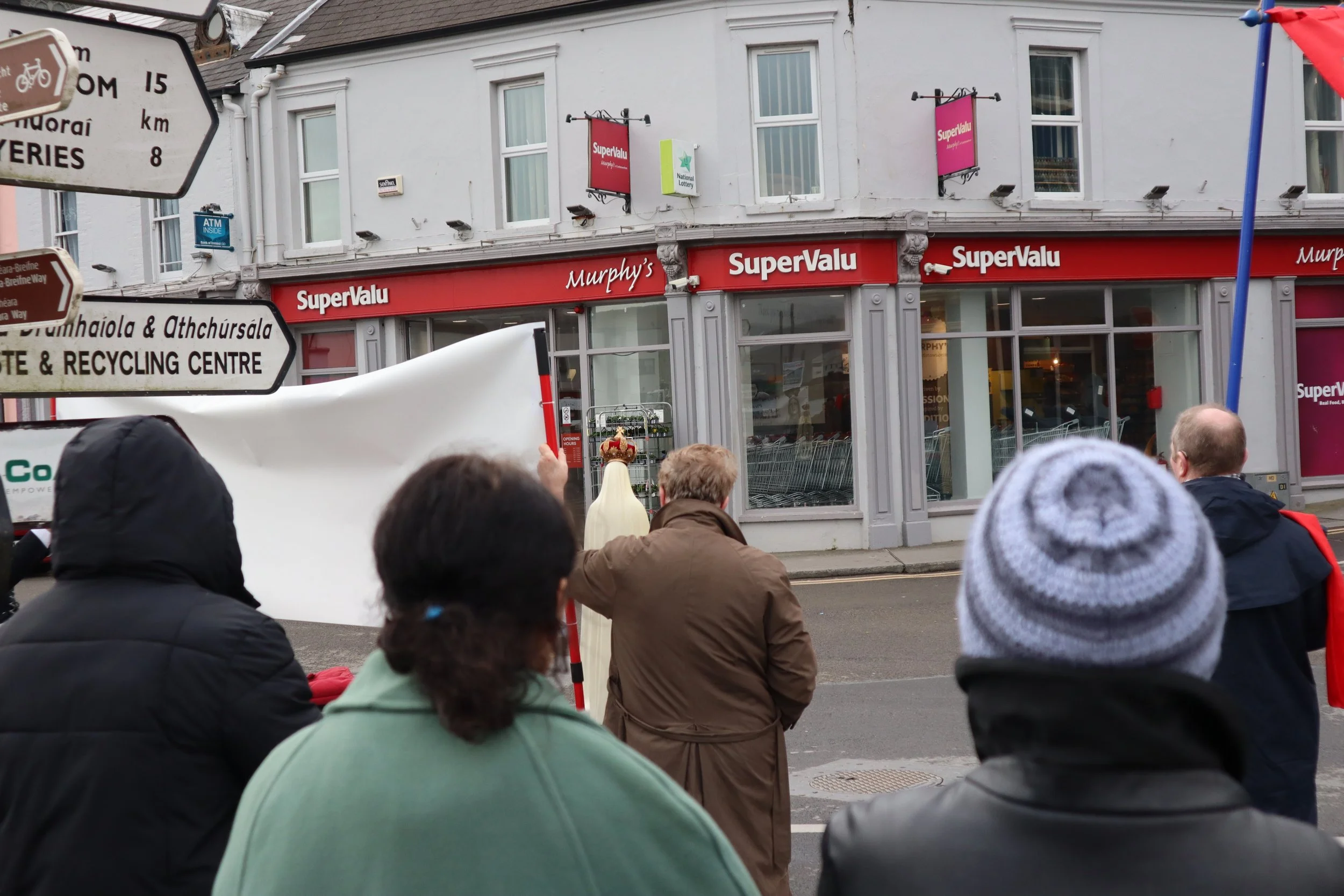
Irish Society for Christian Civilisation – ISFCC, an organisation of lay Catholics, held three Rosary Rallies between Thursday and Saturday in Castletown-Bearhaven, Bantry, and Kinsale praying to St. Peter to protect our fishermen and in order to promote the message of Our Lady of Fatima, specifically Our Lady's warning about Russia – it will spread its errors.” The volunteers and friends of ISFCC also gave out 500 hundred rosaries, miraculous medals, and scapulars to the fishermen.

However, the Rosary Rallies were the focus of attention due to the 9ft banner which read, “Praying the Rosary for Ireland. Please join us! St. Peter protect our fishermen! Our Lady of Fatima, preserve us the `errors of Russia!`” The participants prayed the Joyful, Sorrowful and Glorious Mysteries of the Rosary and sang Marian hymns between each decade.


Rory O’Hanlon, who led the Rosary Rallies, said that “We are here for two reasons. First to thank and encourage the fishermen here for standing up to the Russian Navy, and second to remind people of Our Lady of Fatima’s warning of the “errors of Russia”, that is, Communism.”

When the Russian Navy announced their intention to do live fire drills in Ireland’s Exclusive Economic Zone, the West Cork fishermen took matters into their own hands, threatening to disrupt the drills with sixty fishing trawlers. This threat succeeded in making the Russians change course away from their plans that not only disrespected the livelihood of the West Cork community, but also disregarded the right to private property, which Communism hates so much.

Rosary Cork

Damien Murphy, a volunteer of ISFCC, stated that, “The response of the locals to the rallies has been great.” He explained that the participants of the Rosary Rally in Castletown-Bearhaven were all invited to have a cup of tea in Murphy’s Restaurant after the gathering. The passers-by often stopped to join in with the Rosary Rallies or to make the sign of the cross and many took photos and gave thumbs up in support. One lady heard the rosary from her home and joined the rally.

After the Rosary Rallies, volunteers and friends would proceed to the bars, cafés, butchers, and other shops to distribute scapulars, rosaries and miraculous medals to the fishermen. They did this in Castletown-Bearhaven, Kinsale, Union Hall, Skibbereen, and Bantry. One worker at the fishermen Co-op asked for at least two dozen miraculous medals to hand out to the fishermen.

Patrick Murphy took two dozen miraculous medals for his men as well as Alan, skipper of the Syracuse, who took a bunch of miraculous medals for each of his crew members and said, “You’re doing great work!”  The Chef’s Table also gave out doughnuts.

The idea of public square Rosary Rallies isn’t new. Since 2010, Irish Society for Christian Civilisation has organised hundreds of Rosary Rallies. On October 14th, 2017, ISFCC organised two hundred Rosary Rallies across Ireland in commemoration of the centenary of Our Lady of Fatima.

Organiser, Rory O’Hanlon, concluded “What we are asking people to do is what Our Lady asked of us at Fatima, prayer, penance and amendment of life. Because at the heart of every crisis in the world today lies a moral problem. And it is through the rosary especially that God gives us the wisdom, prudence and confidence to solve our problems.”


Irish Men's Rosary Continues to Grow

The Year of Saint Joseph brought many great fruits to the church.

One of them was the Men’s Rosary Rallies which reclaimed the streets of Poland from proxy warriors for the abortion industry who attacked churches in 2020 and 2021.

These images of men lining the streets of major cities and towns and kneeling in prayer together have now inspired others to get involved in various locations across the world.

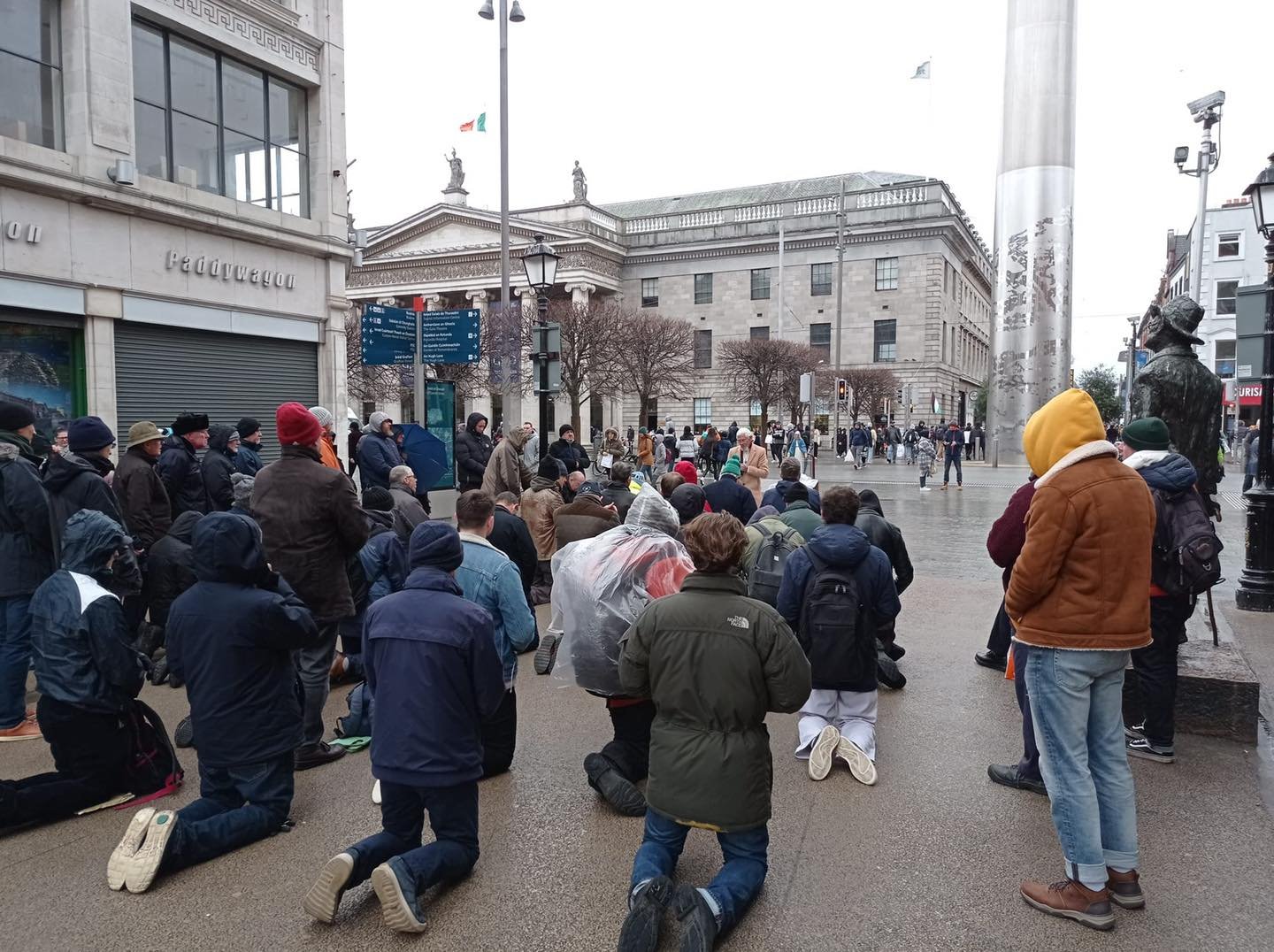
The initiative has really taken off in Ireland, with initial Rosary Rallies in Derry and Newry leading to many towns and cities announcing synchronised events involving thousands of Irish men.

In the biggest day yet, yesterday saw Rosaries in Omagh, Dublin, Tralee and Knock amongst others.

The event in Omagh built on the successes of recent events in the North, with a large crowd of men kneeling in the lashing rain.

In the South West of Ireland, Tralee was the location for Catholic men stepping outside and praying in public.

The Marian Shrine at Knock, County Mayo probably had the coldest looking conditions for a Rosary but many man endured nonetheless.

In the capital city of Dublin, a crowd gathered near the Spire.

The Men’s Rosary is a simple, yet effective manner of bringing about a renewal of the Catholic faith, both in Ireland and across the world.

You can keep up to date with the latest news at mensrosaryireland.com


Ireland's Catholic Underground

2022 marks the centenary of the Legion of Mary, the Irish church’s greatest success in the Twentieth Century.

From confronting Communism in China and North Korea to confronting poverty in South America and Africa to confronting atheism in the West, Frank Duff’s visionary apostolate has amassed tens of millions of followers.

As part of the celebrations for their centenary, the Legion are running a series of Men’s Conferences throughout the year. The Morning Star Hostel, which provides accommodation, food and spiritual support for men in need, has hosted the first two events.

The second one involved Father Brendan Kilcoyne, of the Brendan Option podcast, hosted by Immaculata Productions who filmed the event for Youtube.

In a wide ranging keynote speech, Father Kilcoyne spoke about the upcoming Synod and the dangers of being too tame in conversations surrounding it. He also spoke about the need for Catholics to be unafraid of what they have to offer the world, a world which as Father Kilcoyne puts it, has little in the way of philosophical thought underpinning it.

The event is part of what Father Kilcoyne calls the ‘Catholic Underground’, a part of the burgeoning undercurrent of renewed faith and dynamism of spirituality that is taking place away from the mainstream establishment. Impressed with the turnout and vibrancy in the room, Father Kilcoyne asks, ‘Who knew that Catholic Underground was so big?’

How fitting that it takes place in so meek yet powerful of a place as the Legion of Mary headquarters.

Starting from those humble beginnings in Dublin, the Legion of Mary grew to encompass presidiums in China, South America and Africa, surviving and even thriving amongst poverty, tyranny and violence.

Frank Duff, if you are not familiar with him, was a civil servant who had a remarkable perception of theology and of its practical implications within the world. He had worked for Michael Collins and later for WT Cosgrave during the early years of the state. The Legion of Mary may have an image of being non confrontational, but when it came to proclaiming the gospel, Duff’s zeal for apostolic work was anything but. Fr. Thomas O’Flynn C.M. wrote in his book Frank Duff As I Knew Him:

He had unflinching honesty in asserting what he believed to be the truth. Sometimes at the Pauline Circle, the ecumenical group run by the Legion, I would wince at the fortrightness with which he put forward the teaching of the church to our separated brethren. But even if they did not always agree with him they respected him for his honesty.

He was a fighter, never afraid to defend his corner when the interests of the faith or the Legion were at stake. This courage was part of the psychological gear necessary for his task. When he was launching the new movement in the lay apostolate that later became known as the Legion of Mary he had encountered opposition: sometimes from people in high places. A pioneer in any walk of life needs courage. Frank Duff had it in plenty.

Duff was largely overlooked by the hierarchy in Ireland and one can only wonder how different the history of Twentieth Century Catholicism in Ireland would have been had he been listened to.

In a talk published on the Iona Institute website, Duff’s biographer Finola Kennedy wrote of how Duff broke the norms of secular culture in trying to help unmarried mothers to gain stability in their lives, housing them in his hostel The Regina Coeli. She wrote:

Duff’s special sympathy for unmarried mothers was at odds with the mores of the time when the consequences of an extra-marital birth were disastrous, rendering both mother and child social outcasts. He was probably close to the view of the writer George Moore who in his powerful novel, Esther Waters written at the end of the nineteenth century, tells the story of a mother’s fight for the life of her illegitimate son. Moore wrote, ‘Hers is a heroic adventure if one considers it – a mother’s fight for the life of her child against all the forces that civilisation arrays against the lowly and the illegitimate’.

Anyone who has ever visited Frank Duff’s house in Dublin will notice that in his living room, one finds copies of National Geographic, travel books and encyclopedias concerning every part of the globe and various dictionaries for other languages. The inception of the Legion coincided with the birth of international travel through airplane and also the missions of Irish priests, particularly the Columbans, to the Far East and elsewhere.

One of the most famous examples of these was Fr. Aedan McGrath SSC.

In his book Navan to China, McGrath tells the story of Chinese Legionaries who exhibited profound faith as he had witnessed on countless occasions since his first arrival there in 1930. One of the most striking of these was one where he says:

Under the most trying of circumstances, the Legionaries behaved splendidly in every way. On one occasion a drunken Army Official, who was suspicious of the Praesidia meetings, wildly broke into a junior meeting when the young girls were reciting the Rosary. As he strode into the room, swearing vengeance on all and sundry, not one little head turned: the Legionaries continued their prayers uninterrupted under the leadership of the young girl President! As he surveyed the scene, the officer’s face changed completely, he removed his cap, bowed his head reverently and quietly left the room - conquered by a group of little Legionaries praying to the Mother of God!'

How proud I was of the behaviour and spirit of my Legionaries both on this occasion and at other times when bombs and shells were dropping thickly all around the Mission.

McGrath also told of how in 1946, Pope Pius XII had sent word to the Chinese church to follow the model of the Legion of Mary so as to reach millions of Chinese people with the Good News. Pius XII was not naive however and told them:

You are going to be expelled sometime and in the meantime it is vital that you build up a framework which will caretake the Church in your absence, and that instrument lies ready for you in the Legion.

The Chinese bishops became familiar with the Legion handbook as a means of educating themselves with this new tool. The Chinese Communist Party were completely terrified of the Legion of Mary, it put women into positions of authority, it had no clear centralised structure and it seemed to be spreading like wildfire. Most terrifyingly, it carried with it the name of ‘Legion’ and other Roman inspired paraphernalia.

They tried to paint the Legion as a tool of Imperialism in order to deter Chinese people from joining it.

McGrath writes:

The legion was charged with being ‘reactionary’ at several ‘accusation meetings’ convened by the city authorities. The accusations were sustained, but the ‘reasoning’ at these mass meetings followed the line that ‘foreign priests’ were influential in organising the various groups of Legionaries and since foreigners were imperialists, the Legion was therefore a tool of Imperialism.

At this point in time, the Legion had reached 90 dioceses in China. Such was the disdain towards their success, that the Chinese Communist Party referred to Frank Duff as ‘Ireland’s greatest imperialist’.

Fr. McGrath ended up being imprisoned and tortured by the Chinese Communist Party for 32 months in 1951. In his recollection of his interrogations, he talks about how the Chinese police held one meeting in a church and demanded to know about what the Legion meant by ‘conquering the world’.

The Legion grew rapidly also in Hong Kong, where it was reported that 74 presidia were in operation in 1954.

One of the core motivations for Duff to found and build the Legion of Mary was St. Louis Mary de Montfort’s True Devotion to Mary.

The Legion has three causes for canonisation, one of which was Alphonsus Lambe, who recognised the importance of De Montfort’s book when he travelled to Argentina. In her book Envoy Extraordinaire, Hilde Firtel writes:

Alfie breached a very thorny subject, namely the sentimental and unenlightened devotion to Our Lady that is occasionally found in Latin America. In Europe one hears criticism that some people have saved nothing of devotion to Catholicism save devotion to Our Lady. But this fact which is taken as true is taken as an excuse to deprecate devotion to Our Lady. This is to err in the opposite extreme.

Alfie proposed the remedy as acquainting the faithful with the ‘True Devotion’ of Saint Louis Marie De Montfort. This would give them a true picture of Our Lady’s role in God’s plan of salvation and would gradually rectify their ideas.

The centrality of De Montfort and the deep Marian spirituality of the Legion handbook are core aspects, which transmit profound theological truths to even the lay person.

Duff met a number of popes, but was largely unappreciated in his home country. Perhaps it was because of the uncomfortably prescience with which he could perceive the future for Ireland not just in spiritual terms but economic terms also:

Obviously all this constitutes a danger signal for us in Ireland. We have arrived at the point when taxation has become oppressive and We know it is going to get heavier. At what stage will it amount to a taking over of our ,entire lives by the State" Then there will be no more effort; no more initiative. An eminent man of our own times has said that it is impossible for a dishonest people to become a great nation. I would amplify this thought and say that a people which does not give value cannot hope to keep the Faith.

The mere contemplation of such a nest of problems is enough to paralyse. Solution must be attempted in a spirit of pure faith. The crisis is as great as any of the classic ones of the past. So Legionaries of Mary will, quite naturally, turn to her who is the help of Christians, the destroyer of all heresies, the woman of perpetual succour, to whom recourse has never been made unavailingly.

Duff foresaw that Ireland’s poor catechesis would eventually lead the slide towards atheism:

It has always been imagined by us that the Irish people have a unique regard for the Mass. Therefore it is a shock to encounter proofs to the contrary. I have now covered a good deal of the surface of the country and I tell you our experience in regard to daily Mass, which surely is the test of appreciation. The attendance is miserable in proportion. Yet in the smaller places there is nothing doing at that time and the majority could attend. I specify one case where we had a priest with us and offered a week-day Mass to a village which normally has one on Sunday only. Not a single local person turned up for it. Other places would be better but not much better. Does that sort of thing afford justification for our alleged love of the Mass?

Quite evidently that degree of religion is not going to stand up to the adverse influences which are every day thickening and marshalling themselves. Therefore we find ourselves at a crisis point of religion. The thought forces itself upon me: Is it possible that the tragedy of France and so many other countries is going to reproduce itself in Ireland? We are walking on a slippery slope at the moment. That cannot continue. It improves or it deteriorates-usually the latter.

It was not possible to save France. Portugal. Spain. Italy. Holland. all of which have lost the Faith in the main. Acute French observers coming here soon after the Second World War declared that they saw a remarkable likeness between the Ireland of that time and the France of two hundred years previously: the same characteristics and the same weakness. Two hundred years ago would have been the period in which France would have prided itself on being the most Catholic country in the world that is immediately preceding the French Revolution. The Revolution did not create all thy hollowness and the hatred of religion which then appeared. It only revealed what was there. It was like taking off a mask.

Spain and Portugal spread the Faith over great tracts of the world's surface but those supreme services to the Church did not mean that the keeping of the Faith was guaranteed to them in perpetuity. They plunged into the most hideous phase of anti-religion which could exist and set themselves to propagate it over the world. It could not be said that the people in those country is put up any fight worth while against that horror. After a little flurry of resistance they abandoned themselves to the irreligion which their governments decreed. Even though the more violent aspects of atheism have worn off, the percentage of belief and practice there is negligible and it cannot be claimed that things are improving.

Does that likeness of conditions discerned by the French observers suggest that we will in due course slide into what they have become? We would be insane if we just shrugged off that possibility.

The Legion of Mary was an antidote to all of this. In many countries across the world, it has been a successful antidote. In Ireland, there is still time for it to be so.

Legionaries across Ireland can still be found today, visiting hospitals, feeding the homeless and handing out miraculous medals on streets.

Duff may have had a profound impact on the rest of the world, but he had a special place in his heart for Ireland, including Joseph Mary Plunkett’s poem I See His Blood Upon the Rose with accompanying artwork at the back of the Legion of Mary handbook.

He saw that the mission of the Legion in Ireland was similar to that of the St. Columbanus and the apostles before them, to go purify within before going out into a chaotic world:

These poured out from their little Isle into that continental wilderness. They invaded nearly every part of it. They rebuilt the lost Faith, built it better than it was before because this time it depended on conviction and not on State scaffolding. They may be said to have made modern Catholicism. That was the Peregrinatio pro Christo.

They would have viewed their mission in a very different way from that in which the Apostles looked on theirs. Much more was known about the world than in the year 33. Christianity moreover had taken root. It might have been laid waste over most of the world but those monks would have seen that as a mere temporary calamity which must be repaired. Certainly ( the Faith was not suffering in Ireland. It was new there and boiling with fervour. The monks were providentially ready for a supreme adventure of that kind.

100 years on from its foundation, the Legion of Mary still has the potential to show the vision and determination that Duff embodied and that has sustained millions of Legionaries, many in secret in China, North Korea and elsewhere.

How blessed we are in Ireland to be able to claim this as our recent spiritual heritage.

You can watch the full video of the conference below:


Aussie Cops STORM Church During Mass

The International Lockdown of the past two years has led to many violations of civil rights, particularly among religious people.

In Ireland, anti Catholic politicians surrounded outdoor Rosary Rallies and set Gardai on people, Gardai also visited priests and issued warnings if a single person above the allowed amount attended a funeral and there was also the siege of Fr. PJ Hughes as he attempted to say Mass. The most shocking of all was the invasion of a church in Athlone last year, with the shocking images of Drew Harris’s men invading the sanctuary.

As much of the Western World winds down from the lockdown restrictions, one country is finding it hard to let go.

Australia has been home to some of the most horrific overreach of state authority, as exemplified by their recent show trial of Novak Djokovic.

Now, police in Western Australia have stormed Mass at St. Bernadette’s, Glendalough.

One parishioner shocked at the behaviour by the police commented:

“I mean I’ve never seen anything like this and I don’t think many people have, certainly not in this country.”

In images from the aggressive storming, police can be seen checking the vaccination and mask compliance of parishioners.

The parish later wrote on Facebook:

“You are not permitted to enter the Church unless you are wearing a mask,” he wrote in a social media post.

“If you have an exemption letter from your doctor, then please make certain that you carry this on you at all times. 

“Heavy fines on the parish priest, our parish and individuals will be incurred if you are caught without wearing your mask.  Please co-operate with this request so as to avoid any complications’’.

Australia has long been a hotbed of anti Catholicism. Even recently, authorities failed in efforts to frame Cardinal George Pell for abuse in a show trial that was eventually overturned when competent judges actually did their jobs and assessed evidence properly.

With much controversy rightfully questioning China’s human rights record ahead of the Winter Olympics, we have to ask ourselves are we becoming any better? The West is becoming as hostile to the faith and to civil rights as China is.

A Men’s Rosary Rally outside St. Mary’s Cathedral will now be offered in reparation for the Australian nation’s attack on the Mass.

The Little Irish Girl Who Changed The World

In 1897, a young French women died in a Carmelite Monastery in Northern France. Virtually unknown to the outside world, Therese Martin would go on to become Saint Therese, arguably the most revered saint of the subsequent hundred years. Despite only being 24 at the time of her death, her short life was profound her enough to see her named ‘The Greatest Saint of Modern Times’ by none other than Pope Pius X.

Pope Pius X had dealt the the saintly life of another sickly young girl, an Irish child by the name of Ellen Organ, who was born 6 years after Saint Therese’s death and died 11 years after the French nun. Her short life was marked by suffering, both physical and, it would appear, spiritual. The latter is not something to be expected in such a young life, yet it appears as though this were the case, leading to Pope Pius X seeing her life as the instigation for changes in the First Holy Communion of children.

William Organ married Mary Aherne in 1896, both of them Catholics living in County Waterford, in the South of Ireland. They had four children, of whom Ellen was the youngest. Nellie, as she came to be affectionately known, would often talk about ‘Holy God’ in a manner that suggested a deep affiliation with her Creator. She moved to Spike Island, where her father was stationed as a soldier. Her life quickly became tragically affected by the poverty of the time however, with her mother dying when Nellie was three, due to tuberculosis.

Struggling to maintain care of the family, William Organ placed Nellie and her siblings into the care of religious orders, the Good Shepherd Sisters in Cork welcome Nellie and her sister Mary into their care.

Under the care of the nuns, Little Nellie showed an understanding of the faith that made them startled. She had a fixation with Our Lord’s crucifixion and asked why it had been allowed.

Nellie became enchanted with the statues of the Little Child of Prague, stating that she could see images of him dancing for her amusement and becoming excited.

In late 1907, it became clear that Nellie would not have a long life. So sick was she that Bishop O’Callaghan administered the Sacrament of Confirmation upon her, in preparation for her inevitable death. Her response was striking, something that one might have expected from Saint Therese of Joan of Arc, she said ‘I am now a Soldier of Holy God’.

It was after this that she started to develop her most mystical insights, particularly in relation to the Blessed Sacrament. She repeatedly stated that God was ‘imprisoned’ and instinctively knew upon first seeing a monstrance that ‘there is Holy God’.

The Mother Superior decided to approach the priest to ask if she could receive Communion, which was an unusual request for one so young. The Jesuit priest quizzed the little girl on her knowledge of the Eucharist, with Nellie affirming that it was ‘Holy God’. She said that He ‘makes the nuns and everyone else holy’, before stating that ‘Jesus rests on the tongue then goes into the heart’. The bishop, hearing this report from the priest, agreed to let her receive her First Holy Communion.

Nellie would often claim to be talking to Holy God, with a peace coming upon her near the end of her short life, with serenity surrounding her as she gleefully told of God’s love for her.

Shortly before her death, she was praying the Rosary with one of the nuns when she asked to say a prayer for ‘The Pope, my Holy Father’.

On February 2nd 1908, the short yet profound mortal life of Little Nellie Organ came to an end, but her impact upon the world was only beginning.

Hearing of her life, the pope for whom she prayed, Pius X, said ‘She was an angel’.

Only two years after her death, Pope St. Pius X wrote Quam Singulari, his encyclical bringing about radical changes in the age of First Holy Communion.

The great pope wrote:

After careful deliberation on all these points, this Sacred Congregation of the Discipline of the Sacraments, in a general meeting held on July 15, 1910, in order to remove the above-mentioned abuses and to bring about that children even from their tender years may be united to Jesus Christ, may live His life, and obtain protection from all danger of corruption, has deemed it needful to prescribe the following rules which are to be observed everywhere for the First Communion of children.

1. The age of discretion, both for Confession and for Holy Communion, is the time when a child begins to reason, that is about the seventh year, more or less. From that time on begins the obligation of fulfilling the precept of both Confession and Communion.

2. A full and perfect knowledge of Christian doctrine is not necessary either for First Confession or for First Communion. Afterwards, however, the child will be obliged to learn gradually the entire Catechism according to his ability.

3. The knowledge of religion which is required in a child in order to be properly prepared to receive First Communion is such that he will understand according to his capacity those Mysteries of faith which are necessary as a means of salvation (necessitate medii) and that he can distinguish between the Bread of the Eucharist and ordinary, material bread, and thus he may receive Holy Communion with a devotion becoming his years.

4. The obligation of the precept of Confession and Communion which binds the child particularly affects those who have him in charge, namely, parents, confessor, teachers and the pastor. It belongs to the father, or the person taking his place, and to the confessor, according to the Roman Catechism, to admit a child to his First Communion.

5. The pastor should announce and hold a General Communion of the children once a year or more often, and he should on these occasions admit not only the First Communicants but also others who have already approached the Holy Table with the above-mentioned consent of their parents or confessor. Some days of instruction and preparation should be previously given to both classes of children.

6. Those who have charge of the children should zealously see to it that after their First Communion these children frequently approach the Holy Table, even daily if possible, as Jesus Christ and Mother Church desire, and let this be done with a devotion becoming their age. They must also bear in mind that very grave duty which obliged them to have the children attend the public Catechism classes; if this is not done, then they must supply religious instruction in some other way.

7. The custom of not admitting children to Confession or of not giving them absolution when they have already attained the use of reason must be entirely abandoned. The Ordinary shall see to it that this condition ceases absolutely, and he may, if necessary, use legal measures accordingly.

8. The practice of not administering the Viaticum and Extreme Unction to children who have attained the use of reason, and of burying them with the rite used for infants is a most intolerable abuse. The Ordinary should take very severe measures against those who do not give up the practice.

Just as had been the case with Saint Therese a decade earlier, the brevity of life was no obstacle to the breadth of her influence nor to the depths of her holiness.

Ireland Removes Cribs While Projecting Pagan Images

By Thomas Hegarty

Welcome to modern day Ireland. A place where pagans removed Christmas cribs and crucifixes from our hospitals and public buildings only to replace them with images of pagan goddesses.

This is Ireland in 2022. We elected county councillors to manage our local utilities but they are now calling the shots to de-Christianise Ireland and using our taxes to pay for this paganisation.

Here’s the evidence. [Don’t forget to sign up to the new Friends of the Parish Telegram channel]

The Labour Lord Mayor of Dublin, Alison Gilliland is a driving force behind a “Brigit 2022” series of events “celebrating” the “Celtic (pagan) goddess Brigit, who she claims is associated with “creativity and wisdom” and the “traditional Gaelic (pagan) festival of Imbolc (pagan festival). This is the same Alison Gilliland (Labour) who faced a backlash on twitter last December when she called Dublin’s Christmas Lights “Winter Lights”.

These pagan events are “free” to attend but Irish taxpayers will get the bill as these “free” pagan events are sponsored (paid for) by Dublin City Council who are in turn funded by Irish workers through our taxed wages.

Despite the festival being held on Saint Brigid’s Day, 1st of February and being called Brigit 2022, the events literature never mentions Saint Brigid. this comes as no surprise to us as the events programme includes HerStory, a pagan goddess worshipping, radical feminist group who campaigned for gay marriage and child abortion.

The “Brigit 2022” event includes a concert headlined by activist Imelda May. An Irish Times article this week, quoted Imelda May on Brigit 2022;
“Brigit was an ancient goddess, our matron saint, woman of wisdom, healing and light daughter of Dagda, descendent of Danu, member of magical Tuatha Dé Danann, protector of children, saviour of poor, symbol for smiths, worshipped by poets.”

Imelda May continues;
“Inspiring descendants past and to come, her creative flame fires eternal. Adored by Ireland for thousands of years, she awakens Imbolc (pagan practice), the dawning of spring, new birth, fresh starts. It’s time to thank her. It’s time to heal. It’s about time.”

Imelda May makes no distinction whatsoever between an imaginary pagan goddess named Brigid and the real-life Christian Saint Brigid of Kildare. Her statement mixing a pagan goddess with a real life Christian Saint goes unchallenged by the Irish Times.

In the same Irish Times article written by Tom O’Brien, he writes;

“Drawing inspiration from the Celtic (pagan) goddess Brigitfrom which the Christian saint originated, Brigit 2022 celebrates the contributions of Irish women through the ages, highlighting their stories and promoting their contribution to society.”

As part of their celebrations for 1st February, HerStory will be projecting images of their pagan goddess on public buildings including Trinity College, Dublin’s GPO, Newbridge Town Hall and the Barn in Leixlip. they will also be projecting their pagan images on Saint Brigid’s Anglican Cathedral in Kildare Town.

How Ireland has changed. In 2017, according to Extra.ie, Beaumont Hospital announced they were removing all Christmas Cribs from their hospital saying the Christmas cribs were not “multifaith”.
Many Public buildings, healthcare and education facilities have binned Christmas Cribs and crucifixes all over Ireland. Our Christian heritage is under attack by modern day pagans willing to twist the facts to eradicate any and all signs of Christianity.

Move over Christianity and make room for the pagan worshippers and give us part of your hard earned salary to pay for the de-Christianisation programme.

Subscribe FRIENDS OF THE PARISH ... FAMILY-FAITH-COUNTRY 🇮🇪 | Editorial Team FOTP | Substack

Irish Pro Family Group to Host Synod Webinar

The following is a press release from Irish Pro Family group Family Solidarity:

Family Solidarity invites you to a webinar on “The Irish Synodal Pathway” with Bishop Brendan Leahy (Bishop of Limerick) and Dr Nicola Brady (Chair of the Steering Committee).

Thursday 3rd February 2022 at 7.00 pm on Zoom.

Request link by email to familysolidarityireland@gmail.com

Last year the Catholic Church in Ireland has begun a synodal pathway that will lead to a National Synodal Assembly in 2026. This is a period of prayer, listening and discussion about the past, the present and the future of the Church in Ireland. Bishop Leahy and Nicola Brady will present the timeline and the aims of the synodal pathway, and how families can contribute to it.

Bloody Sunday and Abortion

By Thomas Hegarty

Subscribe to Friends of the Parish Substack

Derry’s Bloody Sunday was a brutal attack on Catholics marching for their Civil Rights by the British Army Paratroop regiment. It is said that the paratroopers launched their attack on the Catholic civil rights marchers from the nearby Gwyn’s Institution, originally an orphanage and later a public library in Derry City. The library was later razed to the ground after Bloody Sunday by angry Derry locals.

14 innocent Catholics were murdered in the paratrooper attack on unarmed civilians in what was later described as the greatest recruitment drive for the IRA.

Many more Catholics were badly injured on Bloody Sunday. The injured couldn’t go to Derry’s main hospital, Altnagelvin, for fear they would be arrested by the Paratroopers who were waiting at the accident and emergency rooms to arrest them. Instead, most of the injured were treated in makeshift field hospitals in Derry and across the border in Donegal.

The days that followed were difficult for Catholics in Derry. A silence and a fear descended on the City as they mourned, waked and buried their dead.

This weekend, Irish Political parties were out in full force, rightly condemning the Bloody Sunday murders.

This weekend also, the Irish Abortion Clock recorded a death toll of 20,424 unborn children since Repeal of the Right To Life.

However, the very same political parties that condemn the murders of 14 innocent civilians 50 years ago actively support the abortion of tens of thousands of unborn Irish children. These politicians are unwilling to acknowledge their hypocrisy for fear they might not be popular with their pro-choice, liberal voters.

There are no politicians queuing up this weekend to give soundbites to the media about Ireland’s aborted boys and girls. Our Irish politicians look back in horror and anger at Bloody Sunday but choose not to look at abortion with the same sense of horror or anger.

Every day, seven days a week, the Republic of Ireland aborts 18 unborn children in maternity hospitals and GP clinics around the country.

There is no outcry, in fact, our politicians encourage abortion and incentivise abortion GPs for each abortion they commit.

Every day, Ireland kills more human beings than were killed on Bloody Sunday.
Like Gwyn’s Institution in Brooke Park whose ruins have been bulldozed into the ground and out of sight as if it never existed, our 20,424 aborted Irish children are out of sight and out of mind, as if they never existed.

For our Irish aborted unborn, every day is a Bloody Sunday.

Our thoughts and prayers are with those 14 innocent Catholics who lost their lives at the hands of the Paratroop regiment 50 years ago.

Our thoughts and prayers are also with the 20,424 unborn boys and girls who lost their lives to weak politicians promoting and encouraging abortion in Ireland today.

Father Edward Daly: In Persona Christi On Bloody Sunday

Of the countless stark images from The Troubles in Northern Ireland, few convey the brutality and senselessness of those years more than the image of Fr. Edward Daly on Bloody Sunday in 1972.

Waving a white handkerchief, covered in blood, the priest can be seeing pleading with British soldiers to show mercy as they massacred 14 unarmed Catholic civilians, shooting 26 in total.

Only a few months earlier, the same regiment had massacred 9 civilians at Ballymurphy, including Catholic priest Father Hugh Mullan as he did what Fr. Edward Daly did, waving a white handkerchief to beg for a cessation in the killings. The British soldiers did not listen and instead chose to murder him.

On the day in question, paratroopers opened fire on innocent civilians in the bogside area of Derry City, using some stones being thrown as a pretext to horrific violence. A 17 year old, Jackie Duddy, was running alongside Fr. Daly when a he was shot in the back. It was Jackie’s limp body that was photographed behind Fr. Edward Daly’s handkerchief, before he later succumbed to his injuries and died.

7 of the 14 who were murdered were teenagers when they were killed.

The selflessness of Father Edward Daly, later to become Bishop Edward Daly, is the real story of most people’s experiences of Catholics priests in Ireland in the Twentieth Century and throughout history. A priest has a particularly unique role, in repeating the sacrificial nature of Christ not only through the offering of the Mass, but also through their earthly lives, in service of his parishioners and of the Kingdom of God. The striking image of Father Daly, surrounded by death and danger as bullets fired around him, perfectly encapsulates priesthood at its very purest.

Father Daly’s love for his flock is of the sort that Irish priests were examples of most of their 1600 years on this island, no one else persevered with Catholics during the Penal Laws, even heroic men such as Daniel O’Connell come up short when compared to others such as Saint Oliver Plunkett, who were mutilated to the point of death for their love of Christ and for their flock. Father Edward was one of many who maintained the reminder that a priest is not merely a man in a cloth, but one ordained to act In Persona Christi, in the person of Christ.

Fr. Daly died in 2016.

May Bishop Daly, and all of the victims of Bloody Sunday, rest in peace.


Mel Gibson 'Church Needs House Cleaning'

Mel Gibson is set to release a new film starring Mark Wahlberg, entitled ‘Father Stu’.

The story is based upon the true story of Father Stuart Long, a boxer and troublemaker turned priest.

In a new interview, the Catholic director has stated that this story is a reminder for Catholics to get back to what the church is good at. Gibson points out that bad characters have used the institution for evil in recent years, with a need for ‘house cleaning’ now required to take place.

The comments come some months after Gibson criticised the ‘bullying and persecution’ of Traditionalist priests by extremist liberal ones.

Aeterni Patris by Leo XIII

AETERNI PATRIS
ENCYCLICAL OF POPE LEO XIII 
ON THE RESTORATION OF CHRISTIAN PHILOSOPHY


To the Patriarchs, Primates, Archbishops, and
Bishops of the Catholic World in Grace and
Communion with the Apostolic See.

The only-begotten Son of the Eternal Father, who came on earth to bring salvation and the light of divine wisdom to men, conferred a great and wonderful blessing on the world when, about to ascend again into heaven, He commanded the Apostles to go and teach all nations,(1) and left the Church which He had founded to be the common and supreme teacher of the peoples. For men whom the truth had set free were to be preserved by the truth; nor would the fruits of heavenly doctrines by which salvation comes to men have long remained had not the Lord Christ appointed an unfailing teaching authority to train the minds to faith. And the Church built upon the promises of its own divine Author, whose charity it imitated, so faithfully followed out His commands that its constant aim and chief wish was this: to teach religion and contend forever against errors. To this end assuredly have tended the incessant labors of individual bishops; to this end also the published laws and decrees of councils, and especially the constant watchfulness of the Roman Pontiffs, to whom, as successors of the blessed Peter in the primacy of the Apostles, belongs the right and office of teaching and confirming their brethren in the faith. Since, then, according to the warning of the apostle, the minds of Christ's faithful are apt to be deceived and the integrity of the faith to be corrupted among men by philosophy and vain deceit,(2) the supreme pastors of the Church have always thought it their duty to advance, by every means in their power, science truly so called, and at the same time to provide with special care that all studies should accord with the Catholic faith, especially philosophy, on which a right interpretation of the other sciences in great part depends. Indeed, venerable brethren, on this very subject among others, We briefly admonished you in Our first encyclical letter; but now, both by reason of the gravity of the subject and the condition of the time, we are again compelled to speak to you on the mode of taking up the study of philosophy which shall respond most fitly to the excellence of faith, and at the same time be consonant with the dignity of human science.

2. Whoso turns his attention to the bitter strifes of these days and seeks a reason for the troubles that vex public and private life must come to the conclusion that a fruitful cause of the evils which now afflict, as well as those which threaten, us lies in this: that false conclusions concerning divine and human things, which originated in the schools of philosophy, have now crept into all the orders of the State, and have been accepted by the common consent of the masses. For, since it is in the very nature of man to follow the guide of reason in his actions, if his intellect sins at all his will soon follows; and thus it happens that false opinions, whose seat is in the understanding, influence human actions and pervert them. Whereas, on the other hand, if men be of sound mind and take their stand on true and solid principles, there will result a vast amount of benefits for the public and private good. We do not, indeed, attribute such force and authority to philosophy as to esteem it equal to the task of combating and rooting out all errors; for, when the Christian religion was first constituted, it came upon earth to restore it to its primeval dignity by the admirable light of faith, diffused "not by persuasive words of human wisdom, but in the manifestation of spirit and of power",(3) so also at the present time we look above all things to the powerful help of Almighty God to bring back to a right understanding the minds of man and dispel the darkness of error.(4) But the natural helps with which the grace of the divine wisdom, strongly and sweetly disposing all things, has supplied the human race are neither to be despised nor neglected, chief among which is evidently the right use of philosophy. For, not in vain did God set the light of reason in the human mind; and so far is the super-added light of faith from extinguishing or lessening the power of the intelligence that it completes it rather, and by adding to its strength renders it capable of greater things.

3. Therefore, Divine Providence itself requires that, in calling back the people to the paths of faith and salvation, advantage should be taken of human science also-an approved and wise practice which history testifies was observed by the most illustrious Fathers of the Church. They, indeed, were wont neither to belittle nor undervalue the part that reason had to play, as is summed up by the great Augustine when he attributes to this science "that by which the most wholesome faith is begotten . . . is nourished, defended, and made strong."(5)

4. In the first place, philosophy, if rightly made use of by the wise, in a certain way tends to smooth and fortify the road to true faith, and to prepare the souls of its disciples for the fit reception of revelation; for which reason it is well called by ancient writers sometimes a steppingstone to the Christian faith,(6) sometimes the prelude and help of Christianity,(7) sometimes the Gospel teacher.(8) And, assuredly, the God of all goodness, in all that pertains to divine things, has not only manifested by the light of faith those truths which human intelligence could not attain of itself, but others, also, not altogether unattainable by reason, that by the help of divine authority they may be made known to all at once and without any admixture of error. Hence it is that certain truths which were either divinely proposed for belief, or were bound by the closest chains to the doctrine of faith, were discovered by pagan sages with nothing but their natural reason to guide them, were demonstrated and proved by becoming arguments. For, as the Apostle says, the invisible things of Him, from the creation of the world, are clearly seen, being understood by the things that are made: His eternal power also and divinity;(9) and the Gentiles who have not the Law show, nevertheless, the work of the Law written in their hearts.(10) But it is most fitting to turn these truths, which have been discovered by the pagan sages even, to the use and purposes of revealed doctrine, in order to show that both human wisdom and the very testimony of our adversaries serve to support the Christian faith-a method which is not of recent introduction, but of established use, and has often been adopted by the holy Fathers of the Church. What is more, those venerable men, the witnesses and guardians of religious traditions, recognize a certain form and figure of this in the action of the Hebrews, who, when about to depart out of Egypt, were commanded to take with them the gold and silver vessels and precious robes of the Egyptians, that by a change of use the things might be dedicated to the service of the true God which had formerly been the instruments of ignoble and superstitious rites. Gregory of NeoCaesarea(11) praises Origen expressly because, with singular dexterity, as one snatches weapons from the enemy, he turned to the defense of Christian wisdom and to the destruction of superstition many arguments drawn from the writings of the pagans. And both Gregory of Nazianzen(12) and Gregory of Nyssa(13)praise and commend a like mode of disputation in Basil the Great; while Jerome(14) especially commends it in Quadratus, a disciple of the Apostles, in Aristides, Justin, Irenaeus, and very many others. Augustine says: "Do we not see Cyprian, that mildest of doctors and most blessed of martyrs, going out of Egypt laden with gold and silver and vestments? And Lactantius, also and Victorinus, Optatus and Hilary? And, not to speak of the living, how many Greeks have done likewise?"(15) But if natural reason first sowed this rich field of doctrine before it was rendered fruitful by the power of Christ, it must assuredly become more prolific after the grace of the Saviour has renewed and added to the native faculties of the human mind. And who does not see that a plain and easy road is opened up to faith by such a method of philosophic study?

5. But the advantage to be derived from such a school of philosophy is not to be confined within these limits. The foolishness of those men who "by these good things that are seen could not understand Him, that is, neither by attending to the works could have acknowledged who was the workman,"(16) is gravely reproved in the words of Divine Wisdom. In the first place, then, this great and noble fruit is gathered from human reason, that it demonstrates that God is; for the greatness of the beauty and of the creature the Creator of them may be seen so as to be known thereby.(17) Again, it shows God to excel in the height of all perfections, especially in infinite wisdom before which nothing lies hidden, and in absolute justice which no depraved affection could possibly shake; and that God, therefore, is not only true but truth itself, which can neither deceive nor be deceived. Whence it clearly follows that human reason finds the fullest faith and authority united in the word of God. In like manner, reason declares that the doctrine of the Gospel has even from its very beginning been made manifest by certain wonderful signs, the established proofs, as it were, of unshaken truth; and that all, therefore, who set faith in the Gospel do not believe rashly as though following cunningly devised fables,(18) but, by a most reasonable consent, subject their intelligence and judgment to an authority which is divine. And of no less importance is it that reason most clearly sets forth that the Church instituted by Christ (as laid down in the Vatican Council), on account of its wonderful spread, its marvellous sanctity, and its inexhaustible fecundity in all places, as well as of its Catholic unity and unshaken stability, is in itself a great and perpetual motive of belief and an irrefragable testimony of its own divine mission.(19)

6. Its solid foundations having been thus laid, a perpetual and varied service is further required of philosophy, in order that sacred theology may receive and assume the nature, form, and genius of a true science. For in this, the most noble of studies, it is of the greatest necessity to bind together, as it were, in one body the many and various parts of the heavenly doctrines, that, each being allotted to its own proper place and derived from its own proper principles, the whole may join together in a complete union; in order, in fine, that all and each part may be strengthened by its own and the others' invincible arguments. Nor is that more accurate or fuller knowledge of the things that are believed, and somewhat more lucid understanding, as far as it can go, of the very mysteries of faith which Augustine and the other fathers commended and strove to reach, and which the Vatican Council itself(20) declared to be most fruitful, to be passed over in silence or belittled. Those will certainly more fully and more easily attain that knowledge and understanding who to integrity of life and love of faith join a mind rounded and finished by philosophic studies, as the same Vatican Council teaches that the knowledge of such sacred dogmas ought to be sought as well from analogy of the things that are naturally known as from the connection of those mysteries one with another and with the final end of man.(21)

7. Lastly, the duty of religiously defending the truths divinely delivered, and of resisting those who dare oppose them, pertains to philosophic pursuits. Wherefore, it is the glory of philosophy to be esteemed as the bulwark of faith and the strong defense of religion. As Clement of Alexandria testifies, the doctrine of the Saviour is indeed perfect in itself and wanteth naught, since it is the power and wisdom of God. And the assistance of the Greek philosophy maketh not the truth more powerful; but, inasmuch as it weakens the contrary arguments of the sophists and repels the veiled attacks against the truth, it has been fitly called the hedge and fence of the vine.(22) For, as the enemies of the Catholic name, when about to attack religion, are in the habit of borrowing their weapons from the arguments of philosophers, so the defenders of sacred science draw many arguments from the store of philosophy which may serve to uphold revealed dogmas. Nor is the triumph of the Christian faith a small one in using human reason to repel powerfully and speedily the attacks of its adversaries by the hostile arms which human reason itself supplied. This species of religious strife St. Jerome, writing to Magnus, notices as having been adopted by the Apostle of the Gentiles himself; Paul, the leader of the Christian army and the invincible orator, battling for the cause of Christ, skillfully turns even a chance inscription into an argument for the faith; for he had learned from the true David to wrest the sword from the hands of the enemy and to cut off the head of the boastful Goliath with his own weapon.(23) Moreover, the Church herself not only urges, but even commands, Christian teachers to seek help from philosophy. For, the fifth Lateran Council, after it had decided that "every assertion contrary to the truth of revealed faith is altogether false, for the reason that it contradicts, however slightly, the truth,"(24) advises teachers of philosophy to pay close attention to the exposition of fallacious arguments; since, as Augustine testifies, "if reason is turned against the authority of sacred Scripture, no matter how specious it may seem, it errs in the likeness of truth; for true it cannot be."(25)

8. But in order that philosophy may be bound equal to the gathering of those precious fruits which we have indicated, it behooves it above all things never to turn aside from that path which the Fathers have entered upon from a venerable antiquity, and which the Vatican Council solemnly and authoritatively approved. As it is evident that very many truths of the supernatural order which are far beyond the reach of the keenest intellect must be accepted, human reason, conscious of its own infirmity, dare not affect to itself too great powers, nor deny those truths, nor measure them by its own standard, nor interpret them at will; but receive them, rather, with a full and humble faith, and esteem it the highest honor to be allowed to wait upon heavenly doctrines like a handmaid and attendant, and by God's goodness attain to them in any way whatsoever. But in the case of such doctrines as the human intelligence may perceive, it is equally just that philosophy should make use of its own method, principles, and arguments-not, indeed, in such fashion as to seem rashly to withdraw from the divine authority. But, since it is established that those things which become known by revelation have the force of certain truth, and that those things which war against faith war equally against right reason, the Catholic philosopher will know that he violates at once faith and the laws of reason if he accepts any conclusion which he understands to be opposed to revealed doctrine.

9. We know that there are some who, in their overestimate of the human faculties, maintain that as soon as man's intellect becomes subject to divine authority it falls from its native dignity, and hampered by the yoke of this species of slavery, is much retarded and hindered in its progress toward the supreme truth and excellence. Such an idea is most false and deceptive, and its sole tendency is to induce foolish and ungrateful men wilfully to repudiate the most sublime truths, and reject the divine gift of faith, from which the fountains of all good things flow out upon civil society. For the human mind, being confined within certain limits, and those narrow enough, is exposed to many errors and is ignorant of many things; whereas the Christian faith, reposing on the authority of God, is the unfailing mistress of truth, whom whoso followeth he will be neither enmeshed in the snares of error nor tossed hither and thither on the waves of fluctuating opinion. Those, therefore, who to the study of philosophy unite obedience to the Christian faith, are philosophizing in the best possible way; for the splendor of the divine truths, received into the mind, helps the understanding, and not only detracts in nowise from its dignity, but adds greatly to its nobility, keenness, and stability. For surely that is a worthy and most useful exercise of reason when men give their minds to disproving those things which are repugnant to faith and proving the things which conform to faith. In the first case they cut the ground from under the feet of error and expose the viciousness of the arguments on which error rests; while in the second case they make themselves masters of weighty reasons for the sound demonstration of truth and the satisfactory instruction of any reasonable person. Whoever denies that such study and practice tend to add to the resources and expand the faculties of the mind must necessarily and absurdly hold that the mind gains nothing from discriminating between the true and the false. Justly, therefore, does the Vatican Council commemorate in these words the great benefits which faith has conferred upon reason: Faith frees and saves reason from error, and endows it with manifold knowledge.(26) A wise man, therefore, would not accuse faith and look upon it as opposed to reason and natural truths, but would rather offer heartfelt thanks to God, and sincerely rejoice that, in the density of ignorance and in the flood-tide of error, holy faith, like a friendly star, shines down upon his path and points out to him the fair gate of truth beyond all danger of wandering.

10. If, venerable brethren, you open the history of philosophy, you will find all We have just said proved by experience. The philosophers of old who lacked the gift of faith, yet were esteemed so wise, fell into many appalling errors. You know how often among some truths they taught false and incongruous things; what vague and doubtful opinions they held concerning the nature of the Divinity, the first origin of things, the government of the world, the divine knowledge of the future, the cause and principle of evil, the ultimate end of man, the eternal beatitude, concerning virtue and vice, and other matters, a true and certain knowledge of which is most necessary to the human race; while, on the other hand, the early Fathers and Doctors of the Church, who well understood that, according to the divine plan, the restorer of human science is Christ, who is the power and the wisdom of God,(27) and in whom are hid all the treasures of wisdom and knowledge,(28) took up and investigated the books of the ancient philosophers, and compared their teachings with the doctrines of revelation, and, carefully sifting them, they cherished what was true and wise in them and amended or rejected all else. For, as the all-seeing God against the cruelty of tyrants raised up mighty martyrs to the defense of the Church, men prodigal of their great lives, in like manner to false philosophers and heretics He opposed men of great wisdom, to defend, even by the aid of human reason, the treasure of revealed truths. Thus, from the very first ages of the Church, the Catholic doctrine has encountered a multitude of most bitter adversaries, who, deriding the Christian dogmas and institutions, maintained that there were many gods, that the material world never had a beginning or cause, and that the course of events was one of blind and fatal necessity, not regulated by the will of Divine Providence.

11. But the learned men whom We call apologists speedily encountered these teachers of foolish doctrine and, under the guidance of faith, found arguments in human wisdom also to prove that one God, who stands pre-eminent in every kind of perfection, is to be worshiped; that all things were created from nothing by His omnipotent power; that by His wisdom they flourish and serve each their own special purposes. Among these St. Justin Martyr claims the chief place.

After having tried the most celebrated academies of the Greeks, he saw clearly, as he himself confesses, that he could only draw truths in their fullness from the doctrine of revelation. These he embraced with all the ardor of his soul, purged of calumny, courageously and fully defended before the Roman emperors, and reconciled with them not a few of the sayings of the Greek philosophers.

12. Quadratus, also, and Aristides, Hermias, and Athenagoras stood nobly forth in that time. Nor did Irenaeus, the invincible martyr and Bishop of Lyons, win less glory in the same cause when, forcibly refuting the perverse opinions of the Orientals, the work of the Gnostics, scattered broadcast over the territories of the Roman Empire, he explained (according to Jerome) the origin of each heresy and in what philosophic source it took its rise.(29) But who knows not the disputations of Clement of Alexandria, which the same Jerome thus honorably commemorates: "What is there in them that is not learned, and what that is not of the very heart of philosophy?"(30) He himself, indeed, with marvellous versatility treated of many things of the greatest utility for preparing a history of philosophy, for the exercise of the dialectic art, and for showing the agreement between reason and faith. After him came Origen, who graced the chair of the school of Alexandria, and was most learned in the teachings of the Greeks and Orientals. He published many volumes, involving great labor, which were wonderfully adapted to explain the divine writings and illustrate the sacred dogmas; which, though, as they now stand, not altogether free from error, contain nevertheless a wealth of knowledge tending to the growth and advance of natural truths. Tertullian opposes heretics with the authority of the sacred writings; with the philosophers he changes his fence and disputes philosophically; but so learnedly and accurately did he confute them that he made bold to say: "Neither in science nor in schooling are we equals, as you imagine."(31) Arnobius, also, in his works against the pagans, and Lactantius in the divine Institutions especially, with equal eloquence and strength strenuously strive to move men to accept the dogmas and precepts of Catholic wisdom, not by philosophic juggling, after the fashion of the Academicians, but vanquishing them partly by their own arms, and partly by arguments drawn from the mutual contentions of the philosophers.(32) But the writings on the human soul, the divine attributes, and other questions of mighty moment which the great Athanasius and Chrysostom, the prince of orators, have left behind them are, by common consent, so supremely excellent that it seems scarcely anything could be added to their subtlety and fulness. And, not to cover too wide a range, we add to the number of the great men of whom mention has been made the names of Basil the Great and of the two Gregories, who, on going forth from Athens, that home of all learning, thoroughly equipped with all the harness of philosophy, turned the wealth of knowledge which each had gathered up in a course of zealous study to the work of refuting heretics and preparing Christians.

13. But Augustine would seem to have wrested the palm from all. Of a most powerful genius and thoroughly saturated with sacred and profane learning, with the loftiest faith and with equal knowledge, he combated most vigorously all the errors of his age. What topic of philosophy did he not investigate? What region of it did he not diligently explore, either in expounding the loftiest mysteries of the faith to the faithful, or defending them against the full onslaught of adversaries, or again when, in demolishing the fables of the Academicians or the Manichaeans, he laid the safe foundations and sure structure of human science, or followed up the reason, origin, and causes of the evils that afflict man? How subtly he reasoned on the angels, the soul, the human mind, the will and free choice, on religion and the life of the blessed, on time and eternity, and even on the very nature of changeable bodies. Afterwards, in the East, John Damascene, treading in the footsteps of Basil and of Gregory of Nazianzen, and in the West, Boethius and Anselm following the doctrines of Augustine, added largely to the patrimony of philosophy.

14. Later on, the doctors of the middle ages, who are called Scholastics, addressed themselves to a great work-that of diligently collecting, and sifting, and storing up, as it were, in one place, for the use and convenience of posterity the rich and fertile harvests of Christian learning scattered abroad in the voluminous works of the holy Fathers. And with regard, venerable brethren, to the origin, drift, and excellence of this scholastic learning, it may be well here to speak more fully in the words of one of the wisest of Our predecessors, Sixtus V: "By the divine favor of Him who alone gives the spirit of science wisdom, and understanding, and who thou ages, as there may be need, enriches His Church  with new blessings and strengthens it with safeguards, there was founded by Our fathers, men of eminent wisdom, the scholastic theology, which two glorious doctors in particular angelic St. Thomas and the seraphic St. Bonaventure, illustrious teachers of this faculty, . . .with surpassing genius, by unwearied diligence, and at the cost of long labors and vigils, set in order and beautified, and when skilfuly arranged and clearly explained in a variety of ways, handed down to posterity.

15. "And, indeed, the knowledge and use of so salutary a science, which flows from the fertilizing founts of the sacred writings, the sovereign Pontiffs, the holy Fathers and the councils, must always be of the greatest assistance to the Church, whether with the view of really and soundly understanding and interpreting the Scriptures, or more safely and to better purpose reading and explaining the Fathers, or for exposing and refuting the various errors and heresies; and in these late days, when those dangerous times described by the Apostle are already upon us, when the blasphemers, the proud, and the seducers go from bad to worse, erring themselves and causing others to err, there is surely a very great need of confirming the dogmas of Catholic faith and confuting heresies."

16. Although these words seem to bear reference solely to Scholastic theology, nevertheless they may plainly be accepted as equally true of philosophy and its praises. For, the noble endowments which make the Scholastic theology so formidable to the enemies of truth-to wit, as the same Pontiff adds, "that ready and close coherence of cause and effect, that order and array as of a disciplined army in battle, those clear definitions and distinctions, that strength of argument and those keen discussions, by which light is distinguished from darkness, the true from the false, expose and strip naked, as it were, the falsehoods of heretics wrapped around by a cloud of subterfuges and fallacies"(33) - those noble and admirable endowments, We say, are only to be found in a right use of that philosophy which the Scholastic teachers have been accustomed carefully and prudently to make use of even in theological disputations. Moreover, since it is the proper and special office of the Scholastic theologians to bind together by the fastest chain human and divine science, surely the theology in which they excelled would not have gained such honor and commendation among men if they had made use of a lame and imperfect or vain philosophy.

17. Among the Scholastic Doctors, the chief and master of all towers Thomas Aquinas, who, as Cajetan observes, because "he most venerated the ancient doctors of the Church, in a certain way seems to have inherited the intellect of all."(34) The doctrines of those illustrious men, like the scattered members of a body, Thomas collected together and cemented, distributed in wonderful order, and so increased with important additions that he is rightly and deservedly esteemed the special bulwark and glory of the Catholic faith. With his spirit at once humble and swift, his memory ready and tenacious, his life spotless throughout, a lover of truth for its own sake, richly endowed with human and divine science, like the sun he heated the world with the warmth of his virtues and filled it with the splendor of his teaching. Philosophy has no part which he did not touch finely at once and thoroughly; on the laws of reasoning, on God and incorporeal substances, on man and other sensible things, on human actions and their principles, he reasoned in such a manner that in him there is wanting neither a full array of questions, nor an apt disposal of the various parts, nor the best method of proceeding, nor soundness of principles or strength of argument, nor clearness and elegance of style, nor a facility for explaining what is abstruse.

18. Moreover, the Angelic Doctor pushed his philosophic inquiry into the reasons and principles of things, which because they are most comprehensive and contain in their bosom, so to say, the seeds of almost infinite truths, were to be unfolded in good time by later masters and with a goodly yield. And as he also used this philosophic method in the refutation of error, he won this title to distinction for himself: that, single-handed, he victoriously combated the errors of former times, and supplied invincible arms to put those to rout which might in after-times spring up. Again, clearly distinguishing, as is fitting, reason from faith, while happily associating the one with the other, he both preserved the rights and had regard for the dignity of each; so much so, indeed, that reason, borne on the wings of Thomas to its human height, can scarcely rise higher, while faith could scarcely expect more or stronger aids from reason than those which she has already obtained through Thomas.

19. For these reasons most learned men, in former ages especially, of the highest repute in theology and philosophy, after mastering with infinite pains the immortal works of Thomas, gave themselves up not so much to be instructed in his angelic wisdom as to be nourished upon it. It is known that nearly all the founders and lawgivers of the religious orders commanded their members to study and religiously adhere to the teachings of St. Thomas, fearful least any of them should swerve even in the slightest degree from the footsteps of so great a man. To say nothing of the family of St. Dominic, which rightly claims this great teacher for its own glory, the statutes of the Benedictines, the Carmelites, the Augustinians, the Society of Jesus, and many others all testify that they are bound by this law.

20. And, here, how pleasantly one's thoughts fly back to those celebrated schools and universities which flourished of old in Europe - to Paris, Salamanca, Alcalá, to Douay, Toulouse, and Louvain, to Padua and Bologna, to Naples and Coimbra, and to many another! All know how the fame of these seats of learning grew with their years, and that their judgment, often asked in matters of grave moment, held great weight everywhere. And we know how in those great homes of human wisdom, as in his own kingdom, Thomas reigned supreme; and that the minds of all, of teachers as well as of taught, rested in wonderful harmony under the shield and authority of the Angelic Doctor.

Z 1. But, furthermore, Our predecessors in the Roman pontificate have celebrated the wisdom of Thomas Aquinas by exceptional tributes of praise and the most ample testimonials. Clement VI in the bull In Ordine; Nicholas V in his brief to the friars of the Order of Preachers, 1451; Benedict XIII in the bull Pretiosus, and others bear witness that the universal Church borrows lustre from his admirable teaching; while St. Pius V declares in the bull Mirabilis that heresies, confounded and convicted by the same teaching, were dissipated, and the whole world daily freed from fatal errors; others, such as Clement XII in the bull Verbo Dei, affirm that most fruitful blessings have spread abroad from his writings over the whole Church, and that he is worthy of the honor which is bestowed on the greatest Doctors of the Church, on Gregory and Ambrose, Augustine and Jerome; while others have not hesitated to propose St. Thomas for the exemplar and master of the universities and great centers of learning whom they may follow with unfaltering feet. On which point the words of Blessed Urban V to the University of Toulouse are worthy of recall: "It is our will, which We hereby enjoin upon you, that ye follow the teaching of Blessed Thomas as the true and Catholic doctrine and that ye labor with all your force to profit by the same."(35) Innocent XII, followed the example of Urban in the case of the University of Louvain, in the letter in the form of a brief addressed to that university on February 6, 1694, and Benedict XIV in the letter in the form of a brief addressed on August 26, 1752, to the Dionysian College in Granada; while to these judgments of great Pontiffs on Thomas Aquinas comes the crowning testimony of Innocent VI: "His teaching above that of others, the canonical writings alone excepted, enjoys such a precision of language, an order of matters, a truth of conclusions, that those who hold to it are never found swerving from the path of truth, and he who dare assail it will always be suspected of error."(36)

22. The ecumenical councils, also, where blossoms the flower of all earthly wisdom, have always been careful to hold Thomas Aquinas in singular honor. In the Councils of Lyons, Vienna, Florence, and the Vatican one might almost say that Thomas took part and presided over the deliberations and decrees of the Fathers, contending against the errors of the Greeks, of heretics and rationalists, with invincible force and with the happiest results. But the chief and special glory of Thomas, one which he has shared with none of the Catholic Doctors, is that the Fathers of Trent made it part of the order of conclave to lay upon the altar, together with sacred Scripture and the decrees of the supreme Pontiffs, the Summa of Thomas Aquinas, whence to seek counsel, reason, and inspiration.

23. A last triumph was reserved for this incomparable man-namely, to compel the homage, praise, and admiration of even the very enemies of the Catholic name. For it has come to light that there were not lacking among the leaders of heretical sects some who openly declared that, if the teaching of Thomas Aquinas were only taken away, they could easily battle with all Catholic teachers, gain the victory, and abolish the Church.(37) A vain hope, indeed, but no vain testimony.

24. Therefore, venerable brethren, as often as We contemplate the good, the force, and the singular advantages to be derived from his philosophic discipline which Our Fathers so dearly loved. We think it hazardous that its special honor should not always and everywhere remain, especially when it is established that daily experience, and the judgment of the greatest men, and, to crown all, the voice of the Church, have favored the Scholastic philosophy. Moreover, to the old teaching a novel system of philosophy has succeeded here and there, in which We fail to perceive those desirable and wholesome fruits which the Church and civil society itself would prefer. For it pleased the struggling innovators of the sixteenth century to philosophize without any respect for faith, the power of inventing in accordance with his own pleasure and bent being asked and given in turn by each one. Hence, it was natural that systems of philosophy multiplied beyond measure, and conclusions differing and clashing one with another arose about those matters even which are the most important in human knowledge. From a mass of conclusions men often come to wavering and doubt; and who knows not how easily the mind slips from doubt to error? But, as men are apt to follow the lead given them, this new pursuit seems to have caught the souls of certain Catholic philosophers, who, throwing aside the patrimony of ancient wisdom, chose rather to build up a new edifice than to strengthen and complete the old by aid of the new-ill-advisedly, in sooth, and not without detriment to the sciences. For, a multiform system of this kind, which depends on the authority and choice of any professor, has a foundation open to change, and consequently gives us a philosophy not firm, and stable, and robust like that of old, but tottering and feeble. And if, perchance, it sometimes finds itself scarcely equal to sustain the shock of its foes, it should recognize that the cause and the blame lie in itself. In saying this We have no intention of discountenancing the learned and able men who bring their industry and erudition, and, what is more, the wealth of new discoveries, to the service of philosophy; for, of course, We understand that this tends to the development of learning. But one should be very careful lest all or his chief labor be exhausted in these pursuits and in mere erudition. And the same thing is true of sacred theology, which, indeed, may be assisted and illustrated by all kinds of erudition, though it is absolutely necessary to approach it in the grave manner of the Scholastics, in order that, the forces of revelation and reason being united in it, it may continue to be "the invincible bulwark of the faith."(38)

25. With wise forethought, therefore, not a few of the advocates of philosophic studies, when turning their minds recently to the practical reform of philosophy, aimed and aim at restoring the renowned teaching of Thomas Aquinas and winning it back to its ancient beauty.

26. We have learned with great joy that many members of your order, venerable brethren, have taken this plan to heart; and while We earnestly commend their efforts, We exhort them to hold fast to their purpose, and remind each and all of you that Our first and most cherished idea is that you should all furnish to studious youth a generous and copious supply of those purest streams of wisdom flowing inexhaustibly from the precious fountainhead of the Angelic Doctor.

27Many are the reasons why We are so desirous of this. In the first place, then, since in the tempest that is on us the Christian faith is being constantly assailed by the machinations and craft of a certain false wisdom, all youths, but especially those who are the growing hope of the Church, should be nourished on the strong and robust food of doctrine, that so, mighty in strength and armed at all points, they may become habituated to advance the cause of religion with force and judgment, "being ready always, according to the apostolic counsel, to satisfy every one that asketh you a reason of that hope which is in you,"(39) and that they may be able to exhort in sound doctrine and to convince the gainsayers."(40) Many of those who, with minds alienated from the faith, hate Catholic institutions, claim reason as their sole mistress and guide. Now, We think that, apart from the supernatural help of God, nothing is better calculated to heal those minds and to bring them into favor with the Catholic faith than the solid doctrine of the Fathers and the Scholastics, who so clearly and forcibly demonstrate the firm foundations of the faith, its divine origin, its certain truth, the arguments that sustain it, the benefits it has conferred on the human race, and its perfect accord with reason, in a manner to satisfy completely minds open to persuasion, however unwilling and repugnant.

28. Domestic and civil society even, which, as all see, is exposed to great danger from this plague of perverse opinions, would certainly enjoy a far more peaceful and secure existence if a more wholesome doctrine were taught in the universities and high schools-one more in conformity with the teaching of the Church, such as is contained in the works of Thomas Aquinas.

29. For, the teachings of Thomas on the true meaning of liberty, which at this time is running into license, on the divine origin of all authority, on laws and their force, on the paternal and just rule of princes, on obedience to the higher powers, on mutual charity one toward another-on all of these and kindred subjects-have very great and invincible force to overturn those principles of the new order which are well known to be dangerous to the peaceful order of things and to public safety. In short, all studies ought to find hope of advancement and promise of assistance in this restoration of philosophic discipline which We have proposed. The arts were wont to draw from philosophy, as from a wise mistress, sound judgment and right method, and from it, also, their spirit, as from the common fount of life. When philosophy stood stainless in honor and wise in judgment, then, as facts and constant experience showed, the liberal arts flourished as never before or since; but, neglected and almost blotted out, they lay prone, since philosophy began to lean to error and join hands with folly. Nor will the physical sciences themselves, which are now in such great repute, and by the renown of so many inventions draw such universal admiration to themselves, suffer detriment, but find very great assistance in the restoration of the ancient philosophy. For, the investigation of facts and the contemplation of nature is not alone sufficient for their profitable exercise and advance; but, when facts have been established, it is necessary to rise and apply ourselves to the study of the nature of corporeal things, to inquire into the laws which govern them and the principles whence their order and varied unity and mutual attraction in diversity arise. To such investigations it is wonderful what force and light and aid the Scholastic philosophy, if judiciously taught, would bring.

30. And here it is well to note that our philosophy can only by the grossest injustice be accused of being opposed to the advance and development of natural science. For, when the Scholastics, following the opinion of the holy Fathers, always held in anthropology that the human intelligence is only led to the knowledge of things without body and matter by things sensible, they well understood that nothing was of greater use to the philosopher than diligently to search into the mysteries of nature and to be earnest and constant in the study of physical things. And this they confirmed by their own example; for St. Thomas, Blessed Albertus Magnus, and other leaders of the Scholastics were never so wholly rapt in the study of philosophy as not to give large attention to the knowledge of natural things; and, indeed, the number of their sayings and writings on these subjects, which recent professors approve of and admit to harmonize with truth, is by no means small. Moreover, in this very age many illustrious professors of the physical sciences openly testify that between certain and accepted conclusions of modern physics and the philosophic principles of the schools there is no conflict worthy of the name.

31. While, therefore, We hold that every word of wisdom, every useful thing by whomsoever discovered or planned, ought to be received with a willing and grateful mind, We exhort you, venerable brethren, in all earnestness to restore the golden wisdom of St. Thomas, and to spread it far and wide for the defense and beauty of the Catholic faith, for the good of society, and for the advantage of all the sciences. The wisdom of St. Thomas, We say; for if anything is taken up with too great subtlety by the Scholastic doctors, or too carelessly stated-if there be anything that ill agrees with the discoveries of a later age, or, in a word, improbable in whatever way-it does not enter Our mind to propose that for imitation to Our age. Let carefully selected teachers endeavor to implant the doctrine of Thomas Aquinas in the minds of students, and set forth clearly his solidity and excellence over others. Let the universities already founded or to be founded by you illustrate and defend this doctrine, and use it for the refutation of prevailing errors. But, lest the false for the true or the corrupt for the pure be drunk in, be ye watchful that the doctrine of Thomas be drawn from his own fountains, or at least from those rivulets which, derived from the very fount, have thus far flowed, according to the established agreement of learned men, pure and clear; be careful to guard the minds of youth from those which are said to flow thence, but in reality are gathered from strange and unwholesome streams.

32. But well do We know that vain will be Our efforts unless, venerable brethren, He helps Our common cause who, in the words of divine Scripture, is called the God of all knowledge;(41) by which we are also admonished that "every best gift and every perfect gift is from above, coming down from the Father of lights",(42) and again: "If any of you want wisdom, let him ask of God, who giveth to all men abundantly, and upbraideth not: and it shall be given him."(43)

33. Therefore in this also let us follow the example of the Angelic Doctor, who never gave himself to reading or writing without first begging the blessing of God, who modestly confessed that whatever he knew he had acquired not so much by his own study and labor as by the divine gift; and therefore let us all, in humble and united prayer, beseech God to send forth the spirit of knowledge and of understanding to the children of the Church and open their senses for the understanding of wisdom. And that we may receive fuller fruits of the divine goodness, offer up to God the most efficacious patronage of the Blessed Virgin Mary, who is called the seat of wisdom; having at the same time as advocates St. Joseph, the most chaste spouse of the Virgin, and Peter and Paul, the chiefs of the Apostles, whose truth renewed the earth which had fallen under the impure blight of error, filling it with the light of heavenly wisdom.

34. In fine, relying on the divine assistance and confiding in your pastoral zeal, most lovingly We bestow on all of you, venerable brethren, on all the clergy and the flocks committed to your charge, the apostolic benediction as a pledge of heavenly gifts and a token of Our special esteem.

Given at St. Peter's, in Rome, the fourth day of August, 1879, the second year of our pontificate.

LEO XIII

REFERENCES:

1. Matt.28:19.

2. Col. 2:8.

3. 1 Cor. 2:4.

4. See Inscrutabili Dei consilio, 78:113.

5. De Trinitate, 14, 1, 3 (PL 42, 1037); quoted by Thomas Aquinas, Summa theologiae, 1, 1, 2.

6. Clement of Alexandria, Stromata, 1, 16 (PG 8, 795); 7, 3 (PG 9, 426).

7. Origen, Epistola ad Gregorium (PG 11, 87-91).

8. Clement of Alexandria, Stromata, 1,5 (PG 8, 718-719). 

9. Rom. 1:20.

10. Rom.2:14-15.

11. Gregory of Neo-Caesarea (also called Gregory Thaumaturgus that is "the miracle worker"), In Origenem oratio panegyrica, 6 (PG 10, 1093A).

12. Carm., 1, Iamb. 3 (PG 37, 1045A-1047A). 

13. Vita Moysis (PG 44, 359).

14. Epistola ad Magnum, 4 (PL 22, 667). Quadratus, Justin Irenaeus, are counted among the early Christian apologists, who devoted their works to the defence of Christian truth against the pagans.

15. De doctrina christiana, l, 2, 40 (PL 34, 63). 

16. Wisd. 13:1.

17. Wisd. 13:5. 

18. 2 Peter 1:16.

19. Const. Dogm, de Fid. Cath., c.3. 

20. Const. cit., c.4.

21. Loc. cit.

22. Stromata, l, 20 (PG 8, 818).

23. Epistola ad Magnum, 2 (PL 22, 666). 

24. Bulla Apostolici regiminis.

25. Epistola 147, ad Marcellinum, 7 (PL 33, 589). 

26. Const. Dogm. de Fid. Cath., c.4.

27. 1 Cor. 1:24. 

28. Col. 2:3.

29. Epistola ad Magnum, 4 (PL 22, 667). 

30. Loc. cit.

31. Tertullian, Apologet., 46 (PL 1, 573). 

32. Lactantius, Div. Inst., 7, 7 (PL 6, 759). 

33. Bulla Triumphantis, an. 1588.

34. Cajetan's commentary on Sum. theol., IIa-IIae 148, 9. Art. 4; Leonine edit., Vol. 10, p. 174, n.6.

35. Constitutio 5a, data die 3 Aug. 1368, ad Cancell. Univ. Tolos.

36. Sermo de S. Thoma. 

37. Bucer.

38. Sixtus V, Bulla Triumphantis

39. 1 Peter 3:15.

40. Titus 1:9. 

41. 1 Kings 2:3. 

42. James 1:17. 

43. James 1:5.

Are 'Catholic' Politicians More Moral?

Are Catholic Politicians more moral than the average politician?

I was surprised to learn from a recent Catholic Arena article that former British Prime Minister Tony Blair, had converted to Catholicism. I do not agree with Blair’s politics, but wish him well as a brother-in-Christ and pray that he has made peace with his decision to join the 2003 Iraq War.

Politicians are strange animals: they should be classified under Mammalia but many people rate them as Reptilia. An IPSOS 2019 survey looked at the public’s view of the trustworthiness of many professions world-wide. Politicians consistently scored badly.

Catholicus Politicus

The Blair article got me pondering on a particular species of politician: “Catholicus Politicus” — the Catholic Politician! Are Catholic Politicians more moral than the average politician? Sadly, the current Catholic politicians who immediately come to mind are zealots in their support of abortion: the President of the US, Joe Biden; Prime Minister of Canada, Justin Trudeau; the President of France, Emmanuel Macron and the Speaker of the US House of Representatives, Nancy Pelosi, third-in-line for POTUS in an emergency.

Some suggest that Boris Johnson, the Prime Minister of the UK, is a ‘bad’ Catholic politician. Boris may be a hypocrite — drinking wine on a patio with co-workers while enforcing the lockdown on others — but as a miscreant he does not seem to rank in the ‘Premier League’ of offenders! (Boris was baptised Catholic; confirmed in the Church of England and is now on his third marriage, recently wed in Westminster Cathedral) With remarkable self-awareness, he noted: “Christianity is a superb ethical system and I would count myself as a kind of very, very bad Christian”.

I previously wrote about ‘devout’ Joe Biden receiving Communion, despite his zealotry for abortion.

Sinners, Penitents and the Holy Eucharist — Catholic Arena

When asked about a ‘good’ Catholic politician, most think of JFK. Kennedy was the first Catholic American President — 60 years ago. Kennedy advanced Civil Rights in America and started the Peace Corps but authorised the Bay of Pigs invasion of Cuba (planned by Eisenhower) and was the president to send the first Special Forces / a.k.a. “military advisors” into Vietnam in 1961. Add to this, we may never know the true story of the Cuban Missile Crisis.

In formerly Catholic countries (like Ireland) political parties often have many members who are nominally ‘catholic.’ Catholic voters should watch for the politicians who have sold their souls for votes or position.

Political Manifesto

Before the last US election, Pope Francis gave beautifully simple advice which can be applied to most any candidate.

“Study the proposals well, pray and choose in conscience.”

The United States Conference of Catholic Bishops [USCCB] gave detailed guidance on selecting a candidate with an informed conscience. They produced a 53-page document “Forming Consciences for Faithful Citizenship” which is unfortunately long, though in particular the second section can help Catholic voters in any country. The USCCB topics are grouped under the headings of:

  • HUMAN LIFE.

  • PROMOTING PEACE.

  • MARRIAGE AND FAMILY LIFE.

  • RELIGIOUS FREEDOM.

  • PREFERENTIAL OPTIONS FOR THE POOR AND ECONOMIC JUSTICE.

  • HEALTH CARE. MIGRATION.

  • CATHOLIC EDUCATION.

  • PROMOTING JUSTICE AND COUNTERING VIOLENCE.

  • COMBAT UNJUST DISCRIMINATION.

  • CARE FOR OUR COMMON HOME.

  • COMMUNICATIONS, MEDIA; CULTURE.

  • GLOBAL SOLIDARITY.

(Individual topics are summarised in the Appendix.)

Discussion

If need be, please reference the additional material from the USCCB.

Beware of seemingly ‘benevolent’ summaries provided by others! I found one summary of the USCCB document from an anonymous group of “theological authors and lay Catholic ministers, to help spread the bishop’s document Forming Consciences for Faithful Citizenship. They provided a review of Biden and Trump’s platforms and though the authors mention that each issue does not have equal moral weighting, they ascribed 1 point for each of the 47 topics they had selected from the USCCB, as “Aligns” with the Catholic Church or “Does Not Align” for each candidate. (Other categories included “Inconclusive” or “Changed.”) Their tally was overly simplistic and biased in favour of Joe Biden. (Such as Biden’s support for 600,000+ abortions per annum being considered equivalent to Trump’s support of the Death Penalty: 22 death penalties were imposed in 2019.)

There were other issues. Biden got 5 “Aligns” points in the section on Migration. As president he halted construction of the wall on the southern US border, which allowed a major increase in illegal immigration. Many support him doing so, but it has increased the smuggling — and possibly the trafficking — of children. Also, 30 to 80% of the women who cross the border illegally are raped en route and many men and women are drafted into being drug mules because they cannot afford the $5,000-12,000 fee charged by the coyotes.

The anonymous group also gave Biden points under “Catholic Education” though he scorns the Church’s teaching on abortion: Yowzer!

Any list has weaknesses, the bishops said nothing about the life-saving benefits of Oil and Gas through heating, transportation, medication, etc. They only indirectly mentioned the damage to our natural resources when providing “Clean-Energy sources.” (e.g., a two-megawatt windmill uses 260 tons of steel from 300 tons of iron-ore and 170 tons of coking coal.)

Political Classification

I classify Catholic politicians into 3 groups:

1. Those who support Catholic values (often supporting Human Rights)

2. Those who take a (cowardly) “neutral” stance

3. Nominal Catholics whose policies conflict with Catholic teachings and often conflict with basic human rights.

Maybe we should classify ourselves first, before we classify the politicians! We need to answer honestly: do we promote Catholic values at the ballot-box? Generally, we get the politicians we deserve. Please vote wisely, where and whenever your next election may be!

By Dr. Kevin Hay

APPENDIX of USCCB topics for an informed conscience:

HUMAN LIFE:

Abortion

Euthanasia and Assisted Suicide

Cloning and destruction of Human Embryos

Genocide

Torture

Direct and intentional targeting of noncombatants in war or terrorist attacks

Misuse of Biotechnology and Human Experimentation

The Death Penalty

PROMOTING PEACE:

Avoid War and the promotion of Peace

Rejection of Torture

Avoid the preventative use of Military Force

Reverse the spread of Nuclear, Chemical, and Biological Weapons

Reallocation of resources to the urgent needs of the poor

MARRIAGE AND FAMILY LIFE:

Support a definition of marriage which recognizes and protects the lifelong commitment between a man and a woman (some references to GENDER issues)

Opposition to unjust discrimination against those who experience & ‘‘deep-seated homosexual tendencies’’ who ‘‘must be accepted with respect, compassion, and sensitivity’’

Valuing, protecting, and the nurturing of children

Family-supportive tax code, divorce laws, immigration and welfare policies

Just wages

Protection of children (with the right to grow up with a father & mother)

Opposition to contraceptive / abortion mandates in public health programs

RELIGIOUS FREEDOM:

Promotion of Religious Liberty (referencing persecutions in other countries)

PREFERENTIAL OPTIONS FOR THE POOR AND ECONOMIC JUSTICE:

Jobs for all who can work

Just wages

Removing barriers to equal pay & employment for women

Overcoming discrimination

Right of workers to organize (Join a union /collective bargaining)

Economic freedom, initiative and right to own private property

The reduction of social and economic inequalities

Legislation against exploitative interest rates.

Welfare policy reducing poverty and avoiding family breakdown

Welfare safety net: Income Tax & Child Tax Credits

Support of Faith Based Groups which work to support communities.

Social Security protections

Commitment to Affordable Housing (also supported by religious groups)

Agriculture Policy and Food Security for all

Sustainable agriculture / stewardship

HEALTH CARE:

Affordable and accessible Health Care

Strengthen Medicare & Medicaid

Compassionate care for HIV/AIDS and addictions

MIGRATION:

Care for ALL newcomers (authorized and unauthorized)

Comprehensive immigration reform

Broad and Fair legalization program; a path to Citizenship

Work program with just wages

Family reunification policies

Access to legal protections including Due Process

Refuge/Asylum for those fleeing persecution and violence

Policies to address the root causes of human trafficking (poverty, conflict, judicial breakdown)

Humane and just control of a nation’s borders

Immigrant detention only for public safety (not as deterrence or punishment.)

Special status for trafficked children.

CATHOLIC EDUCATION:

Parental right to choose the education for their children

Government support (tax credits/scholarships) helping parental choices

Moral and character formation consistent with parental beliefs

Quality education, for all

Just salaries and fair benefits for teachers

Equality of programming between public and private/religious schools.

PROMOTING JUSTICE AND COUNTERING VIOLENCE:

Moral responsibility and effective response to violent crime

Criminal Justice System reform (for remediation, rather than punishment)

Reasonable restrictions on access to assault weapons and handguns

Opposing the Death Penalty

COMBAT UNJUST DISCRIMINATION:

Combat any Unjust Discrimination (Race, Religion, Sex, Ethnicity, Disabling Condition, Age.)

Remove barriers to education

Protect voting rights

Good policing

Equal employment for women and minorities.

CARE FOR OUR COMMON HOME:

Protection of the land, water and air.

Energy conservation with development of alternative, renewable, and Clean-Energy sources

A call to address Climate Change

US to lead in the development of poorer nations

Address migration from environmental degradation/climate change.

Avoid coercive population control programs.

COMMUNICATIONS, MEDIA; CULTURE:

Promoting responsible regulation of electronic media (respecting freedom of speech yet addressing the

lowered standards which leading to offensive materials)

Support non-commercial religious programming

Limit the concentrated control of the Media

Resist the focus on profit

Support rating systems and parental supervision.

Vigorous enforcement of obscenity and child pornography laws

Improve the blocking technology for parents, schools and libraries.

GLOBAL SOLIDARITY:

Alleviation of Global Poverty and increased development aid

Relief of excessive debt and disease

Equitable trade policies

Promotion of religious liberty and human rights. (Defense of religious minorities around the world.)

Political and financial support for beneficial United Nations programs, other international bodies and international law

Asylum for refugees

Actively address regional conflicts

Specifically provide leadership in the Israeli-Palestinian conflict (ensuring security for Israel; a viable state for Palestinians; respect for Lebanon and peace in the region.)

Sinn Fein Interrupts Tribute to Dead Girl

Every week, Sinn Fein (who accepted British Rule for the first time last year in order to impose abortion), seem to find new ways to lower the moral standards in Ireland’s branches of the Oireachtas.

In the past week, it was the turn of Senator Paul Gavan, a male politician who heckled female politician Senator Sharon Keoghan as she mourned the death of her 15 year old friend Ann Lovett.

Ann Lovett’s story was particularly tragic. She died at a grotto to Our Lady in the 1980s, the story was retold by Senator Keoghan, who stated:

On 31 January 1984, one of my childhood friends, Ann Lovett, died with her baby son at a grotto in Granard. She had moved to Granard after her first year in St. Clare's convent. Our class was told of the death. Two pupils were chosen to go to the funeral and the rest of us were left to grieve in our own way. I am told I was one of the girls who mitched out of school to hitch a lift to her funeral. I have no memory of that day. My thoughts last week after the horror that took place in Tullamore were also with the tragic death of Ann in Granard. The country shared its pain with the Murphy family. I am sure the national solidarity gave comfort to the friends, family and colleagues of Ashling in Tullamore. I contrast that with Granard in 1984. The village of Granard is still healing from that tragic loss 38 years later. I often wonder if Ann had options. I am sure she could have aborted her baby but she did not. Today, we are in such a great place for young girls who find themselves pregnant unexpectedly. There are teen support groups-----

A surly Paul Gavan, who is a man, grossly interrupted the female politician as she recalled the tragic death of her female friend, grunting:

I actually cannot believe I just heard that.

A clearly, and understandably, upset Keoghan replied to the male Senator by stating:

I am sorry; Ann Lovett was a friend of mine. I cannot believe that I have to deal with this every single time I get up to speak in this Chamber.

I am spoken down to in here every time. It is nothing short of bullying.

She then finished by saying:

Gianna Care is also available to help and support young girls who find themselves pregnant. These options must be given to young girls seeking options from the HSE through the My Options helpline. I am hoping that the HSE, if its representatives are listening in today, will come out strongly stating that the services it is providing give options to those seeking help. If not, maybe they should rename the site "My Option" and not My Options.

Shirley Bassey and the Smell of the Sheep

If you wanted to contrast two stories from Ireland to highlight the everyday reality of the church, then this past week provided two perfectly juxtaposed events.

In one, the story that got the most attention, the hangover of the worst excesses of clericalism could be observed. It involves a ‘celebrity’ priest being showered with compliments from the adoring media, with headlines proclaiming him to be a ‘popular Waterford priest’ and mourning his laicisation. His priesthood was recalled by parishioners who remembered sometimes showing up to Christmas Mass early, just to hear him (not the Mass itself it seems).

The priest in question made headlines in the Catholic blogosphere in 2017 after a bizarre impersonation of Shirley Bassey on a travel show on state media went viral.

Much of the public commentary around the laicisation was based upon the suggestion that there was something about a priest’s exclusion that was different from that of a lay person, which seems completely at odds with much of the liberal rhetoric surrounding the upcoming Synod, likewise many liberal commentators appeared to poke criticisms at both the bishop and the pope, which of course we know is something that liberal commentators tend to find fault with when Traditionalists appear to do it.

In the same week, there was very little discussion of another, more moving story involving the family of a Buddhist woman who was murdered last year in Dublin.

Urantsetseg Tserendorj was a mother of two who was murdered in the increasingly violent capital, with a 15 year old child due to stand trial for the killing soon.

Her grieving family had sought a Buddhist Temple in which to hold a memorial event for her, but as there were none available in the locality, they instead emailed the Oratory in Dublin, St. Kevin’s Latin Mass Chaplaincy in Harrington Street.

The Mongolian community attended Sunday Morning Mass in large numbers in order to honour the memory of Urantsetseg Tserendorj. President Michael D Higgins attended, as did Urantsetseg Tserendorj’s husband, Ulambayar Surenkho.

The administrator at St. Kevin’s, Fr. Gerard Deighan was quoted in The Irish Times as saying

A few days ago I received a simple email asking if Urantsetseg’s name could be mentioned at Sunday Mass in this church since this church had special significance for her husband

I had no idea at the time how significant this invitation would become nor the large number of people that would come along to show their respect for Urantsetseg and their solidarity with your family

We pray that she is at peace and that those who continue to mourn her tragic loss will also find peace as the time passes on. We pray also for peace in the hearts of our fellow citizens and an end to all kinds of violence in our city and in our land.

The cleric obsessed liberal wing of the church in Ireland would do well to read the story from Saint Kevin’s and to realise that the church is not merely about them, it is about God first and foremost, it is about what Pope Francis calls ‘the smell of the sheep’ second.

Another liberal priest in Waterford Diocese wrote last year in a newspaper of his disgust with ‘ultra Catholics’ who wish to receive Communion on the tongue. Imagine being that parishioner and seeing your priest speak about you in that fashion, not to your face, but to a secular media outlet. It is highly unlikely that the those providing the Traditional Latin Mass in the same Diocese would have felt the same level of disgust towarda their ‘ultra Catholic' parishioners.

If we are to be honest about the upcoming Synod, we must ask why the liberal wing of the Irish church is trying so hard to preserve the cult of the priest, particularly that of the kind who sings Shirley Bassey on state media and who uses their authority to lambast parishioners to a wide audience instead of speaking to them privately, as with the Communion incident.

The Ultra Montanist Anglo Saxon publications of the American Catholic blogosphere must ask themselves if their chiding of Traditional Latin Mass communities is really about the faith, or about themselves trying to soak up some of the glories of clericalism by proximity, attained by sycophantism.

One thing is certain, something that needs to be brought to attention after the widespread slandering and bullying of Traditional Latin Mass communities in the wake of the document from last summer and it is this:

Of these two stories that hit the headlines in Ireland this week, the smell of the sheep was only apparent in one and the smell of clericalism was apparent in the other.

An Open Letter to RTE On St. Brigid

Dear RTE News,

On Saint Brigid’s Day, 1st February 2018, 2019 and 2020, RTE partnered with a group called Herstory.

Lobby group, Herstory, were given free reign and went unchallenged by RTE when they claimed Saint Brigid and a mythical pagan goddess Herstory calls Brigid were one in the same person. These claims were made over three years and were broadcast without any critical analysis by RTE news.

Graphics of Herstory’s mythical goddess were broadcast by RTE of Herstory artwork on historic Irish buildings, including Churches.
RTE at no time challenged Herstory as to their narrative of a pagan goddess being linked to Saint Brigid.

Over the three year period 2018 - 2020, no Church leader or scholar was asked their opinion on the Herstory narrative to refute HerStory’s spin on Saint Brigid.

As a Catholic, I was offended by these RTE broadcasts, finding them grossly misleading, derogatory and heavily biased.

I noted in 2021, after the RTE “GOD IS A RAPIST” broadcast, RTE returned to the traditional Saint Brigid and dropped the Herstory portrayal of Saint Brigid as some sort of mythical pagan goddess.

The inconvenient truth is that Saint Brigid renounced paganism and converted to Christianity to become a magnificent leader for Christians.

I hope this year that RTE will broadcast a traditional Christian Saint Brigid’s day segment. If RTE are going to broadcast HerStory’s pagan narrative, I hope for the purposes of fairness, RTE will ask Herstory to explain why they celebrate a mythical pagan goddess called Brigid and what if any link is there to the very real person of Saint Brigid.

In the interests of fair reporting and to ensure there is no biased reporting by RTE, I request RTE interview a suitable Church scholar with knowledge of the Christian Saint Brigid to refute the claims that Herstory makes.

Now that Saint Brigid’s Day will be a public holiday from 2023, it is timely that RTE gives a balanced view of this topic when they report on Saint Brigid each year.

It is a pity to see RTE, who once used the Saint Brigid’s cross for their logo, abandon Saint Brigid and replace Saint Brigid with misleading pagan narratives that go unchallenged.

Yours Sincerely,

Friends of the Parish Substack

Summary Block
This is example content. Double-click here and select a page to feature its content. Learn more


Pro Family Group Pens Open Letter to Macron

The shocking comments from French President Emmanuel Macron this week gave sent shockwaves through prolife groups in Europe.

The former Rothschild investment banker called for abortion, the intentional killing of an unborn child, to be enshrined in EU law, move designed to bring pressure on Poland and Hungary and other countries where families are valued.

In response, pro family organisation FAFCE have released the following open letter to President Macron.

Dear Mr. President,

Following your speech at the European Parliament on the occasion of the start of the French Presidency of the Council of the European Union, we would like to express our concerns about some contradictions in your statement.

While on the one hand you speak of a “rule of law that is existential for our Europe“, on the other hand you propose to enshrine in the Charter of Fundamental Rights a practice that is illegal in several EU Member States.

Similarly, you rightly point out that this Charter has enshrined “the abolition of the death penalty throughout the Union“, yet you wish to recognise as a fundamental right a practice that is considered by many citizens a fatal act of violence against our most vulnerable members.

The recognition of a so-called “right to abortion” would, moreover, be in flagrant contradiction to the Charter itself, which enshrines in its first two articles the inviolability of human dignity and the right to life.

Dear Mr. President,

We are concerned to witness all those who, in accordance with science, believe that human life begins at conception.

In 1948, Denis de Rougemont stated that “the supreme conquest of Europe is called the dignity of man and its true form is in freedom“. Should we fear that limits will be imposed on the freedom to take responsibility for new life, by accompanying mothers and families in difficulty?

As you said in your statement, democracy, progress, and peace are all “under threat”. The first and greatest threat is the killing of the unborn. If, as you said, democracy was born in Europe and has been given new lives over the last seventy years, do we not owe the same to the children who will participate in and make that democracy possible?

Dear Mr. President,

We sincerely invite you not to use this Semester for political and ideological purposes. We invite you to work for the common good of our peoples, our families, and our children, who are the future of Europe. Our Federation, together with all persons of good will, is at the service of the institutions to work together constructively, respecting the principles of subsidiarity and proportionality. If these common touchstones are missing, the words dearest to you—such as “values” and “democracy”—will be emptied of their meaning.

On the contrary, our societies deserve concrete, supportive, and effective European policies, based on the real needs of families. Such policies are necessary to face the triple challenge of the digital, environmental and demographic transitions.

Please accept, Mr President, the expression of our highest consideration.

Vincenzo Bassi, President

Antoine Renard, Honorary President

No Bodies Found At Canada 'Mass Grave'

When the Chinese Communist Party sought to stop the Christian faith’s growth in the mid Twentieth Century, they found it difficult to convince devout Catholics that their beliefs were incompatible with being a patriotic Chinese person.

Being Communists, they found it easy to lie about whatever it was that they needed in order to get the end result.

They devised two main lies to charge the Catholics with. One was that their faith was a form of imperialism and the second was that the nuns who cared for the poor children of China were actually guilty of infanticide and mass murder.

These same charges were levelled at the Irish church in 2018, as the church was called Imperialists despite the British and not the church establishing the Magdalene Laundries, and the nuns who minded tens of thousands of unwanted children for decades were accused of burying 800 babies in a septic tank, with no evidence. No bodies have ever been found, no dig ever carried out and evidence to the contrary has repeatedly refuted this claim, even as Ireland reaches record homelessness for children in 2022 under its woke regime.

In Canada, these same charges were furthered by media outlets last year, who provoked arson attacks against churches on a par with those immediately preceding the Spanish Civil War.

The claim was that large numbers of children had been buried in ‘mass graves’. One of the interesting things about this claim was that there was no possibility that someone could have ended up deceased at this time unless they had been murdered, with the church facing absurd accusations as they did in Ireland. A ‘cemetery’ became a ‘mass grave’ which then became ‘children murdered and dumped in mass grave’. Despite high mortality rates in poor people at this time, despite the fact that children were only in Residential Schools because there was such abject poverty at the time, Catholics were somehow made out to have kidnapped these children.

Now, a new article has gone viral after exploding the myth of what had allegedly taken place at this site. It notes that it was China of all people who furthered this narrative at UN level.

It gives a summary which asks the same questions which must be asked of the allegations that 800 babies were dumped into a septic tank in a building where they were cared for and where nuns were regularly receiving donations of coffins and even had a handyman on site to build coffins.

The summary reads:

t is hard to believe that a preliminary search for an alleged cemetery or mass grave in an apple orchard on reserve land near the residential school of Kamloops could have led to such a spiral of claims endorsed by the Canadian government and repeated by mass media all over the world. It gives a terrible and simplistic impression of complex issues in Canadian history. The exhumations have not yet begun and no remains have obviously been found. Imaginary stories and emotion have outweighed the pursuit of truth. On the road to reconciliation, isn’t the best way to seek and tell the whole truth rather than deliberately create sensational myths?

We encourage everyone to read this analysis, which offers a timely insight into this hysterical set of mistruths.

In Kamloops, Not One Body Has Been Found – The Dorchester Review

Cardinal Kung and the Legion of Mary

The centenary year of the Legion of Mary has made many Irish people sit up and take notice of the fact that the lay organisation provided some of the most astounding successes of the Irish church in the Twentieth Century.

Amassing tens of millions of members, providing care and spiritual support for millions more, the organisations trumps the falsified image of the Irish church as an insular and stagnant entity.

In China and North Korea, hundreds of thousands of members were either harassed, imprisoned or even killed for their faith by the Communist authorities. Irish priest Fr. Aedan McGrath was brutally treated by the Communists. Terrified of his influence over the Chinese Church that they wished to crush, the Communists declared that Legion founder Frank Duff was the ‘reactionary guardian of the interests of the ruling class’. McGrath was jailed for almost three years, enduring horrific treatment in the meantime.

Another famous Legionary in China was a native, Cardinal Ignatius Kung.

Ordained in 1930, Kung became a bishop in 1949. As bishop, he took over the mantel of promoting the Legion of Mary after Nuncio Antonio Ribero was expelled and prevented from continuing his work there. Kung realised that the Legion was necessary in order to promote an asymmetric ecclesiastical structure to compete with a large scale Communist takeover that would obliterate any visible Catholic worship. To make matters more complicated, the Communists setup the counterfeit ‘Patriotic Church’.

Kung resisted the establishment of this fake church and was arrested for it in 1955. Upon arrest he defiantly exclaimed:

Long live Christ the King, Long Live the Pope

Interned for five years, he was sentenced to life in prison in 1960.

Kung and McGrath had known each other in China and in fact Kung was very encouraging towards McGrath’s work both before and after the Irishman had come to Shanghai. The Legion grew rapidly, with the alarmed Communists declaring that Legionaries were:

running dogs of the U.S. imperialists under the cloak of religion, and an anti-revolutionary, subversive organization

Many Legionaries, including Shanghai Legion President Francis TS Shen, were executed by the Communists. Others faced decades of hard labour. The Communists had smelled the power of the Legion, they had seen Cardinal Kung rally 3,000 young men to their cathedral with 1,000 women praying the Rosary. The demonic spirit that infests the Communist mentality sensed the holiness of Kung and of the wider Legion and sought to remove it.

In 1957, Fulton Sheen wrote of Kung:

The West has its Mindszenty, but the East has its Kung. God is glorified in His saints

In 1979, Pope John Paul II had him declared a Cardinal in secret. In 1991, he was able to receive his red hat in person after his eventual release, following 30 years of imprisonment.

His bravery, fortitude and faith in the face of the Communist machine were exemplary of the Legion’s mission and its quiet hope in Our Lady’s assistance with our prayers to Our Lord.

They are a reminder that the Irish church’s history in the Twentieth Century is much deeper than the shallow caricatures of self loathing Irish journalists who seek to rewrite the past in order to assuage their own guilt about their secular country’s less than admirable present.