BREAKING: Pope Francis's FSSP Meeting

The details of Pope Francis’s recent meeting with the FSSP have been revealed and they are good news for those devoted to the Latin Mass.

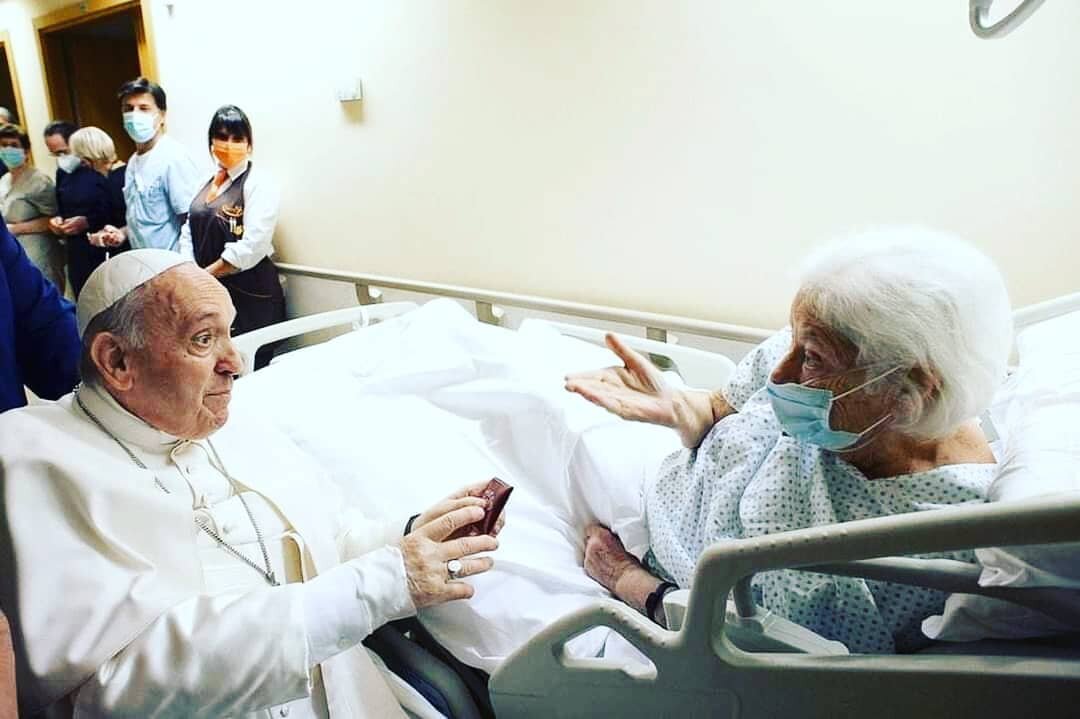
On Friday, February 4, 2022, two members of the Priestly Fraternity of St. Peter, Fr. Benoît Paul-Joseph, Superior of the District of France, and Fr. Vincent Ribeton, Rector of St. Peter’s Seminary in Wigratzbad, were received in private audience by the Holy Father, Pope Francis, for nearly an hour.

During the very cordial meeting, they recalled the origins of the Fraternity in 1988, the Pope expressed that he was very impressed by the approach taken by its founders, their desire to remain faithful to the Roman Pontiff and their trust in the Church. He said that this gesture should be “preserved, protected and encouraged”.

In the course of the audience, the Pope made it clear that institutes such as the Fraternity of St. Peter are not affected by the general provisions of the Motu Proprio Traditionis Custodes, since the use of the ancient liturgical books was at the origin of their existence and is provided for in their constitutions.

The Holy Father subsequently sent a decree signed by him and dated February 11, the day the Fraternity was solemnly consecrated to the Immaculate Heart of Mary, confirming for the members of the Fraternity the right to use the liturgical books in force in 1962, namely: the Missal, the Ritual, the Pontifical and the Roman Breviary.

Grateful to the Holy Father, the members of the Fraternity of St. Peter are in thanksgiving for this confirmation of their mission. They invite all the faithful who feel close to them as a spiritual family to attend or join them in prayer at the Mass tomorrow, on the feast of the Chair of St. Peter, and to pray for the Supreme Pontiff.

**

The Holy Father Francis, grants to each and every member of the Society of Apostolic Life “Fraternity of Saint Peter”, founded on July 18, 1988 and declared of “Pontifical Right” by the Holy See, the faculty to celebrate the sacrifice of the Mass, and to carry out the sacraments and other sacred rites, as well as to fulfill the Divine Office, according to the typical editions of the liturgical books, namely the Missal, the Ritual, the Pontifical and the Roman Breviary, in force in the year 1962.

They may use this faculty in their own churches or oratories; otherwise it may only be used with the consent of the Ordinary of the place, except for the celebration of private Masses.

Without prejudice to what has been said above, the Holy Father suggests that, as far as possible, the provisions of the motu proprio Traditionis Custodes be taken into account as well.

Given in Rome, near St. Peter’s, on February 11, the Feast of Our Lady of Lourdes, in the year 2022, the ninth year of my Pontificate.

Francis

Can Human Rights Exist Without God?

Dr. Kevin Hay

During a recent discussion, I was embarrassed to discover that I could not prove that Human Rights are Inherent and Immutable. Worse: I couldn’t even show that we have Human Rights! An argument against Homo Sapiens having unique ‘Rights’ arises from the probability that we are not the only advanced species in the Universe.

There may be billions of sentient life forms— so, why would humanity have special Rights? (“There are up to 19,000,000,000,000,000,000,000 stars similar to ours with at least one planet similar to Earth.”) The good news is that ‘Faster Than Light’ travel is highly improbable, so alien rights are moot!

After mulling on the Human Rights conundrum without finding a satisfactory answer, I took to Netflix for distraction! Curiously, the final episode of “Afterlife,” gave glimmers of insight. Afterlife was written, produced, and directed by atheist and comedian, Ricky Gervais. He also plays the main character of Tony Johnson, who is suicidally depressed after the death of his wife from cancer. For most of the series Tony is consistently horrible to people and considers this to be his ‘super-power’!

[SPOILER ALERT!] In the final episode, after watching pre-recorded messages from his wife, Tony comes to the realisation that his ‘superpower’ is being kind to other people. He even manages to tell the odd white lie to protect the feelings of others, rather than lambasting them with his usual brutal honesty! The clip below is of Tony, a reporter for the local paper, interviewing children with cancer.

Gervais paints a beautiful image of life, love, death, and reconciliation. He gives us his view of an afterlife, a ‘supernatural state.’ Religions obviously focus on ‘God’ and supernatural states first. Only secondly, do Religions show us how to live a good life. Christ gave the simplest instructions of all: Love your God and Love your Neighbour.

Gervais may be light on the God bit, but he seems to be doing well on the “Love your neighbour” part.


The misnomer of ‘Human Rights’

Humans are happiest when caring for others: our families, then friends, community, and extended affiliations / humanity.

A weakness in atheism and secular societies is the abandonment of guides like the Holy Bible, the Torah, the Koran, etc. Humanity came precipitously close to self-destruction during WWII, so we developed an alternative moral roadmap: the UN Declaration of Human Rights, 1948. Some countries have similar documents, including the Magna Carta Liberatum (the Great Charter of Freedoms) in England, 1215 A.D.; the Declaration of Independence in the US, 1776; and the Charter of Rights and Freedoms in Canada, 1982.

These Declarations and Charters define ‘Human Rights,’ but they are much better perceived to be our Responsibilities to fellow human beings. Responsibilities show us how to start loving our neighbour.

This was poignantly said by Aleksandr Solzhenitsyn:

“We hear a constant clamor for rights, rights, always rights, but so very little about responsibility. And we have forgotten God. The need now is for selflessness, for a spirit of sacrifice, for a willingness to put aside personal gains for the salvation of the whole Western world.”

Are human responsibilities immutable?

Quick answer: Yes!

This answer is from a Moral Absolutist position, which brings us to certain definitions:

Moral Absolutism: “Moral Absolutism is the ethical belief that there are absolute standards against which moral questions can be judged, and that certain actions are right or wrong, regardless of the context of the act.” (As in something is either “Right” or “Wrong.”)

Moral Relativism: “the doctrine that knowledge, truth, and morality exist in relation to culture, society, or historical context, and are not absolute.” (As in, this is ‘My’ Truth.)

Post-Modernism (abbreviated from Wikipedia): An intellectual stance defined by opposition to epistemic certainty and the stability of meaning. Post-Modernism dismisses objective facts as naive realism and is characterized by self-referentiality, epistemological, moral relativism, pluralism, irony, irreverence, and eclecticism; rejects the ‘‘universal validity’’ of binary oppositions, stable identity, hierarchy, andcategorization. (As in “Nothing is a fact.”)

The legal definitions we use for Human Rights and Responsibilities are limited by our capacity to conceptualize such intangibles, and our ability to explain them through language.

Relativists will claim that Rights and Responsibilities are not inherent or immutable, because they ‘are granted by others’ (e.g. by governments.) They claim that Rights and Responsibilities can vary according to the situation: indeed, they can be denied, but they cannot be nullified.

Our responsibilities to others do not vary particularly unless there is a major overriding reason, such as the need for self-defense when dealing with a violent person. Typically, what varies is our attentiveness to the task.

Moral Absolutism and Double Effect

Mainstream religions hold positions towards Moral Absolutism. Some have accused the Catholic Church of changing what it deems to be ‘moral’ at times.

This can arise when a situation is analyzed using the principles of Double Effect. There are four criteria and all four must be fulfilled for an action to be considered moral.

  • The aim of the action must be good, or at least morally neutral.

  • The good effect must come directly from the good action.

  • The evil effect must not be desired but only permitted (and so long there is no other reasonable choice.)

  • There must be a sufficiently grave reason for permitting the evil effect to occur.

This means that one may NOT act immorally even for a good outcome (e.g., one cannot intentionally kill an innocent person to save other lives.)

Applying Double Effect to Abortion, shows its immorality in every clause:

1. The aim of an abortion is the death of an innocent human being (so is not good, nor neutral.)

2. All ‘good effects’ arise from the deliberate killing of an innocent person, so they do not come from a ‘good action’.

3. There are reasonable alternatives (e.g., adoption) and the evil effect — the death of the child — is the desired outcome.

4. The mother’s circumstances cannot be so grave as to outweigh the killing of an innocent human being.

Pro-Aborts always bring up the issue of treating some serious illness in a pregnant woman. Using Double Effect, it appears to be moral to fully treat a seriously ill pregnant woman, even if the treatment might lead to the death of her child, so long as there is no otherreasonable treatment choice and that outcome is an indirect and unwanted consequence of the treatment.

The optimism of Christianity

Relativism seems more “user-friendly” than Moral Absolutism because its believers can rationalize most every situation to suit themselves! (“self-referentiality.”) This can lead to the complete abrogation of all personal responsibility — little wonder it is so popular.

Post-Modernism is an easy philosophy to ascribe to, but it seems pitifully negative. Imagine believing that nothing has innate value, consistency, or validity…ever. So depressing. It must be hard for an Atheist or Humanist to maintain a consistently moral stance through times of doubt. Religions support us through dark times and give us hope and a sense of continuity into an afterlife. Catholic ideas of redemption and forgiveness are wonderfully reassuring.

It is clear why dictators repress Religion. If Pol Pot and his followers had any sense of love of their neighbour, Cambodia might have avoided the Killing Fields. We do not have to look far to see worrisome examples today.

The Bible encapsulates all of this in just one sentence:

‘But the greatest of these is love…’

Benedict in Way of German Synodal Path - Gänswein

To observers of the church, there was something quite strange about the timing of the attack on Pope Benedict XVI’s character in January 2022.

The correction of a minor mistake in a mammoth 1,000 page report quickly escalated into apparent implication into the abuse contained within the report, with secular media outlets and liberal Catholics uniting in implying something about the story that simply did not exist.

Despite the damaging nature of these claims, not just to Pope Benedict XVI but to the whole church, very few voices had the integrity to join the pope as he defended himself from these false accusations.

Among the very few to speak up was Cardinal Dominik Duka, who wrote:

For me, this is one of the greatest disappointments I have experienced in our Roman Catholic Church. To denigrate a person, to denounce him unjustly and not even to give him the opportunity to evaluate this so-called blessing, which must have cost hundreds of thousands of euros, because it does not give the possibility of a legal reprieve? I ask: what is that?

I point out the following fact: that from the entire record, any priest who has studied church law, or even a layman who has graduated from a theological faculty and attended a course in church law, must understand that the then Archbishop of Munich, Joseph Ratzinger, had no jurisdiction and no possibility of resolving this case in any way - the priest X. in question was a priest of the diocese of Essen.

Therefore, I protest and indeed take the liberty of calling the Archbishop of Munich, his curia, and the President of the German Bishops' Conference to account for the defamation and tarnishing of the reputation of Pope Benedict XVI!

Those particular facts undermined virtually of the misleading propaganda being proposed by mainstream media and liberal Catholics.

These facts have been elaborated upon in a subsequent interview with Pope Benedict XVI’s secretary Georg Gänswein.

Gänswein told ETWN:

You know the history - there was a mistake after the munich report was published. But this was not a mistake on the part of Pope Benedict, as he himself indicated in his letter. The appendix explains how this happened. It was an accident that unfortunately happened. It should not have happened. But it happened.

I still remember, when we were going through a statement he sent to the law firm, how during the last block of "questions and answers" he said: "I don't remember that meeting - the famous one - on January 15, 1980. But if it says that I was not present, then that absence is proven — or was proved then — thanks to a document from that meeting." And that's where the mistake happened. "So if it says I was absent, I accept that. I said, "Holy Father, it's in the digital documents we just checked, so we can assume it's true." Again, it was not checked, not at all. It only reappeared when the report was presented and one of the experts said: Benedict was present, not absent. I was in shock and the others were in shock too. And then we checked it again. And indeed, there was a mistake. I told Pope Benedict and he said: "We must immediately say that this was a mistake on our part." It wasn't intentional, so it wasn't a lie — the lies are deliberate; it was a mistake. "We have to say it as soon as possible," he insisted. "Prepare a press release, discuss it with the Secretariat of State, and then move on."

As well as elaborating upon the 8,000 pages of files that Benedict was required to sift through, Ganswein echoed Cardinal Duka’s comments by stating:

The minutes of this meeting state: "Archbishop Cardinal Ratzinger present"; the then Vicar General was not present. He was absent. Responsible workers received a request from a German diocese to ask if a priest who would come to Munich for treatment for a certain period of time could stay in the Munich parish. That was the subject of the meeting. The diocese's request was granted. "We appoint a priest or a parish priest in whose rectory he can stay," it was said. It wasn't about content at all. That is, it was only a question of whether this request should be granted or not. And cardinal Ratzinger present, of course, agreed: Of course, if we can help, we will help. What happened later, the cooperation here, the cooperation there, was already beyond his consciousness. At that time, there was no talk of it at all. Also, the reason for the therapy that he could have been a pedophile priest was never mentioned. There is no mention of this in the protocol. The claim that he knew about it, that he protected and covered him is simply a lie. And I have to say quite frankly: It's slander. It's just not true. You have to know the facts as they are, and also accept the facts as they are. And then I can interpret them. But I can't put the chariot in front of the horse. I just can't. That is insinuation. And that ultimately takes away Pope Benedict's moral credibility, and then he can no longer defend himself.

But let me answer the question you asked me earlier – you are absolutely right. Benedict said in writing the letter: "It should be a very personal letter. And that's why there's this distinction between my letter and the appendix. So that people can see that it is my letter, a letter that I wrote, and an appendix that is the work of four co-workers whom I know and approve." But this letter is something he wrote, if you will, in God's presence. The last paragraph is perhaps the key to everything. He says, "Quite soon I will find myself before the last judge of my life," before the gracious judge.

In fact, this was not the first time he had apologized to victims of abuse. I remember very well, and this is also mentioned in the letter, that during his travels as Pope he often met people who had been sexually abused by priests. These meetings were very emotional, always in the chapel, without the presence of the press, always beginning in the chapel with a short prayer and then followed by a meeting. And then I could see the effects of those meetings. And this is a simple presentation of the facts. Many of the victims then testified, whether on radio or television, how this meeting benefited them and relieved them of all the pressure, the heaviness. Benedict always said: Every victim of abuse is too much, every case of abuse is too much, and as a result it cannot be corrected. The only thing that can help is a plea for forgiveness and also a kind of plea for these people to be entrusted to God's protection.

Most interestingly, he comments on the German Synodal Path by stating:

Certain goals that the Synodal Way is aiming at are something for which the person and the work of Benedict stand in the way. And there is this great, great danger that everything that has to do with pedophilia and abuse is now taken monocausally, so to speak, in order to open this Way first and then go down that road. Last week we saw what texts were passed, and where this is supposed to lead.

The Synodal Way is an event that, theologically or ecclesiastically speaking, does not correspond to a synod. It's an event that can be held, and they can also produce texts. But these texts are not binding in any way, and certainly not for the life of the Church. We will see to what extent the results of these texts can be fruitful — or not — for the process of the world Synod. I am convinced that they will not be fruitful. If I want a different Church that is no longer based on revelation, so to speak, if I want a different structure of the Church that is no longer sacramental but pseudo-democratic, then I must also see that this has nothing to do with Catholic understanding, with Catholic ecclesiology, with the Catholic understanding of the Church.

The collusion between media and liberal elements within the church appears to have brought about this coordinated attack on Pope Benedict XVI, using falsifications and the very real abuse of innocent people to achieve their goals.

It is shameful and a warning to the global church to be ready for subversive elements who are willing to exploit any issue and destroy any persons for their own benefit.

Sinn Fein Claims Debunked (VIDEO)

British raised politician Paul Gavan hit the headlines last week after claiming that ‘women and pregnant people’ were being ‘intimidated’ while trying to abort their babies in Limerick.

Gavan hilariously cited a ‘study’ by astro turf pro abortion group Together for Safety, which made several unverified claims of harassment by prolife advocates in Limerick.

As it turns out, a new video completely debunks the British raised politician’s claims about the treatment of androgynous wombed peoples in the South West.

The video, uploaded by journalist Cathal McCarthy, comically shows two gentle women named Antoinette and Meta softly stating that they pray silently in ‘solidarity with the unborn whose lives are taken’. They also said that sometimes the fathers and mothers in the maternity hospital ask them to pray for their babies.

They also stated that they do NOT approach people and in fact become quieter when people approach them.

Cathal McCarthy also asked them about Sinn Fein’s accusation regarding when abortions take place, something that was the subject of a recent scandal involving campaigner Ellen Coyne.

The women said ‘we know the hospitals that have been approved for abortion, that’s just a fact’.

They also confirmed that the hospital has no problem with them praying, even though local politicians do.

The debunking comes on the same day that Catholic Arena debunked another Limerick Sinn Fein TD’s claims that Catholics had gate crashed a ‘Vigil’ in the city. In the shocking sectarian footage, small girls are subjected to horrific sectarian abuse, similar events at Holy Cross School in 2002.

The American Imperialist pro abort shouts:

'Catholic m*therf*ckers dumb. The f*ck y'all doin? Praying to God? P*ssy sh*t'

Ireland becomes less and less serious as a country that more that politicians are allowed to behave with impunity in this fashion. Sinn Fein, Social Democrats and Labour are technically ‘opposition’ parties, yet are doing this as the minions of the government’s astro turf abortion group Together for Safety. Sinn Fein are supposed to be a party representing Catholics, yet they are dedicated to harassing and abusing Catholics, even outright lying about them and inciting death threats. Labour and Social Democrats are supposed to represent ordinary people, yet here they are slandering and abusing ordinary people.

There are some Catholics who are very ‘nice’ and ‘thoughtful and ‘kind’ and who think that this mistreatment will never target them as they quietly practise their faith, but the impending left wing government under Sinn Fein will seek to build on the anti Catholicism that the party is currently more open about engaging in.

Cathal McCarthy’s Full Video debuts this weekend, subscribe to his channel to see it.

'Catholic Motherf*ckers' Horrific Sectarian Abuse in Limerick

A month on and the fallout continues from the Far Left’s efforts to smear innocent Catholic men in Limerick.

A number of pro abortion extremists tried to exploit the tragic death of a young teacher in January, by calling for an end to single sex Catholic education (even though the suspect was not from Ireland and hence could not have been influence by our education system), while some more sinister elements tried to use it to attack Men’s Rosary Rallies.

Despite assistance from ‘journalists’ and ‘politicians’, the attempted smear has largely fallen flat only a few weeks in as footage definitively proves that it was the pro abortion group harassing those praying the Rosary and not the other way around.

In fact, in the latest footage, small little girls are being called ‘Catholic motherf-ckers’. The megaphone clad American shrieks ‘m*therf*ckers dumb. The f*ck y'all doin? Praying to God? P*ssy sh*t'.

A Sinn Fein TD later claimed that the group that included praying little girls were actually the ones in the wrong! The horrific scenes evoke memories of the Holy Cross School incidents of twenty years ago in the North, where Catholic schoolchildren were subjected to horrific sectarian abuse, the difference this time is that Sinn Fein are fully on the side of those delivering the abuse and fully against the Catholic children.

Le Pen Calls Trads 'Dodgy', Compares them to 'Nazis'

Pro abortion centrist Marine Le Pen, who some term to be ‘far right’ on immigration, has launched a scathing attack on Traditionalist Catholics in France.

The Presidential Candidate, who was ahead of Emmanuel Macron in the polls recently, appeared completely riled at losing some of her base to Eric Zemmour, the Jewish journalist who has courted the Traditional Catholic vote with some success.

Insulting both Zemmour and those who had lost faith in her pro abortion brand of ‘right wing’ politics, Le Pen said that his supporters were ‘dodgy characters’. Among those ‘dodgy characters’, she stated ‘There are traditionalist Catholics, pagans, and a few Nazis’.

The entry of Zemmour, who has defended Catholics under threat of arson and beheading in Macron’s France, coincided with Le Pen’s stagnation in the polls.

Le Pen was said to be seething today after Zemmour spoke with President Donald Trump, something that Le Pen tried unsuccessfully to do in 2017.

Le Pen’s odds of victory shortened even further with the entry of Valerie Pecresse, who is seen as a more acceptable socially conservative figure to the oft maligned Le Pen.

One thing is certain, as France watches its priests being beheaded, its Cathedrals burned to the ground and even the tombs of its kings facing being desecrated, the neo conservativism and Trad bashing of Le Pen is not going to save them.

The Forgotten Martyrdom of Saint Valentine

By Thomas Hegarty

Back in the 3rd century, under the rule of Emperor Marcus Aurelius Claudius II, “Claudius the Cruel”, Rome was involved in many unpopular and bloody campaigns. The emperor had to maintain a strong army, but was having a difficult time getting soldiers to join his military leagues. Claudius believed that Roman men were unwilling to join the army because of their strong attachment to their wives and families.

However, the Christian St Valentine of Terni, a holy priest, (some say Bishop) in Rome was said to have celebrated marriages between Christian couples in clandestine secrecy in Rome and advised married men not to go to war and to stay with their wives.
When the secret came to light, Roman Emperor Claudius ordered Valentine’s execution on 14th February 269. His martyrdom was brutally carried out by beheading.

Valentine was buried in Terni near the present Basilica, in a cemetery that already existed in pagan times, where several objects of the 4th and 5th centuries were found. A first basilica was built in the 4th century, outside the walls, on the martyr’s tomb. Destroyed by the Goths together with the city in the 6th century, it was rebuilt in the 7th.
In 1605 Bishop Giovanni Antonio Onorati, obtaining a permission from Pope Paul V, ordered to begin the search for the body of the saint. The body of St. Valentine was soon found in a leaden box containing a marble urn, rough outside but carved with reliefs inside. The head was separated from the torso which confirmed death by beheading. The urn was immediately taken to the cathedral. But the people and the Congregation of Rites wanted that the relics of the martyr continued to rest where they had been buried. So it was decided to build a new basilica on the site.
In 1630 the relics were deposited in an artistic ark consists inside a supine statue. The statue could be seen up to some years ago under the main altar rebuilt by Archduke Leopold. Valentino’s tomb was moved to the new altar in 2003. In the same year, the skull that had been stolen from the tomb in 1979 was returned to Terni.

The original religious celebration named after the Christian saint and martyr Saint Valentine of Terni was established by Pope Gelasius I in 496, to replace the previous pagan festival of Lupercalia. The festivity spread especially in France and England by means of the many monasteries of the Benedictines, who were in charge of the Basilica of Saint Valentine in Terni from the second half of the 7th century.

Dublin’s Valentine Shrine

The Whitefriar Street Carmelite Church (Church of Our Lady of Mount Carmel) in Dublin is unexpectedly one of the city’s most romantic spots. Many are drawn here because the church holds the relics of Saint Valentine, a gift from Pope Gregory XVI in 1836, a small vial of Saint Valentine’s blood. This shrine contains “some” sacred body parts of Saint Valentine the Martyr, together with a small vessel tinged with his blood. They were given to the church by Pope Gregory XVI. They’re kept in a casket on an altar to the right of the main altar. The Shrine to St. Valentine is found on the right hand side of the church as you enter. The casket sits beneath the marble altar in a niche which is protected by an ornate iron and glass gate. Above the altar stands the life-sized statue of the saint set into a marble mosaic alcove.
Today, the Shrine is visited throughout the year by couples who come to pray to Saint Valentine and to ask him to watch over them in their lives together.

Prayer to Saint Valentine
Dear Lord, who art high in the Heavens,
Giver of Love and Passion,
And He who strings the heart’s cords,
Lead the Lovers this day, February ten plus four.
The day during the month of two,
When the date is the perfect number of God
Greater two souls and two hearts.
Some Loves are fleeting ,
But that which is built on you will never fail.
So guide the Lovers to know what is to be.
Your truths the Lovers’ mouths should speak,
For Your truth is that which is honest to the heart.
Only this, then, should pass over the red lips of the Lovers.
Your art, the Lovers simply a medium.
It is only with True Hearts that You can create a Masterpiece,
So let the Lovers remember that their Soul’s Desire
Is the one for which You light their Fire.
And let it be You who creates the Art of the Lovers;
The art of two into one.
Amen.

Subscribe to the Friends of the Parish Substack

Sinn Fein Calls Prayer 'Intimidating'

On the same day that they celebrated Queen Elizabeth’s rule over Northern Ireland, Sinn Fein have stated that prayer should be banned from near abortuaries because it ‘feels’ intimidating.

Frustrated at the fact that their unsubstantiated efforts to paint prolife people as aggressive had failed, Sinn Fein resorted to stating that mere feelings, rather than any actual evidence, should dictate laws in Ireland.

Lynn Boylan, who curiously made a trans exclusionary speech that failed to mention ‘pregnant people’, stated:

I cannot but mention Senator Mullen's comments. He continuously comes into the Chamber and talks about having respect for the people who voted "No" in the repeal the eighth amendment referendum. He is right. Absolutely everybody has a right to their democratic vote and to be respected for that vote. However, he is not listening to what the women who are trying to access healthcare are telling him. We recently had a debate in this Chamber about violence against women. We all talked about how women's voices need to be listened to. People need to listen to the experiences of women. Women are telling us they are intimidated and frightened, and there is a chilling factor in accessing healthcare. Senator Mullen is entitled to his opinion on this - that is absolutely fine - but I am asking him to open his ears and to listen to what women are telling him. They feel intimidated.

Senator Mullen can refer to those involved as decent people, mainly older people, or say they are reflecting in quiet prayer. He can say all of that. It does not matter what they are doing. The reality is that the feeling of the person they are doing it to is one of intimidation. I ask Senator Mullen to reflect on that and to listen to what those experiencing it are telling him. That is all I ask him to do. I fully support him in saying we have to respect people's different views, but when women are telling him they are being intimidated, he must listen to the voices of the women who are being intimidated.

For your consideration, here is some of Sinn Fein’s recent behaviour towards Catholics.

'Women and Pregnant People' Need Abortions Claims Sinn Fein

On a day where their leader celebrated the reign of Queen Elizabeth over Northern Ireland, English raised politician Paul Gavan bizarrely claimed that ‘Women and pregnant people’ were being affected by unspecified anti abortion protests.

Gavan, who works as a Senator, appears to have been insinuating that men can carry and give birth to children, which is not true.

The English raised Sinn Fein member, who works a Senator, also bizarrely claimed that ‘women and pregnant people’ were being ‘targeted’ as they arrived to have their baby aborted. In what way? No evidence was provided, but a vague allusion was made to an astro turf pro abortion group called Together For Safety.

The English raised Sinn Fein member, who now works as a Senator, stated:

he Minister is very welcome. I thank him for taking the time to attend. I am really pleased to be able to move to Committee Stage of the Safe Access to Termination of Pregnancy Services Bill 2021. While Sinn Féin is very proud to be supporting it, I must stress the cross-party nature of the campaign behind it. The Bill has been co-signed by members of Sinn Féin, the Labour Party, the Civil Engagement Group, the Green Party and Fianna Fáil, as well as by the father of the House, Senator Norris.

A Bill has been commissioned and drafted by Together for Safety, a national campaign group working for legislation that would enforce safe access zones around all family planning centres, maternity hospitals and healthcare facilities in Ireland that provide or give information on abortion. All credit for this legislation belongs to Together for Safety and its tireless campaigners across the country. I am thrilled to have three of the many activists from Together for Safety in our Chamber this afternoon, namely, Karen Sugrue, Yvie Murphy and Victoria. I thank them so much for the work and the tireless campaigning that they brought to this Bill and for the broad coalition of support for this Bill, which was built by Together for Safety. It is a tremendous achievement.

I will be brief because we have just a couple of hours to progress this legislation through Committee Stage. I want to be clear that we need this legislation without further delay, because women and pregnant people are entitled to access essential healthcare, including access to termination of pregnancy services, in privacy and dignity, without being subject to intimidation, harassment and the subtle but deliberate chilling effect that anti-choice protestors bring to hospitals, family planning and GP settings across the State. I know that the Minister was informed in the past week of a disturbing new development in my home city, Limerick, where the timing of these anti-choice protests is now coinciding with the timing of appointments for terminations. It is clear, from a number of people who have spoken to Together for Safety, that information is being leaked. These protestors are now targeting women and pregnant people as they arrive for their terminations. That is disgraceful, and it speaks to the urgency required in respect of this Bill. We introduced this Bill three months ago. I was delighted by and appreciate the fact that the Minister allowed the Bill to pass Second Stage. He said that we are all on the same page. I believe we are. It is important to move this Bill forward.

I look forward to the remainder of this Committee Stage debate. A number of the amendments are in response to concerns the Minister raised on Second Stage. We look forward to working with him in order that we can move the legislation forward as a matter of urgency and give women and pregnant people the protection that they deserve, which is already in place in a number of jurisdictions across the world. We need to deliver that as quickly as possible for our people in this State.

Blessed Anne Catherine Emmerich's Vision of the Mass

The following is an extract from Blessed Anne Catherine Emmerich’s Visions. February 9th is her Feast Day.

It reflects on the Mass and importance of giving ourselves entirely to each one.

After seeing at night in my sleep the fearful picture of the murdered child on my right hand, I turned over in horror in my bed, but saw it again on my left hand. I begged God most earnestly to free me from this dreadful sight. I woke up and heard the clock strike. My heavenly Bridegroom said to me, pointing round Him as He spoke: See far more evil that befalls Me every day at the hands of many throughout the whole world.' And as I looked about me into the distance, many things came before my soul which were indeed still more dreadful than that sacrifice of children; for I saw Jesus Himself cruelly sacrificed on the Altar by unworthy and sinful celebrations of the Holy Mysteries. I saw how the blessed Host lay on the altar before unworthy degenerate priests like a living Child Jesus, whom they cut and terribly mutilated with the paten. Their sacrifice, though an efficacious celebration of the Holy Mysteries, appeared like a cruel murder.

The same cruelty was shown to me in the heartless treatment of the members of Christ, His followers, and God's adopted children. I saw at the present time countless good, unhappy men being everywhere oppressed, tormented, and persecuted; and I always saw that it was Jesus who suffered this ill-treatment. The times are terrible; a refuge is no longer anywhere to be found; a dense cloud of sin lies over the whole world, and I see men giving way to the worst crimes with complete indifference and unconcern. I saw all this in many visions while my soul was being led through many lands over the whole earth. At last I came back to the visions of the Feast of Mary's Conception.


Fianna Fail Confirms Plan to Ban Prolife Prayer

Only weeks after her party colleague Conor Sheehan smeared Catholics praying the Rosary in Limerick, pro abortion politician Ivana Bacik asked a question in the Dail today which addressed her party’s desire to see Catholics and prolife demonstrators banned from their right to free speech in public.

Sheehan had abused his power as an elected representative to spread a now debunked theory which claimed that Catholic men had interrupted a ‘Vigil’ (which was actually an event organised by a pro abortion group, who brought pro abortion signs with them) for a teacher who was murdered. Sheehan and Sinn Fein TD Maurice Quinlivan both claimed on social media that the men had ‘shouted over’ the ‘Vigil’, even though videos have since debunked these bizarre claims. Neither Sheehan nor Quinlivan have yet apologised publicly.

Pro austerity party Labour have lately tried to use anti Catholicism and radical pro abortion politics as a means to squeeze their way back to relevance, having created a homelessness and emigration in the past decade with their psychotic cutbacks as part of the puppet government that carried out the will of the International Monetary Fund in the 2010s. Labour were clever enough to join Fine Gael in using abortion and other social topics to soften the blow of austerity for the Irish people.

In the Dail today, Bacik asked pro abortion Taoiseach Michael Martin if legislation to target the free speech of prolife people will be brought forward.

The pro abortion Martin stated that the government were preparing a bill.

Bacik did not provide a single instance of prolife people mistreating women accessing those ‘services’ designed to ensure the controlled demolition of the unborn child. Instead, she mumbled something about an astro turf pro abortion group’s claims, to which the hapless Taoiseach (who will soon surrender his position to Leo Varadkar) said ‘that is very troubling’.

Ireland has now essentially become a one party state, with the only major differences being between personalities, not policies.

Even those who were elected on prolife promises, such as Fianna Fail’s Jack Chambers, have since been steadfast in their opposition to the prolife cause and to the unborn child.

With the upcoming ‘review’ into Ireland’s abortion legislation set to be a whitewash, Catholics can only learn to pray for an end to this gruesome violence against the unborn.

There will be a series of Prolife Vigils at Saint Saviour’s Dominick Street Dublin, beginning 19th February.

Cardinal Duka Defends Pope Benedict XVI

While some Catholic commentators have thrown Pope Benedict XVI under the bus after media distortions of recent developments regarding abuse in German church, others have taken the time to study the case for themselves.

Liberal Catholic commentators have been all too quick to call Benedict XVI ‘tone deaf’ for merely defending himself, dismissing his explanation of events as a ‘non apology’. This is despite Benedict insisting that he had been given the support of Pope Francis in this matter:

To me it proved deeply hurtful that this oversight was used to cast doubt on my truthfulness, and even to label me a liar. At the same time, I have been greatly moved by the varied expressions of trust, the heartfelt testimonies and the moving letters of encouragement sent to me by so many persons. I am particularly grateful for the confidence, support and prayer that Pope Francis personally expressed to me.

One voice that has strongly stood up for the pope is Czech Cardinal Dominik Duka OP, who has released a powerful statement questioning the Archbishop of Munich for his role in assigning blame to Benedict, when the priest in question was not under his jurisdiction, but that of the Diocese of Essen.

Read Cardinal Duka’s remarks below:

''The publication of the Pope's letter is truly a glimpse into the soul of a priest, bishop and pope who is reflecting back on his life but no longer has the strength to comment on all its particulars.

What follows is an analysis by the experts mentioned above, who show us line by line how the so-called blessing is handled in the Archdiocese of Munich. For me, this is one of the greatest disappointments I have experienced in our Roman Catholic Church. To denigrate a person, to denounce him unjustly and not even to give him the opportunity to evaluate this so-called blessing, which must have cost hundreds of thousands of euros, because it does not give the possibility of a legal reprieve? I ask: what is that?

In my article, which will appear in the German magazine Die Tagespost, I point out the following fact: that from the entire record, any priest who has studied church law, or even a layman who has graduated from a theological faculty and attended a course in church law, must understand that the then Archbishop of Munich, Joseph Ratzinger, had no jurisdiction and no possibility of resolving this case in any way - the priest X. in question was a priest of the diocese of Essen.

Therefore, I protest and indeed take the liberty of calling the Archbishop of Munich, his curia, and the President of the German Bishops' Conference to account for the defamation and tarnishing of the reputation of Pope Benedict XVI!

Dominik Cardinal Duka, Archbishop of Prague

Rallies Held In Support Of Fishermen

By Gregory Murphy

Irish Society for Christian Civilisation – ISFCC, an organisation of lay Catholics, held three Rosary Rallies between Thursday and Saturday in Castletown-Bearhaven, Bantry, and Kinsale praying to St. Peter to protect our fishermen and in order to promote the message of Our Lady of Fatima, specifically Our Lady's warning about Russia – it will spread its errors.” The volunteers and friends of ISFCC also gave out 500 hundred rosaries, miraculous medals, and scapulars to the fishermen.

However, the Rosary Rallies were the focus of attention due to the 9ft banner which read, “Praying the Rosary for Ireland. Please join us! St. Peter protect our fishermen! Our Lady of Fatima, preserve us the `errors of Russia!`” The participants prayed the Joyful, Sorrowful and Glorious Mysteries of the Rosary and sang Marian hymns between each decade.


Rory O’Hanlon, who led the Rosary Rallies, said that “We are here for two reasons. First to thank and encourage the fishermen here for standing up to the Russian Navy, and second to remind people of Our Lady of Fatima’s warning of the “errors of Russia”, that is, Communism.”

When the Russian Navy announced their intention to do live fire drills in Ireland’s Exclusive Economic Zone, the West Cork fishermen took matters into their own hands, threatening to disrupt the drills with sixty fishing trawlers. This threat succeeded in making the Russians change course away from their plans that not only disrespected the livelihood of the West Cork community, but also disregarded the right to private property, which Communism hates so much.

Rosary Cork

Damien Murphy, a volunteer of ISFCC, stated that, “The response of the locals to the rallies has been great.” He explained that the participants of the Rosary Rally in Castletown-Bearhaven were all invited to have a cup of tea in Murphy’s Restaurant after the gathering. The passers-by often stopped to join in with the Rosary Rallies or to make the sign of the cross and many took photos and gave thumbs up in support. One lady heard the rosary from her home and joined the rally.

After the Rosary Rallies, volunteers and friends would proceed to the bars, cafés, butchers, and other shops to distribute scapulars, rosaries and miraculous medals to the fishermen. They did this in Castletown-Bearhaven, Kinsale, Union Hall, Skibbereen, and Bantry. One worker at the fishermen Co-op asked for at least two dozen miraculous medals to hand out to the fishermen.

Patrick Murphy took two dozen miraculous medals for his men as well as Alan, skipper of the Syracuse, who took a bunch of miraculous medals for each of his crew members and said, “You’re doing great work!”  The Chef’s Table also gave out doughnuts.

The idea of public square Rosary Rallies isn’t new. Since 2010, Irish Society for Christian Civilisation has organised hundreds of Rosary Rallies. On October 14th, 2017, ISFCC organised two hundred Rosary Rallies across Ireland in commemoration of the centenary of Our Lady of Fatima.

Organiser, Rory O’Hanlon, concluded “What we are asking people to do is what Our Lady asked of us at Fatima, prayer, penance and amendment of life. Because at the heart of every crisis in the world today lies a moral problem. And it is through the rosary especially that God gives us the wisdom, prudence and confidence to solve our problems.”


Irish Men's Rosary Continues to Grow

The Year of Saint Joseph brought many great fruits to the church.

One of them was the Men’s Rosary Rallies which reclaimed the streets of Poland from proxy warriors for the abortion industry who attacked churches in 2020 and 2021.

These images of men lining the streets of major cities and towns and kneeling in prayer together have now inspired others to get involved in various locations across the world.

The initiative has really taken off in Ireland, with initial Rosary Rallies in Derry and Newry leading to many towns and cities announcing synchronised events involving thousands of Irish men.

In the biggest day yet, yesterday saw Rosaries in Omagh, Dublin, Tralee and Knock amongst others.

The event in Omagh built on the successes of recent events in the North, with a large crowd of men kneeling in the lashing rain.

In the South West of Ireland, Tralee was the location for Catholic men stepping outside and praying in public.

The Marian Shrine at Knock, County Mayo probably had the coldest looking conditions for a Rosary but many man endured nonetheless.

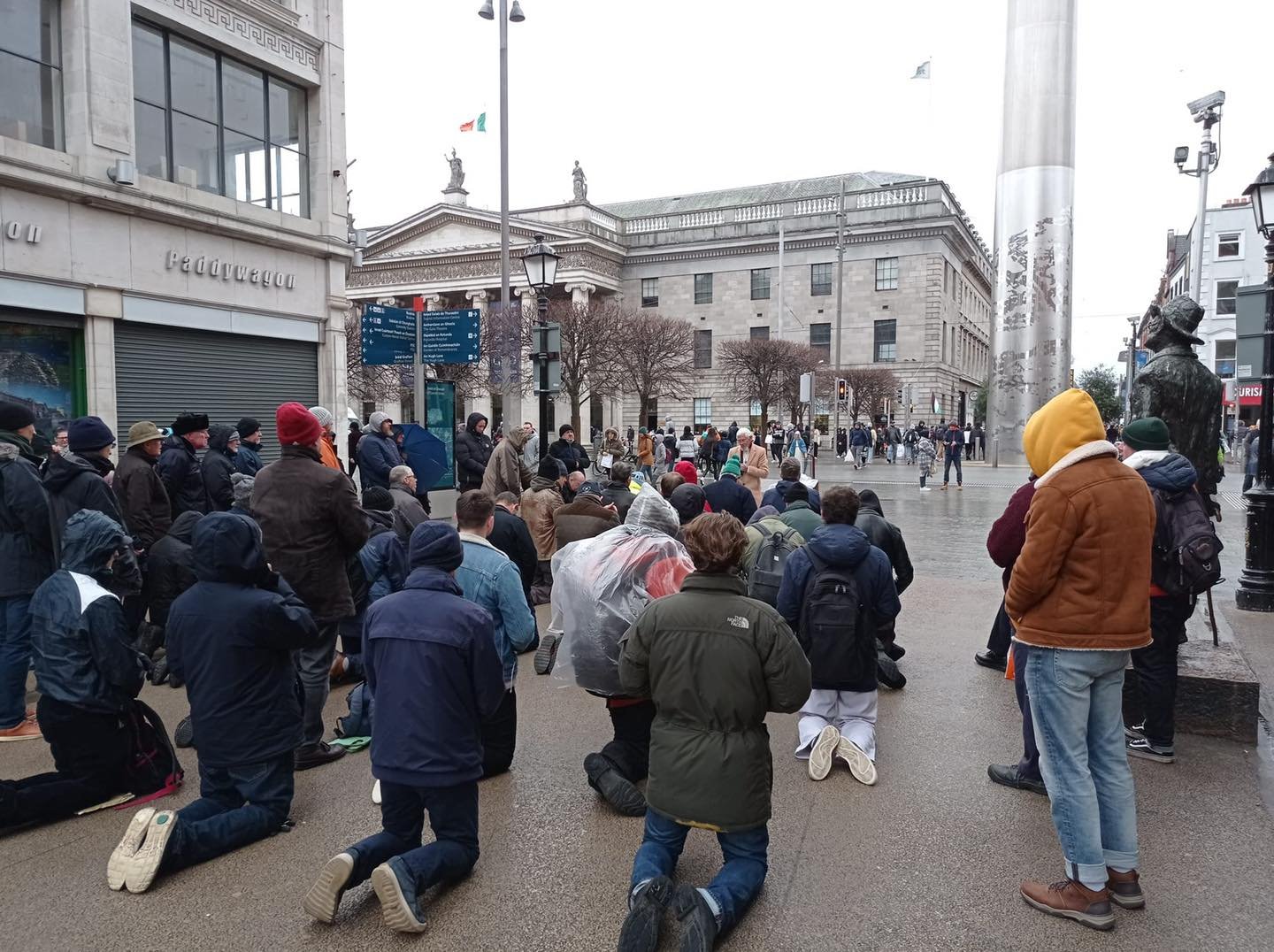
In the capital city of Dublin, a crowd gathered near the Spire.

The Men’s Rosary is a simple, yet effective manner of bringing about a renewal of the Catholic faith, both in Ireland and across the world.

You can keep up to date with the latest news at mensrosaryireland.com


Ireland's Catholic Underground

2022 marks the centenary of the Legion of Mary, the Irish church’s greatest success in the Twentieth Century.

From confronting Communism in China and North Korea to confronting poverty in South America and Africa to confronting atheism in the West, Frank Duff’s visionary apostolate has amassed tens of millions of followers.

As part of the celebrations for their centenary, the Legion are running a series of Men’s Conferences throughout the year. The Morning Star Hostel, which provides accommodation, food and spiritual support for men in need, has hosted the first two events.

The second one involved Father Brendan Kilcoyne, of the Brendan Option podcast, hosted by Immaculata Productions who filmed the event for Youtube.

In a wide ranging keynote speech, Father Kilcoyne spoke about the upcoming Synod and the dangers of being too tame in conversations surrounding it. He also spoke about the need for Catholics to be unafraid of what they have to offer the world, a world which as Father Kilcoyne puts it, has little in the way of philosophical thought underpinning it.

The event is part of what Father Kilcoyne calls the ‘Catholic Underground’, a part of the burgeoning undercurrent of renewed faith and dynamism of spirituality that is taking place away from the mainstream establishment. Impressed with the turnout and vibrancy in the room, Father Kilcoyne asks, ‘Who knew that Catholic Underground was so big?’

How fitting that it takes place in so meek yet powerful of a place as the Legion of Mary headquarters.

Starting from those humble beginnings in Dublin, the Legion of Mary grew to encompass presidiums in China, South America and Africa, surviving and even thriving amongst poverty, tyranny and violence.

Frank Duff, if you are not familiar with him, was a civil servant who had a remarkable perception of theology and of its practical implications within the world. He had worked for Michael Collins and later for WT Cosgrave during the early years of the state. The Legion of Mary may have an image of being non confrontational, but when it came to proclaiming the gospel, Duff’s zeal for apostolic work was anything but. Fr. Thomas O’Flynn C.M. wrote in his book Frank Duff As I Knew Him:

He had unflinching honesty in asserting what he believed to be the truth. Sometimes at the Pauline Circle, the ecumenical group run by the Legion, I would wince at the fortrightness with which he put forward the teaching of the church to our separated brethren. But even if they did not always agree with him they respected him for his honesty.

He was a fighter, never afraid to defend his corner when the interests of the faith or the Legion were at stake. This courage was part of the psychological gear necessary for his task. When he was launching the new movement in the lay apostolate that later became known as the Legion of Mary he had encountered opposition: sometimes from people in high places. A pioneer in any walk of life needs courage. Frank Duff had it in plenty.

Duff was largely overlooked by the hierarchy in Ireland and one can only wonder how different the history of Twentieth Century Catholicism in Ireland would have been had he been listened to.

In a talk published on the Iona Institute website, Duff’s biographer Finola Kennedy wrote of how Duff broke the norms of secular culture in trying to help unmarried mothers to gain stability in their lives, housing them in his hostel The Regina Coeli. She wrote:

Duff’s special sympathy for unmarried mothers was at odds with the mores of the time when the consequences of an extra-marital birth were disastrous, rendering both mother and child social outcasts. He was probably close to the view of the writer George Moore who in his powerful novel, Esther Waters written at the end of the nineteenth century, tells the story of a mother’s fight for the life of her illegitimate son. Moore wrote, ‘Hers is a heroic adventure if one considers it – a mother’s fight for the life of her child against all the forces that civilisation arrays against the lowly and the illegitimate’.

Anyone who has ever visited Frank Duff’s house in Dublin will notice that in his living room, one finds copies of National Geographic, travel books and encyclopedias concerning every part of the globe and various dictionaries for other languages. The inception of the Legion coincided with the birth of international travel through airplane and also the missions of Irish priests, particularly the Columbans, to the Far East and elsewhere.

One of the most famous examples of these was Fr. Aedan McGrath SSC.

In his book Navan to China, McGrath tells the story of Chinese Legionaries who exhibited profound faith as he had witnessed on countless occasions since his first arrival there in 1930. One of the most striking of these was one where he says:

Under the most trying of circumstances, the Legionaries behaved splendidly in every way. On one occasion a drunken Army Official, who was suspicious of the Praesidia meetings, wildly broke into a junior meeting when the young girls were reciting the Rosary. As he strode into the room, swearing vengeance on all and sundry, not one little head turned: the Legionaries continued their prayers uninterrupted under the leadership of the young girl President! As he surveyed the scene, the officer’s face changed completely, he removed his cap, bowed his head reverently and quietly left the room - conquered by a group of little Legionaries praying to the Mother of God!'

How proud I was of the behaviour and spirit of my Legionaries both on this occasion and at other times when bombs and shells were dropping thickly all around the Mission.

McGrath also told of how in 1946, Pope Pius XII had sent word to the Chinese church to follow the model of the Legion of Mary so as to reach millions of Chinese people with the Good News. Pius XII was not naive however and told them:

You are going to be expelled sometime and in the meantime it is vital that you build up a framework which will caretake the Church in your absence, and that instrument lies ready for you in the Legion.

The Chinese bishops became familiar with the Legion handbook as a means of educating themselves with this new tool. The Chinese Communist Party were completely terrified of the Legion of Mary, it put women into positions of authority, it had no clear centralised structure and it seemed to be spreading like wildfire. Most terrifyingly, it carried with it the name of ‘Legion’ and other Roman inspired paraphernalia.

They tried to paint the Legion as a tool of Imperialism in order to deter Chinese people from joining it.

McGrath writes:

The legion was charged with being ‘reactionary’ at several ‘accusation meetings’ convened by the city authorities. The accusations were sustained, but the ‘reasoning’ at these mass meetings followed the line that ‘foreign priests’ were influential in organising the various groups of Legionaries and since foreigners were imperialists, the Legion was therefore a tool of Imperialism.

At this point in time, the Legion had reached 90 dioceses in China. Such was the disdain towards their success, that the Chinese Communist Party referred to Frank Duff as ‘Ireland’s greatest imperialist’.

Fr. McGrath ended up being imprisoned and tortured by the Chinese Communist Party for 32 months in 1951. In his recollection of his interrogations, he talks about how the Chinese police held one meeting in a church and demanded to know about what the Legion meant by ‘conquering the world’.

The Legion grew rapidly also in Hong Kong, where it was reported that 74 presidia were in operation in 1954.

One of the core motivations for Duff to found and build the Legion of Mary was St. Louis Mary de Montfort’s True Devotion to Mary.

The Legion has three causes for canonisation, one of which was Alphonsus Lambe, who recognised the importance of De Montfort’s book when he travelled to Argentina. In her book Envoy Extraordinaire, Hilde Firtel writes:

Alfie breached a very thorny subject, namely the sentimental and unenlightened devotion to Our Lady that is occasionally found in Latin America. In Europe one hears criticism that some people have saved nothing of devotion to Catholicism save devotion to Our Lady. But this fact which is taken as true is taken as an excuse to deprecate devotion to Our Lady. This is to err in the opposite extreme.

Alfie proposed the remedy as acquainting the faithful with the ‘True Devotion’ of Saint Louis Marie De Montfort. This would give them a true picture of Our Lady’s role in God’s plan of salvation and would gradually rectify their ideas.

The centrality of De Montfort and the deep Marian spirituality of the Legion handbook are core aspects, which transmit profound theological truths to even the lay person.

Duff met a number of popes, but was largely unappreciated in his home country. Perhaps it was because of the uncomfortably prescience with which he could perceive the future for Ireland not just in spiritual terms but economic terms also:

Obviously all this constitutes a danger signal for us in Ireland. We have arrived at the point when taxation has become oppressive and We know it is going to get heavier. At what stage will it amount to a taking over of our ,entire lives by the State" Then there will be no more effort; no more initiative. An eminent man of our own times has said that it is impossible for a dishonest people to become a great nation. I would amplify this thought and say that a people which does not give value cannot hope to keep the Faith.

The mere contemplation of such a nest of problems is enough to paralyse. Solution must be attempted in a spirit of pure faith. The crisis is as great as any of the classic ones of the past. So Legionaries of Mary will, quite naturally, turn to her who is the help of Christians, the destroyer of all heresies, the woman of perpetual succour, to whom recourse has never been made unavailingly.

Duff foresaw that Ireland’s poor catechesis would eventually lead the slide towards atheism:

It has always been imagined by us that the Irish people have a unique regard for the Mass. Therefore it is a shock to encounter proofs to the contrary. I have now covered a good deal of the surface of the country and I tell you our experience in regard to daily Mass, which surely is the test of appreciation. The attendance is miserable in proportion. Yet in the smaller places there is nothing doing at that time and the majority could attend. I specify one case where we had a priest with us and offered a week-day Mass to a village which normally has one on Sunday only. Not a single local person turned up for it. Other places would be better but not much better. Does that sort of thing afford justification for our alleged love of the Mass?

Quite evidently that degree of religion is not going to stand up to the adverse influences which are every day thickening and marshalling themselves. Therefore we find ourselves at a crisis point of religion. The thought forces itself upon me: Is it possible that the tragedy of France and so many other countries is going to reproduce itself in Ireland? We are walking on a slippery slope at the moment. That cannot continue. It improves or it deteriorates-usually the latter.

It was not possible to save France. Portugal. Spain. Italy. Holland. all of which have lost the Faith in the main. Acute French observers coming here soon after the Second World War declared that they saw a remarkable likeness between the Ireland of that time and the France of two hundred years previously: the same characteristics and the same weakness. Two hundred years ago would have been the period in which France would have prided itself on being the most Catholic country in the world that is immediately preceding the French Revolution. The Revolution did not create all thy hollowness and the hatred of religion which then appeared. It only revealed what was there. It was like taking off a mask.

Spain and Portugal spread the Faith over great tracts of the world's surface but those supreme services to the Church did not mean that the keeping of the Faith was guaranteed to them in perpetuity. They plunged into the most hideous phase of anti-religion which could exist and set themselves to propagate it over the world. It could not be said that the people in those country is put up any fight worth while against that horror. After a little flurry of resistance they abandoned themselves to the irreligion which their governments decreed. Even though the more violent aspects of atheism have worn off, the percentage of belief and practice there is negligible and it cannot be claimed that things are improving.

Does that likeness of conditions discerned by the French observers suggest that we will in due course slide into what they have become? We would be insane if we just shrugged off that possibility.

The Legion of Mary was an antidote to all of this. In many countries across the world, it has been a successful antidote. In Ireland, there is still time for it to be so.

Legionaries across Ireland can still be found today, visiting hospitals, feeding the homeless and handing out miraculous medals on streets.

Duff may have had a profound impact on the rest of the world, but he had a special place in his heart for Ireland, including Joseph Mary Plunkett’s poem I See His Blood Upon the Rose with accompanying artwork at the back of the Legion of Mary handbook.

He saw that the mission of the Legion in Ireland was similar to that of the St. Columbanus and the apostles before them, to go purify within before going out into a chaotic world:

These poured out from their little Isle into that continental wilderness. They invaded nearly every part of it. They rebuilt the lost Faith, built it better than it was before because this time it depended on conviction and not on State scaffolding. They may be said to have made modern Catholicism. That was the Peregrinatio pro Christo.

They would have viewed their mission in a very different way from that in which the Apostles looked on theirs. Much more was known about the world than in the year 33. Christianity moreover had taken root. It might have been laid waste over most of the world but those monks would have seen that as a mere temporary calamity which must be repaired. Certainly ( the Faith was not suffering in Ireland. It was new there and boiling with fervour. The monks were providentially ready for a supreme adventure of that kind.

100 years on from its foundation, the Legion of Mary still has the potential to show the vision and determination that Duff embodied and that has sustained millions of Legionaries, many in secret in China, North Korea and elsewhere.

How blessed we are in Ireland to be able to claim this as our recent spiritual heritage.

You can watch the full video of the conference below:



Aussie Cops STORM Church During Mass

The International Lockdown of the past two years has led to many violations of civil rights, particularly among religious people.

In Ireland, anti Catholic politicians surrounded outdoor Rosary Rallies and set Gardai on people, Gardai also visited priests and issued warnings if a single person above the allowed amount attended a funeral and there was also the siege of Fr. PJ Hughes as he attempted to say Mass. The most shocking of all was the invasion of a church in Athlone last year, with the shocking images of Drew Harris’s men invading the sanctuary.

As much of the Western World winds down from the lockdown restrictions, one country is finding it hard to let go.

Australia has been home to some of the most horrific overreach of state authority, as exemplified by their recent show trial of Novak Djokovic.

Now, police in Western Australia have stormed Mass at St. Bernadette’s, Glendalough.

One parishioner shocked at the behaviour by the police commented:

“I mean I’ve never seen anything like this and I don’t think many people have, certainly not in this country.”

In images from the aggressive storming, police can be seen checking the vaccination and mask compliance of parishioners.

The parish later wrote on Facebook:

“You are not permitted to enter the Church unless you are wearing a mask,” he wrote in a social media post.

“If you have an exemption letter from your doctor, then please make certain that you carry this on you at all times. 

“Heavy fines on the parish priest, our parish and individuals will be incurred if you are caught without wearing your mask.  Please co-operate with this request so as to avoid any complications’’.

Australia has long been a hotbed of anti Catholicism. Even recently, authorities failed in efforts to frame Cardinal George Pell for abuse in a show trial that was eventually overturned when competent judges actually did their jobs and assessed evidence properly.

With much controversy rightfully questioning China’s human rights record ahead of the Winter Olympics, we have to ask ourselves are we becoming any better? The West is becoming as hostile to the faith and to civil rights as China is.

A Men’s Rosary Rally outside St. Mary’s Cathedral will now be offered in reparation for the Australian nation’s attack on the Mass.

The Little Irish Girl Who Changed The World

In 1897, a young French women died in a Carmelite Monastery in Northern France. Virtually unknown to the outside world, Therese Martin would go on to become Saint Therese, arguably the most revered saint of the subsequent hundred years. Despite only being 24 at the time of her death, her short life was profound her enough to see her named ‘The Greatest Saint of Modern Times’ by none other than Pope Pius X.

Pope Pius X had dealt the the saintly life of another sickly young girl, an Irish child by the name of Ellen Organ, who was born 6 years after Saint Therese’s death and died 11 years after the French nun. Her short life was marked by suffering, both physical and, it would appear, spiritual. The latter is not something to be expected in such a young life, yet it appears as though this were the case, leading to Pope Pius X seeing her life as the instigation for changes in the First Holy Communion of children.

William Organ married Mary Aherne in 1896, both of them Catholics living in County Waterford, in the South of Ireland. They had four children, of whom Ellen was the youngest. Nellie, as she came to be affectionately known, would often talk about ‘Holy God’ in a manner that suggested a deep affiliation with her Creator. She moved to Spike Island, where her father was stationed as a soldier. Her life quickly became tragically affected by the poverty of the time however, with her mother dying when Nellie was three, due to tuberculosis.

Struggling to maintain care of the family, William Organ placed Nellie and her siblings into the care of religious orders, the Good Shepherd Sisters in Cork welcome Nellie and her sister Mary into their care.

Under the care of the nuns, Little Nellie showed an understanding of the faith that made them startled. She had a fixation with Our Lord’s crucifixion and asked why it had been allowed.

Nellie became enchanted with the statues of the Little Child of Prague, stating that she could see images of him dancing for her amusement and becoming excited.

In late 1907, it became clear that Nellie would not have a long life. So sick was she that Bishop O’Callaghan administered the Sacrament of Confirmation upon her, in preparation for her inevitable death. Her response was striking, something that one might have expected from Saint Therese of Joan of Arc, she said ‘I am now a Soldier of Holy God’.

It was after this that she started to develop her most mystical insights, particularly in relation to the Blessed Sacrament. She repeatedly stated that God was ‘imprisoned’ and instinctively knew upon first seeing a monstrance that ‘there is Holy God’.

The Mother Superior decided to approach the priest to ask if she could receive Communion, which was an unusual request for one so young. The Jesuit priest quizzed the little girl on her knowledge of the Eucharist, with Nellie affirming that it was ‘Holy God’. She said that He ‘makes the nuns and everyone else holy’, before stating that ‘Jesus rests on the tongue then goes into the heart’. The bishop, hearing this report from the priest, agreed to let her receive her First Holy Communion.

Nellie would often claim to be talking to Holy God, with a peace coming upon her near the end of her short life, with serenity surrounding her as she gleefully told of God’s love for her.

Shortly before her death, she was praying the Rosary with one of the nuns when she asked to say a prayer for ‘The Pope, my Holy Father’.

On February 2nd 1908, the short yet profound mortal life of Little Nellie Organ came to an end, but her impact upon the world was only beginning.

Hearing of her life, the pope for whom she prayed, Pius X, said ‘She was an angel’.

Only two years after her death, Pope St. Pius X wrote Quam Singulari, his encyclical bringing about radical changes in the age of First Holy Communion.

The great pope wrote:

After careful deliberation on all these points, this Sacred Congregation of the Discipline of the Sacraments, in a general meeting held on July 15, 1910, in order to remove the above-mentioned abuses and to bring about that children even from their tender years may be united to Jesus Christ, may live His life, and obtain protection from all danger of corruption, has deemed it needful to prescribe the following rules which are to be observed everywhere for the First Communion of children.

1. The age of discretion, both for Confession and for Holy Communion, is the time when a child begins to reason, that is about the seventh year, more or less. From that time on begins the obligation of fulfilling the precept of both Confession and Communion.

2. A full and perfect knowledge of Christian doctrine is not necessary either for First Confession or for First Communion. Afterwards, however, the child will be obliged to learn gradually the entire Catechism according to his ability.

3. The knowledge of religion which is required in a child in order to be properly prepared to receive First Communion is such that he will understand according to his capacity those Mysteries of faith which are necessary as a means of salvation (necessitate medii) and that he can distinguish between the Bread of the Eucharist and ordinary, material bread, and thus he may receive Holy Communion with a devotion becoming his years.

4. The obligation of the precept of Confession and Communion which binds the child particularly affects those who have him in charge, namely, parents, confessor, teachers and the pastor. It belongs to the father, or the person taking his place, and to the confessor, according to the Roman Catechism, to admit a child to his First Communion.

5. The pastor should announce and hold a General Communion of the children once a year or more often, and he should on these occasions admit not only the First Communicants but also others who have already approached the Holy Table with the above-mentioned consent of their parents or confessor. Some days of instruction and preparation should be previously given to both classes of children.

6. Those who have charge of the children should zealously see to it that after their First Communion these children frequently approach the Holy Table, even daily if possible, as Jesus Christ and Mother Church desire, and let this be done with a devotion becoming their age. They must also bear in mind that very grave duty which obliged them to have the children attend the public Catechism classes; if this is not done, then they must supply religious instruction in some other way.

7. The custom of not admitting children to Confession or of not giving them absolution when they have already attained the use of reason must be entirely abandoned. The Ordinary shall see to it that this condition ceases absolutely, and he may, if necessary, use legal measures accordingly.

8. The practice of not administering the Viaticum and Extreme Unction to children who have attained the use of reason, and of burying them with the rite used for infants is a most intolerable abuse. The Ordinary should take very severe measures against those who do not give up the practice.

Just as had been the case with Saint Therese a decade earlier, the brevity of life was no obstacle to the breadth of her influence nor to the depths of her holiness.

Ireland Removes Cribs While Projecting Pagan Images

By Thomas Hegarty

Welcome to modern day Ireland. A place where pagans removed Christmas cribs and crucifixes from our hospitals and public buildings only to replace them with images of pagan goddesses.

This is Ireland in 2022. We elected county councillors to manage our local utilities but they are now calling the shots to de-Christianise Ireland and using our taxes to pay for this paganisation.

Here’s the evidence. [Don’t forget to sign up to the new Friends of the Parish Telegram channel]

The Labour Lord Mayor of Dublin, Alison Gilliland is a driving force behind a “Brigit 2022” series of events “celebrating” the “Celtic (pagan) goddess Brigit, who she claims is associated with “creativity and wisdom” and the “traditional Gaelic (pagan) festival of Imbolc (pagan festival). This is the same Alison Gilliland (Labour) who faced a backlash on twitter last December when she called Dublin’s Christmas Lights “Winter Lights”.

These pagan events are “free” to attend but Irish taxpayers will get the bill as these “free” pagan events are sponsored (paid for) by Dublin City Council who are in turn funded by Irish workers through our taxed wages.

Despite the festival being held on Saint Brigid’s Day, 1st of February and being called Brigit 2022, the events literature never mentions Saint Brigid. this comes as no surprise to us as the events programme includes HerStory, a pagan goddess worshipping, radical feminist group who campaigned for gay marriage and child abortion.

The “Brigit 2022” event includes a concert headlined by activist Imelda May. An Irish Times article this week, quoted Imelda May on Brigit 2022;
“Brigit was an ancient goddess, our matron saint, woman of wisdom, healing and light daughter of Dagda, descendent of Danu, member of magical Tuatha Dé Danann, protector of children, saviour of poor, symbol for smiths, worshipped by poets.”

Imelda May continues;
“Inspiring descendants past and to come, her creative flame fires eternal. Adored by Ireland for thousands of years, she awakens Imbolc (pagan practice), the dawning of spring, new birth, fresh starts. It’s time to thank her. It’s time to heal. It’s about time.”

Imelda May makes no distinction whatsoever between an imaginary pagan goddess named Brigid and the real-life Christian Saint Brigid of Kildare. Her statement mixing a pagan goddess with a real life Christian Saint goes unchallenged by the Irish Times.

In the same Irish Times article written by Tom O’Brien, he writes;

“Drawing inspiration from the Celtic (pagan) goddess Brigitfrom which the Christian saint originated, Brigit 2022 celebrates the contributions of Irish women through the ages, highlighting their stories and promoting their contribution to society.”

As part of their celebrations for 1st February, HerStory will be projecting images of their pagan goddess on public buildings including Trinity College, Dublin’s GPO, Newbridge Town Hall and the Barn in Leixlip. they will also be projecting their pagan images on Saint Brigid’s Anglican Cathedral in Kildare Town.

How Ireland has changed. In 2017, according to Extra.ie, Beaumont Hospital announced they were removing all Christmas Cribs from their hospital saying the Christmas cribs were not “multifaith”.
Many Public buildings, healthcare and education facilities have binned Christmas Cribs and crucifixes all over Ireland. Our Christian heritage is under attack by modern day pagans willing to twist the facts to eradicate any and all signs of Christianity.

Move over Christianity and make room for the pagan worshippers and give us part of your hard earned salary to pay for the de-Christianisation programme.

Subscribe FRIENDS OF THE PARISH ... FAMILY-FAITH-COUNTRY 🇮🇪 | Editorial Team FOTP | Substack

Irish Pro Family Group to Host Synod Webinar

The following is a press release from Irish Pro Family group Family Solidarity:

Family Solidarity invites you to a webinar on “The Irish Synodal Pathway” with Bishop Brendan Leahy (Bishop of Limerick) and Dr Nicola Brady (Chair of the Steering Committee).

Thursday 3rd February 2022 at 7.00 pm on Zoom.

Request link by email to familysolidarityireland@gmail.com

Last year the Catholic Church in Ireland has begun a synodal pathway that will lead to a National Synodal Assembly in 2026. This is a period of prayer, listening and discussion about the past, the present and the future of the Church in Ireland. Bishop Leahy and Nicola Brady will present the timeline and the aims of the synodal pathway, and how families can contribute to it.

Bloody Sunday and Abortion

By Thomas Hegarty

Subscribe to Friends of the Parish Substack

Derry’s Bloody Sunday was a brutal attack on Catholics marching for their Civil Rights by the British Army Paratroop regiment. It is said that the paratroopers launched their attack on the Catholic civil rights marchers from the nearby Gwyn’s Institution, originally an orphanage and later a public library in Derry City. The library was later razed to the ground after Bloody Sunday by angry Derry locals.

14 innocent Catholics were murdered in the paratrooper attack on unarmed civilians in what was later described as the greatest recruitment drive for the IRA.

Many more Catholics were badly injured on Bloody Sunday. The injured couldn’t go to Derry’s main hospital, Altnagelvin, for fear they would be arrested by the Paratroopers who were waiting at the accident and emergency rooms to arrest them. Instead, most of the injured were treated in makeshift field hospitals in Derry and across the border in Donegal.

The days that followed were difficult for Catholics in Derry. A silence and a fear descended on the City as they mourned, waked and buried their dead.

This weekend, Irish Political parties were out in full force, rightly condemning the Bloody Sunday murders.

This weekend also, the Irish Abortion Clock recorded a death toll of 20,424 unborn children since Repeal of the Right To Life.

However, the very same political parties that condemn the murders of 14 innocent civilians 50 years ago actively support the abortion of tens of thousands of unborn Irish children. These politicians are unwilling to acknowledge their hypocrisy for fear they might not be popular with their pro-choice, liberal voters.

There are no politicians queuing up this weekend to give soundbites to the media about Ireland’s aborted boys and girls. Our Irish politicians look back in horror and anger at Bloody Sunday but choose not to look at abortion with the same sense of horror or anger.

Every day, seven days a week, the Republic of Ireland aborts 18 unborn children in maternity hospitals and GP clinics around the country.

There is no outcry, in fact, our politicians encourage abortion and incentivise abortion GPs for each abortion they commit.

Every day, Ireland kills more human beings than were killed on Bloody Sunday.
Like Gwyn’s Institution in Brooke Park whose ruins have been bulldozed into the ground and out of sight as if it never existed, our 20,424 aborted Irish children are out of sight and out of mind, as if they never existed.

For our Irish aborted unborn, every day is a Bloody Sunday.

Our thoughts and prayers are with those 14 innocent Catholics who lost their lives at the hands of the Paratroop regiment 50 years ago.

Our thoughts and prayers are also with the 20,424 unborn boys and girls who lost their lives to weak politicians promoting and encouraging abortion in Ireland today.