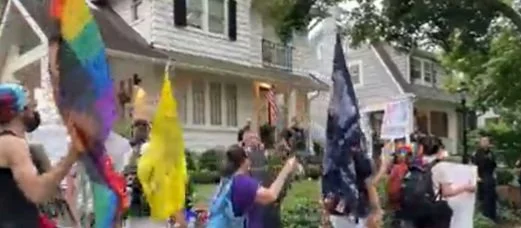
Ruling Irish Party Marches in Hungarian ‘Pride' in Act of Diplomatic Aggression

American Irish self professed Catholic Maria Walsh, who once controversially voted against an EU motion aimed at helping refugees at sea, stormed Budapest's so called ‘Pride Parade' this past weekend in a brazen act of international aggression by Ireland's ruling Fine Gael party.

Fine Gael have overseen a decade of brutal austerity which has led to high levels of homelessness, a collapse in birth rates by 25% and high levels of emigration. They have largely placated the left however by aligning themselves to the Pride and Abortion lobbies as well as advocating for unlimited levels of immigration. They are now, alongside their subservient ‘partners’ Fianna Fail, engaged in sustained psychological warfare against the Hungarian people, evidently because of the country's rising birth rates, its pro family policies and its reluctance towards allowing banks to take priority over ordinary people.

With this in mind, notorious politician Maria Walsh (who is famous for winning a female beauty contest in Ireland) stormed into Budapest this past weekend and took part in its ‘Pride Parade’.

In a tweet she wrote

🇭🇺🇮🇪🇪🇺🏳️‍🌈🏳️‍⚧️

Today, @MariaWalshEU marched in the Budapest Pride parade to show support for Hungarian rainbow family members, activists, and allies. #BudapestPride 🌈 https://t.co/gI629b8OgJ

The American Irish politician, who is a member of a party that has at least one TD who has been photographed at a parade honouring the anti Catholic genocidal Oliver Cromwell, claimed that she was going to ‘shout from the rooftops’ before claiming that ‘human rights’ need to be respected by ‘Orban’.

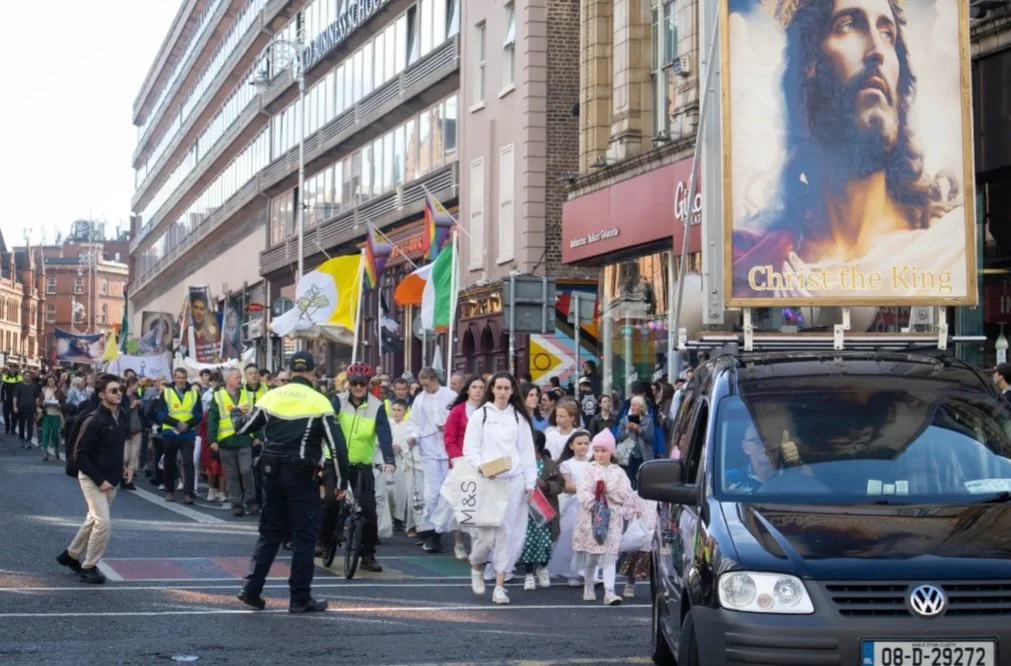
Imagine if a member of Viktor Orban’s government joined Catholic Arena in a procession through Dublin and warned Leo Varadkar that they would be ‘shouting from the rooftops’ about his refusal to recognise religious freedom? Fine Gael and their many supporters in the Irish media and on the left would be quick to warn that Fascism had arrived on Irish shores.

This is not the first act of aggression that Irla nds’s’s government have shown towards Hungary and its prolife counterparts in Poland.

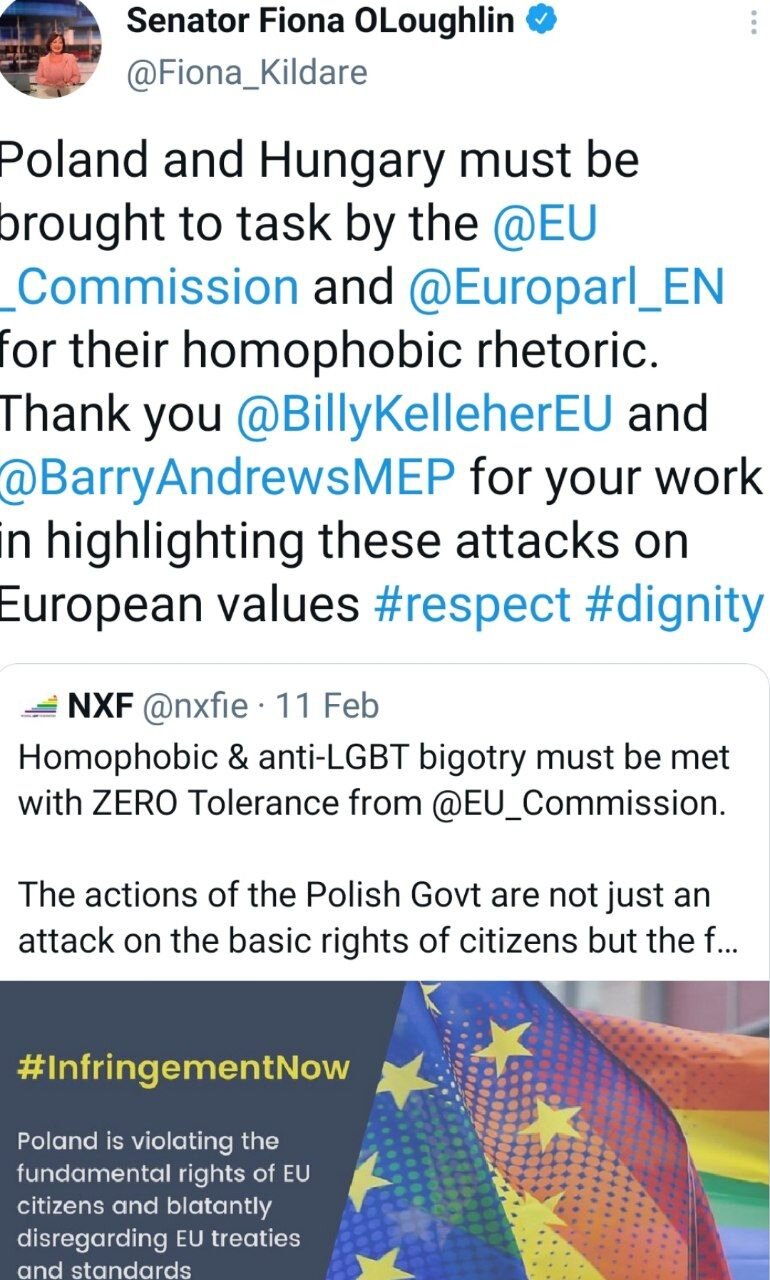
Failed TD Fiona O'Loughlin, who was roundly rejected by voters at the last election after she voted for abortion, has repeatedly campaigned aggressively against the two countries.

Fianna Fail bypassed democracy by handing O'Loughlin a Senator role even after voters made clear that they did not want her, yet she has been amongst those wanting to tell the democratically elected leaders of Poland and Hungary how to run their nation. The irony of this is not easily lost, O'Loughlin's party have overseen Irish birth rates falling below replacement level in conjunction with large scale homelessness and rising drug problems, yet now have the gall to take aim at those who actually care for their citizens. Perhaps shame is what is motivating this behaviour from Fine Gael and Fianna Fail.

Much of this aggression is being implemented not necessarily because Ireland has suddenly decided to become hawkish in its approach towards diplomatic relations, but because of its eagerness to impress its European Union masters, specifically Germany. Ireland is one of the biggest believers in the European Union project, but its belief is rooted in its experiences in the late 1990s and 2000s rather than in the European Union standing by as the parties of Maria Walsh and Fiona O'Loughlin ripped through every household in Ireland with the cruel whip of the International Monetary Fund. The European Union is now a project for the oligarchs, for the banks and for Germany to use the likes of Ireland as pawns to attack those in Eastern Europe who prefer not to have low birth rates, abortion and free for alls for banks.

The stakes have been raised as of late with Western European propaganda undermined by clips of Euro 2020 matches in Budapest that showed tens of thousands in the Hungarian capital enjoying the football in good spirits that served as a dagger to the heart of the fake perceptions of ‘fascism’ that Germany and Ireland have been trying to flame surrounding Hungary's image.

Ireland is now entering into dangerous territory by acting with such aggression, aggression that is primarily anti life, anti European and anti Christian. Simon Coveney recently travelled (during lockdown) to both Iran and Turkey and the Fine Gael Bilderberger did not make a single remark about homosexuality in either country. Why should Hungary be an exception?

Antifa Threaten Terror Attacks Against American Catholics

North America has become one of the worst places for anti Catholic terrorism, indeed anti Christian terrorism against all denominations including Orthodox and Protestant, in 2021.

Most of these acts of terrorism have been concentrated in Canada, egged on by the Anglo Secularist Canadian media, who have been working hard to make people forget their mistreatment of the indigenous Canadians by the secular state. From the 1960s to the 1980s, secular Canadians rehomed thousands of indigenous children with non indigenous families in an event known as the ‘Sixties Scoop’, an event which occurred in living memory and which was facilitated with the help of Canadian mainstream journalists, who ran propaganda pieces encouraging people to adopt these children.

The Canadian media have presented the Residential Schools as a Catholic invention, with their portrayal of the accompanying cemeteries as synonymous with mass murder. One thing that they have refused to inform their audience of however, is the fact that part of the reason as to why they were not returned to their families to be buried was that the state refused to pay to have their bodies repatriated to their families, hence the responsibility fell on the schools to bury them.

No wonder men like Justin Trudeau and his friend Gerald Butts have been so reluctant to implicate the Canadian State, with Butts stating that he ‘understood’ why people were carrying out terror attacks on Catholic churches.

Images have now emerged showing Antifa in Portland threatening terror attacks against Catholic churches there.

E6_s6tvVUAE_gSP.jpg
E6_s6tuVUAA5ENS.jpg

Journalist Drew Hernandez wrote on Twitter:

BREAKING: Portland ANTIFA has now begun to vandalize churches They vandalized church doors with a threatening #hotchurchsummer Reports of gasoline being poured on church steps as a threat Holy Redeemer Catholic Church and St. Patrick’s Catholic Church both targeted

Journalist Andy NGO wrote:

Antifa have been vandalizing Christian houses of worship in Portland (& elsewhere) for months. They’ve done it without condemnation from local & national officials. Any other religion that experienced hate crime targeting like this would be treated differently.

The violence brings to mind the worst behaviours of the Ku Klux Klan, who were also inclined to intimidate Catholics and to set their churches on fire in the 19th and 20th centuries.

Evidently, they also believe that the Anglo Protestant United States which wiped out the Native Americans and which maligned Catholics is somehow synonymous with Catholicism itself.

The level of anti Catholic violence in North America has gone without reply from either Joe Biden or Justin Trudeau, this cannot continue. The countries are on the verge of violence that will soon turn towards priests, nuns and laity if something is not done to bring those committing it to justice.

Catholic Arena

‘Severe and Revolutionary’ Cardinal Burke Speaks on Latin Mass Suppression

Cardinal Raymond Leo Burke has become the latest high profile prelate to express dismay at the Vatican’s widely panned document Traditionis Custodes, which sought to ostracise the Traditional Latin Mass and those who find it fulfilling.

A week has now passed since the document with published with virtually zero informed public support for it and countless instances of impassioned and sincere upset at the perceived harshness of its language and implications.

The Vatican must come out and clear up this mess sooner rather than later.

Cardinal Burke's statement:

Many faithful – laity, ordained and consecrated – have expressed to me the profound distress which the Motu Proprio «Traditionis Custodes» has brought them. Those who are attached to the Usus Antiquior (More Ancient Usage) [UA], what Pope Benedict XVI called the Extraordinary Form, of the Roman Rite are deeply disheartened by the severity of the discipline which the Motu Proprio imposes and offended by the language it employs to describe them, their attitudes and their conduct. As a member of the faithful, who also has an intense bond with the UA, I fully share in their sentiments of profound sorrow.

As a Bishop of the Church and as a Cardinal, in communion with the Roman Pontiff and with a particular responsibility to assist him in his pastoral care and governance of the universal Church, I offer the following observations:

1.  In a preliminary way, it must be asked why the Latin or official text of the Motu Proprio has not yet been published. As far as I know, the Holy See promulgated the text in Italian and English versions, and, afterwards, in German and Spanish translations. Since the English version is called a translation, it must be assumed that the original text is in Italian. If such be the case, there are translations of significant texts in the English version which are not coherent with the Italian version. In Article 1, the important Italian adjective, “unica”, is translated into English as “unique”, instead of “only.” In Article 4, the important Italian verb, “devono”, is translated into English as “should”, instead of “must.”

2.  First of all, it is important to establish, in this and the following two observations (nos. 3 and 4), the essence of what the Motu Proprio contains. It is apparent from the severity of the document that Pope Francis issued the Motu Proprio to address what he perceives to be a grave evil threatening the unity of the Church, namely the UA. According to the Holy Father, those who worship according to this usage make a choice which rejects “the Church and her institutions in the name of what is called the ‘true Church’,” a choice which “contradicts communion and nurtures the divisive tendency … against which the Apostle Paul so vigorously reacted.”

3.  Clearly, Pope Francis considers the evil so great that he took immediate action, not informing Bishops in advance and not even providing for the usual vacatio legis, a period of time between the promulgation of a law and its taking force. The vacatio legis provides the faithful and especially the Bishops time to study the new legislation regarding the worship of God, the most important aspect of their life in the Church, with a view to its implementation. The legislation, in fact, contains many elements that require study regarding its application.

4.  What is more, the legislation places restrictions on the UA, which signal its ultimate elimination, for example, the prohibition of the use of a parish church for worship according to the UA and the establishment of certain days for such worship. In his letter to the Bishops of the world, Pope Francis indicates two principles which are to guide the Bishops in the implementation of the Motu Proprio. The first principle is “to provide for the good of those who are rooted in the previous form of celebration and need to return in due time to the Roman Rite promulgated by Saints Paul VI and John Paul II.” The second principle is “to discontinue the erection of new personal parishes tied more to the desire and wishes of individual priests than to the real need of the ‘holy People of God’.”

5.  Seemingly, the legislation is directed to the correction of an aberration principally attributable to the “the desire and wishes” of certain priests. In that regard, I must observe, especially in the light of my service as a Diocesan Bishop, it was not the priests who, because of their desires, urged the faithful to request the Extraordinary Form. In fact, I shall always be deeply grateful to the many priests who, notwithstanding their already heavy commitments, generously served the faithful who legitimately requested the UA. The two principles cannot help but communicate to devout faithful who have a deep appreciation and attachment to the encounter with Christ through the Extraordinary Form of the Roman Rite that they suffer from an aberration which can be tolerated for a time but must ultimately be eradicated.

6.  From whence comes the severe and revolutionary action of the Holy Father? The Motu Proprio and the Letter indicate two sources: first, “the wishes expressed by the episcopate” through “a detailed consultation of the bishops” conducted by the Congregation for the Doctrine of the Faith in 2020, and, second, “the opinion of the Congregation for the Doctrine of the Faith.” Regarding the responses to the “detailed consultation” or “questionnaire” sent to the Bishops, Pope Francis writes to the Bishops: “The responses reveal a situation that preoccupies and saddens me, and persuades me of the need to intervene.”

7.  Regarding the sources, is it to be supposed that the situation which preoccupies and saddens the Roman Pontiff exists generally in the Church or only in certain places? Given the importance attributed to the “detailed consultation” or “questionnaire,” and the gravity of the matter it was treating, it would seem essential that the results of the consultation be made public, along with the indication of its scientific character. In the same way, if the Congregation for the Doctrine of the Faith was of the opinion that such a revolutionary measure must be taken, it would seemingly have prepared an Instruction or similar document to address it.

8.  The Congregation enjoys the expertise and long experience of certain officials – first, serving in the Pontifical Commission Ecclesia Dei and then in the Fourth Section of the Congregation – who have been charged to treat questions regarding the UA. One must ask whether the “opinion of the Congregation for the Doctrine of the Faith” reflected the consultation of those with the greatest knowledge of the faithful devoted to the UA?

9.  Regarding the perceived grave evil constituted by the UA, I have a wide experience over many years and in many different places with the faithful who regularly worship God according to the UA. In all honesty, I must say that these faithful, in no way, reject “the Church and her institutions in the name of what is called the ‘true Church’.” Neither have I found them out of communion with the Church or divisive within the Church. On the contrary, they love the Roman Pontiff, their Bishops and priests, and, when others have made the choice of schism, they have wanted always to remain in full communion with the Church, faithful to the Roman Pontiff, often at the cost of great suffering. They, in no way, ascribe to a schismatic or sedevacantist ideology.

10.  The Letter accompanying the Motu Proprio states that the UA was permitted by Pope Saint John Paul II and later regulated by Pope Benedict XVI with “the desire to foster the healing of the schism with the movement of Mons. Lefebvre.” The movement in question is the Society of Saint Pius X. While both Roman Pontiffs desired the healing of the schism in question, as should all good Catholics, they also desired to maintain in continuance the UA for those who remained in the full communion of the Church and did not become schismatic. Pope Saint John Paul II showed pastoral charity, in various important ways, to faithful Catholics attached to the UA, for example, granting the indult for the UA but also establishing the Priestly Fraternity of Saint Peter, a society of apostolic life for priests attached to the UA. In the book, Last Testament in his own words, Pope Benedict XVI responded to the affirmation, “The reauthorization of the Tridentine Mass is often interpreted primarily as a concession to the Society of Saint Pius X,” with these clear and strong words: “This is just absolutely false! It was important for me that the Church is one with herself inwardly, with her own past; that what was previously holy to her is not somehow wrong now” (pp. 201-202). In fact, many who presently desire to worship according to the UA have no experience and perhaps no knowledge of the history and present situation of the Priestly Society of Saint Pius X. They are simply attracted to the holiness of the UA.

11.  Yes, there are individuals and even certain groups which espouse radical positions, even as is the case in other sectors of Church life, but they are, in no way, characteristic of the greater and ever increasing number of faithful who desire to worship God according to the UA. The Sacred Liturgy is not a matter of so-called “Church politics” but the fullest and most perfect encounter with Christ for us in this world. The faithful, in question, among whom are numerous young adults and young married couples with children, encounter Christ, through the UA, Who draws them ever closer to Himself through the reform of their lives and cooperation with the divine grace which flows from His glorious pierced Heart into their hearts. They have no need to make a judgment regarding those who worship God according to the Usus Recentior (the More Recent Usage, what Pope Benedict XVI called the Ordinary Form of the Roman Rite) [UR], first promulgated by Pope Saint Paul VI. As one priest, member of an institute of the consecrated life, which serves these faithful, remarked to me: I regularly confess to a priest, according to the UR, and participate, on special occasions, in the Holy Mass according to the UR. He concluded: Why would anyone accuse me of not accepting its validity?

12.  If there are situations of an attitude or practice contrary to the sound doctrine and discipline of the Church, justice demands that they be addressed individually by the pastors of the Church, the Roman Pontiff and the Bishops in communion with him. Justice is the minimum and irreplaceable condition of charity. Pastoral charity cannot be served, if the requirements of justice are not observed.

13.  A schismatic spirit or actual schism are always gravely evil, but there is nothing about the UA which fosters schism. For those of us who knew the UA in the past, like myself, it is a question of an act of worship marked by a centuries-old goodness, truth and beauty. I knew its attraction from my childhood and indeed became very attached to it. Having been privileged to assist the priest as a Mass Server from the time when I was ten years old, I can testify that the UA was a major inspiration of my priestly vocation. For those who have come to the UA for the first time, its rich beauty, especially as it manifests the action of Christ renewing sacramentally His Sacrifice on Calvary through the priest who acts in His person, has drawn them closer to Christ. I know many faithful for whom the experience of Divine Worship according to the UA has strongly inspired their conversion to the Faith or their seeking Full Communion with the Catholic Church. Also, numerous priests who have returned to the celebration of the UA or who have learned it for the first time have told me how deeply it has enriched their priestly spirituality. This is not to mention the saints all along the Christian centuries for whom the UA nourished an heroic practice of the virtues. Some have given their lives to defend the offering of this very form of divine worship.

14.  For myself and for others who have received so many powerful graces through participation in the Sacred Liturgy, according to the UA, it is inconceivable that it could now be characterized as something detrimental to the unity of the Church and to its very life. In this regard, it is difficult to understand the meaning of Article 1 of the Motu Proprio: “The liturgical books promulgated by Saint Paul VI and Saint John Paul II, in conformity with the decrees of Vatican Council II, are the only (unica, in the Italian version which seemingly is the original text) expression of the lex orandi of the Roman Rite.” The UA is a living form of the Roman Rite and has never ceased to be so. From the very time of the promulgation of the Missal of Pope Paul VI, in recognition of the great difference between the UR and the UA, the continued celebration of the Sacraments, according to the UA, was permitted for certain convents and monasteries and also for certain individuals and groups. Pope Benedict XVI, in his Letter to the Bishops of the World, accompanying the Motu Proprio «Summorum Pontificum», made clear that the Roman Missal in use before the Missal of Pope Paul VI, “was never juridically abrogated and, consequently, in principle, was always permitted.”

15.  But can the Roman Pontiff juridically abrogate the UA? The fullness of power (plenitudo potestatis) of the Roman Pontiff is the power necessary to defend and promote the doctrine and discipline of the Church. It is not “absolute power” which would include the power to change doctrine or to eradicate a liturgical discipline which has been alive in the Church since the time of Pope Gregory the Great and even earlier. The correct interpretation of Article 1 cannot be the denial that the UA is an ever-vital expression of “the lex orandi of the Roman Rite.” Our Lord Who gave the wonderful gift of the UA will not permit it to be eradicated from the life of the Church.

16.  It must be remembered that, from a theological point of view, every valid celebration of a sacrament, by the very fact that it is a sacrament, is also, beyond any ecclesiastical legislation, an act of worship and, therefore, also a profession of faith. In that sense, it is not possible to exclude the Roman Missal, according to the UA, as a valid expression of the lex orandi and, therefore, of the lex credendi of the Church. It is a question of an objective reality of divine grace which cannot be changed by a mere act of the will of even the highest ecclesiastical authority.

17.  Pope Francis states in his letter to the Bishops: “Responding to your requests, I take the firm decision to abrogate all the norms, instructions, permissions and customs that precede the present Motu proprio, and declare that the liturgical books promulgated by the saintly Pontiffs Paul VI and John Paul II, in conformity with the decrees of Vatican Council II, constitute the unique [only] expression of the lex orandi of the Roman Rite.” The total abrogation in question, in justice, requires that each individual norm, instruction, permission and custom be studied, to verify that it “contradicts communion and nurtures the divisive tendency … against which the Apostle Paul so vigorously reacted.”

18.  Here, it is necessary to observe that the reform of the Sacred Liturgy carried out by Pope Saint Pius V, in accord with the indications of the Council of Trent, was quite different from what happened after the Second Vatican Council. Pope Saint Pius V essentially put in order the form of the Roman Rite as it had existed already for centuries. Likewise, some ordering of the Roman Rite has been done in the centuries since that time by the Roman Pontiff, but the form of the Rite remained the same. What happened after the Second Vatican Council constituted a radical change in the form of the Roman Rite, with the elimination of many of the prayers, significant ritual gestures, for example, the many genuflections, and the frequent kissing of the altar, and other elements which are rich in the expression of the transcendent reality – the union of heaven with earth – which is the Sacred Liturgy. Pope Paul VI already lamented the situation in a particularly dramatic way by the homily he delivered on the Feast of Saints Peter and Paul in 1972. Pope Saint John Paul II labored throughout his pontificate, and, in particular, during its last years, to address serious liturgical abuses. Both Roman Pontiffs, and Pope Benedict XVI, as well, strove to conform the liturgical reform to the actual teaching of the Second Vatican Council, since the proponents and agents of the abuse invoked the “spirit of the Second Vatican Council” to justify themselves.

19.  Article 6 of the Motu Proprio transfers the competence of institutes of the consecrated life and societies of apostolic life devoted to the UA to the Congregation for Institutes of Consecrated Life and Societies of Apostolic Life. The observance of the UA belongs to the very heart of the charism of these institutes and societies. While the Congregation is competent to respond to questions regarding the canon law for such institutes and societies, it is not competent to alter their charism and constitutions, in order to hasten the seemingly desired elimination of the UA in the Church.

There are many other observations to be made, but these seem to be the most important. I hope that they may be helpful to all the faithful and, in particular, to the faithful who worship according to the UA, in responding to the Motu Proprio «Traditionis Custodes» and the accompanying Letter to the Bishops. The severity of these documents naturally generates a profound distress and even sense of confusion and abandonment. I pray that the faithful will not give way to discouragement but will, with the help of divine grace, persevere in their love of the Church and of her pastors, and in their love of the Sacred Liturgy.

In that regard, I urge the faithful, to pray fervently for Pope Francis, the Bishops and priests. At the same time, in accord with can. 212, §3, “[a]ccording to the knowledge, competence, and prestige which they possess, they have the right and even at times the duty to manifest to the sacred pastors their opinion on matters which pertain to the good of the Church and to make their opinion known to the rest of the Christian faithful, without prejudice to the integrity of faith and morals, with reverence toward their pastors, and attentive to common advantage and the dignity of persons.” Finally, in gratitude to Our Lord for the Sacred Liturgy, the greatest gift of Himself to us in the Church, may they continue to safeguard and cultivate the ancient and ever new More Ancient Usage or Extraordinary Form of the Roman Rite.


Sinn Fein Celebrate Westminster's Abortion Edict

Westminster's allies Sinn Fein have today celebrated the imposition of abortion on Irish babies aa decreed by Westminster.

Despite carrying banners in recent years that stated ‘England Get Out of Ireland’, Sinn Fein's leaders Mary Lou McDonald and Michelle O'Neill are now avid supporters of London's rule in the North.

In recent years the party have become increasingly anti Catholic, even picketing a Catholic church in an Orange Order style event last month, using ‘homophobia’ as an excuse, despite later appearing at a major Islamic festival at Archbishop Croke Park.

Michelle O'Neill has referred to these new ‘services’ as ‘compassionate’ and has presented them as a victory against the DUP.

One can only wonder what level of idiocy it takes to think that allowing London to kill your own people's babies is a victory for either Irish people, Republicanism or for compassion.

Today is a victory for London. Sinn Fein and Michelle O'Neill are now de facto Unionists and so is anyone who votes for them at the ballot box. After decades of fears that Catholics would ‘outbreed’ Protestants, that reality is no longer a threat.

All of this has been allowed to happen under ‘Catholic' Prime Minister Boris Johnson with not a whisper of opposition from ‘Trad' Jacob Rees Mogg.

Archbishop Fisher And Others To Keep Latin Mass

Pope Francis's Motu Proprio Traditione Custodianes has been, by any objective measure, something of a disaster.

It has been criticised for being poorly written, it has been criticised for being divisive while claiming to be unifying, it has been criticised for claiming to have consulted bishops, while most of them have now claimed that they will essentially ignore it, citing the surprise of the news as a reason.

Almost a week has passed since the document was released, with the Vatican making no follow up statements to repair the damage done. This has been a complete PR disaster, yet no one in the Vatican seems to be aware, or at the least to care.

A growing chorus of high profile prelates are now rejecting what was essentially a call to suppress the Traditional Latin Mass. We could give the document the benefit of the doubt and state that it simply meant to afford the bishops more involvement with the decision to allow the TLM in their area, but the tone of the document suggests no such benignity.

In the United States, high profile prelates such as Cardinal Chaput have said they will be allowing Traditional Latin Mass communities to continue as normal. Even prelates in Germany have announced that they will be continuing as normal.

One of the most interesting replies has been from Archbishop of Sydney Anthony Fisher OP, who warned that to use the liturgy as a ‘weapon’ would ‘factionalist’ the church. He pointed out that there was a reference to the glib celebrations of the Novus Ordo in Traditione Custodianes, but only ‘in passing’.

Like any good Dominican, he explains the situation from a rational beginning, by pointing out that there are ‘24 Catholic Churches in full Communion with the Pope and with each other. 23 Eastern and One Western (Latin)’. Archbishop Fisher then explains the liturgical variety in each, stating: ‘Each has its particular liturgical rites, customs and spiritual traditions, and there are also varieties within each tradition. So, while we share one faith, we are a very ritually diverse Church! That is part of our richness’.

He then explains how with the Latin Rite, there are still countless diverse elements, the Dominican Rite being one, he writes ‘While we share one rite, Western Catholics are also ritually diverse’.

With more and more bishops expressing an appreciation for the Latin Mass in their dioceses, it may soon become the case that this Motu Proprio has strengthened rather than weakened the availability of the TLM and the fondness for it.

You can read the full text of Archbishop Fisher’s letter below:

E63jANiVcAIQaBu.jpg
E63jANgVUAUGAKW.jpg

Far Left's Euthanasia Bill Stalls Because of 'Serious Flaws'

Since last year, the ironically named ‘Dying with Dignity’ Bill has been heavily promoted by the Irish Far Left and their ever obliging supporters in the Irish media (much of which is actually British owned).

Although it has seemed quite bizarre that the party promoting the bill, People Before Profit, were also calling for the most severe lockdown restrictions in order to ‘save lives’, the strange timing of a bill that would encourage higher and quicker deaths of elderly and disabled rarely received criticism from the Irish media, apart from those printed in their Letters sections.

What mostly received criticism in those instances was the poor wording of the bill. Put together by Gino Kenny, the bill seemed to completely lack any necessary safeguards towards stopping abuse of its system, it lacked all awareness of the potential for the right to die becoming the duty to die in a country with serious healthcare problems.

This was outlined repeatedly by Dr. Kevin Hay’s articles in Catholic Arena.

Hard Cases Make Bad Law — Catholic Arena

A Detailed Analysis of Ireland's Dying with Dignity Bill — Catholic Arena

Now, Gino Kenny is claiming that the current bill will make little to no further progress. He has tweeted:

It’s becoming evident that the Justice Committee will not be recommending the progress of the Dying with Dignity. This is a complete prevarication of the issue and the bill. There was no policy scrutiny just a legal opinion which could have been overcome. A shambolic process.

One of his supporters replied:

We're still under the thumb of the Church in Ireland. They will never relent.

The recent slew of ‘progressive’ bills in Ireland meant that People Before Profit may have expected this to progress in an easier manner than it did.

Despite Kenny’s claims that it would not progress, it will go to a Special Oireachtas Committee, as announced today. In recommending the Special Oireachtas Committee, the Joint Committee on Justice Report pointed out that the bill has many flaws, which they have given as reason for it not progress to the Committee Stage.

Following detailed scrutiny of the Dying with Dignity Bill 2020, the Joint Committee on Justice has recommended that an Oireachtas Special Committee be established to undertake an examination on the topic of assisted dying which should report within a specific timeframe.

The Dying with Dignity Bill 2020 is a Private Member’s Bill from Deputy Gino Kenny that seeks to allow for the provision of assisted dying to qualifying persons – those suffering from a terminal illness – with the aim of allowing them to achieve a dignified and peaceful end of life. If enacted, this Bill would give a medical practitioner the legal right to provide assistance to a qualifying person to end their life, according to the terms of this Act.

While conducting Pre-Committee scrutiny for this Bill, the Committee sought public submissions on the topic and over 1,400 submissions were received by the deadline in January 2021. These submissions fall under broad categories relating to legal, medical, personal, academic, faith-based and end-of-life or rights-based perspectives on the provisions contained within the Bill.

The Bill was also sent to the Office of the Parliamentary Legal Advisers (OPLA) to ascertain the legal and constitutional implications of such proposed legislation. An analysis of both these submissions and the OPLA analysis forms the basis of the Committee’s Report on Scrutiny of the Dying with Dignity Bill 2020.

Committee Cathaoirleach James Lawless TD said: “The Committee, in considering the matter, recognised that its function is to legislate, however, this comes with particular responsibilities and care must be taken when recommending the progression of legislative proposals. On foot of its deliberations, the Committee has made a number of observations and an overall recommendation, which can be found at the end of this report.

“Based on its consideration, the Committee has determined that the Bill has serious technical issues in several sections, that it may have unintended policy consequences – particularly regarding the lack of sufficient safeguards to protect against undue pressure being put on vulnerable people to avail of assisted dying – that the drafting of several sections of the Bill contain serious flaws that could potentially render them vulnerable to challenge before the courts, and that the gravity of such a topic as assisted dying warrants a more thorough examination which could potentially benefit from detailed consideration by a Special Oireachtas Committee.  

“Therefore, it reluctantly decided that the Bill should not progress to Committee Stage but that a Special Oireachtas Committee should be established, at the earliest convenience, to progress the matter.  In addition, all submissions received by the Justice Committee would be shared with any such Committee.”

Deputy Lawless added: “I would like to commend Deputy Kenny for his dedication in proposing and advocating for the progression of this legislation and for opening up a conversation which needs to be had. I would also like to express my gratitude on behalf of the Committee to all those who sent in written submissions and to the OPLA for their insight into this important Bill.”

The ‘Faith Based’ arguments that were given in submission were summarised as thus:

Individuals, groups, and organisations who sent submissions to the Committee on a religious basis accounted for approximately 435 submissions and all of these submissions fundamentally opposed this Bill on religious grounds, while also highlighting several other reasons for their opposition. Many of the submissions made on a personal religious basis used the same template to express their opposition to the Bill, which highlighted five key reasons to oppose assisted dying. Firstly, many of the submissions felt that assisted dying was always morally wrong and they equated assisted dying with murder, highlighting that it would breach the fifth Commandment of God, which proclaims ‘Thou shalt not kill’. They believe that human beings have been created in the image of God and that it is God who gives life, therefore the end of life should be entirely in God’s hands. As stated previously, many of the submissions based on religious beliefs expressed their displeasure with assisted dying and with the previous legalisation of abortion in 2018, drawing comparisons between the two and arguing both of these essentially allow for vulnerable individuals to be killed. They argued that Irish society is still nominally Christian and needs to reflect on itself and on its core values. Secondly, these submissions believed in the sanctity of life or that all lives have value, and repeated previous arguments that introducing assisted dying would further devalue human life. Thirdly, they argued that we have a duty to protect the vulnerable in society, who would face increasing pressure to avail of assisted dying if it were introduced. Some submissions even argued that allowing assisted dying would alter society’s attitudes towards the elderly and vulnerable and create a culture where these groups are not valued and they may begin to think that ‘they’re better off dead’. Finally, they also believe that assisted dying would be a step back for genuine healthcare and that it is unnecessary as palliative care is a sufficient method of assisting those who are terminally ill. These submissions highlighted research by the Irish Palliative Medicine Consultants’ Association (IPMCA) which had demonstrated that palliative care experts and other members of the medical profession were themselves strongly opposed to the introduction of assisted dying. A survey undertaken by the IMPCA in 2020 found that 88% of palliative medicine doctors are opposed to assisted suicide. This sentiment was also REPORT ON SCRUTINY OF THE DYING WITH DIGNITY BILL 2020 [PMB] Page 25 of 47 expressed by several palliative care professionals in their submissions in the medical section. Submissions questioned the rationale and fairness behind proposals to introduce assisted dying if those who were expected to undertake this task were themselves strongly opposed to it. One submission argued that despite the stated intention of the Bill to be motivated by compassion for the terminally ill, their understand having compassion to mean “suffering with” someone and that assisted dying reflects a failure of compassion on the part of society to respond to the challenges of caring for patients at the end of their lives. In addition to these five points, submissions in this category were also submitted from individuals in Northern Ireland who were concerned at the effect of the legislation on Northern Ireland and the prospect of ‘Euthanasia tourism’ where people from Northern Ireland could cross the border to avail of assisted dying. Finally, other submissions mentioned points previously highlighted in other categories which include the ‘slippery slope’ argument and the risk that assisted dying would be viewed as a cheaper option for insurance companies than conventional treatments for patients.

You can read the full report here: 2021-07-21_report-on-scrutiny-of-the-dying-with-dignity-bill-2020-pmb_en.pdf (oireachtas.ie)

Irish Government Confirms No Ban on Prolife Vigils

Despite a sustained campaign by left wing politicians and their supporters in the Irish media, the Irish government have declined to ban prolife vigils near abortuaries at this time.

Former prolifer Stephen Donnelly, now Minister for Health, was asked by Holly Cairns about the status of legislation on the ‘safe access to the Termination of Pregnancy Bill’ this past week in the Dail.

Cairns is infamous for once tweeting that she would get at an abortion for every minute of air time devoted to the papal conclave.

HC2.jpg

Abortion had only been legalised for over a year when the lockdown crisis began, putting a dent in a growing prolife movement in Ireland.

For this reason, Stephen Donnelly responded:

nsuring access to termination of pregnancy services remains an ongoing priority for the Department of Health.  

It was originally intended to provide for safe access to termination of pregnancy services in the Health (Regulation of Termination of Pregnancy) Act 2018. However, a number of legal issues were identified which necessitated further consideration.  

Since services under the Health (Regulation of Termination of Pregnancy) Act 2018 commenced in January 2019, there has been a limited number of reports of protests or other actions relating to termination of pregnancy.  This is an extremely positive development. It suggests that these services have bedded in relatively smoothly to date and are becoming a normal part of the Irish healthcare system, as intended.   

Where problems do arise with protests outside healthcare services, there is existing public order legislation in place to protect people accessing services, staff and local residents.  

The Department of Health has liaised with An Garda Síochána on safe access to services. The Garda National Protective Services Bureau issued a notice to all Garda Stations raising awareness about the issue. It directed that any protests be monitored, and breaches of existing law dealt with. The Department has provided information on existing public order and other relevant legislation to the HSE for appropriate distribution.    

Termination of pregnancy services have continued to function during the COVID-19 pandemic. There is regular ongoing engagement between my Department and the HSE to facilitate the smooth-running of the service and to resolve any issues that may arise. 

There are prolife vigils still taking place quietly in a number of locations, many of which have had successes.

For the most part however, the location of abortuaries in Maternity Hospitals and Family GPs has been a clever means of ensuring that abortion protests are more difficult to carry out than at made for purpose abortion centers as in other countries.

The prolife movement in Ireland is still trying to find a clearer identity post 2018, we encourage people to get behind any prolife work or to initiate their own if none is readily available. The important thing is to start moving forward, with new ideas and a genuine belief that abortion can be removed from Irish society once again.

A recent story from the UK highlighted the importance of prolife witness near abortion clinics, despite the taunts of so called ‘secular’ prolifers who spend more time criticising the Catholic prolife movement than they do criticising abortion.

Catholic Prolife Vigil Leads to Abortion Clinic Closure — Catholic Arena

Seosamh O’Caoimh

Costa Rica BANS the Latin Mass

Despite having rapidly declining numbers of faithful, with many defecting to Evangelical churches instead, the Episcopal Conference of Costa Rica has made the shocking dictatorial decision to outright BAN the Traditional Latin Mass within their country. Seminarians are not allowed to learn it, priests are not allowed to say it.

Some of the important parts of the document:

‘‘There is no objective justification for the use among us of the liturgy prior to the 1970 reform."

"Those who express affinity for ancient forms do not always express their appreciation of the "validity and legitimacy of the liturgical reform, of the dictates of the Second Vatican Council and of the Magisterium of the Holy Pontiffs’’.

"With sometimes discreet statements or directly offensive comments they question the "sanctity of the new rite" (Summorum Pontificum). They do not seek the synergy that would give theological-pastoral validity to their ritual preferences,’’.

"Since the previous rules, instructions, concessions and customs have been "abrogated", the use of the Missale Romanum of 1962 or any other of the expressions of the pre-1970 liturgy is not authorized from now on. No priest is authorized to continue celebrating according to the ancient liturgy."

"According to these provisions, "the seminarians shall be educated and the new priests." Their formation should be clearly aimed at the appreciation and practice of the liturgy re-christianized by the Second Vatican Council, which is "the only expression of the lex orandi of the Roman Rite’’.

"In addition, the Episcopal Conference of Costa Rica joins the pain and reprobation that were once expressed by Benedict XVI and are now replicated by Pope Francis: it is necessary to celebrate according to the indications given by the different liturgical books, so that the sacred and cultural character is maintained, the absence of which some rightly claim. It is clear that the liturgy reformed by the Second Vatican Council has all the conditions to uplift the human being and strengthen his spiritual life, while responding in a balanced way to the authentic anthropological and cultural needs of the praying man of our times. It is only necessary an adequate application of the norms, orientations and possibilities that give the liturgical books".

"In particular, today we must remember that our liturgy, celebrated according to the books promulgated by Saints Paul VI and John Paul II, must be preserved from any element from the ancient forms. Prayers, vestments or rites that were typical of the liturgy prior to the 1970 reformation should not be introduced into our celebrations’’.

Although many expect the Motu Proprio to be mostly ignored by bishops across the world, there will be a select few dioceses who will use it to spitefully hurt and bully Traditionalists, or in this case, an entire country.

Translation: Costa Rican Bishops Ban Traditional Mass Throughout The Country (infovaticana.com)

219599076_1462835187384351_166197299872026472_n.jpg
219375203_1462835224051014_8930038359624886280_n.jpg
219863460_1462835297384340_2736364897060858855_n.jpg
219709979_1462835250717678_6077274779346503578_n.jpg

Pope John XXIII on how Latin must be given a 'Primary Place'

The following encyclical from 1962 is a reminder that Pope John XXIII greatly valued Latin and wanted it to retain its importance in the life of the church.

On the Promotion of the Study of Latin

Apostolic Constitution

The wisdom of the ancient world, enshrined in Greek and Roman literature, and the truly memorable teaching of ancient peoples, served, surely, to herald the dawn of the Gospel which Gods Son, “the judge and teacher of grace and truth, the light and guide of the human race,” proclaimed on Earth.

Such was the view of the Church Fathers and Doctors. In these outstanding literary monuments of antiquity, they recognized man’s spiritual preparation for the supernatural riches which Jesus Christ communicated to mankind “to give history its fulfillment.”

Thus the inauguration of Christianity did not mean the obliteration of man’s past achievements. Nothing was lost that was in any way true, just, noble and beautiful.

Venerable languages

The Church has ever held the literary evidences of this wisdom in the highest esteem. She values especially the Greek and Latin languages in which wisdom itself is cloaked, as it were, in a vesture of gold. She has likewise welcomed the use of other venerable languages, which flourished in the East. For these too have had no little influence on the progress of humanity and civilization. By their use in sacred liturgies and in versions of Holy Scripture, they have remained in force in certain regions even to the present day, bearing constant witness to the living voice of antiquity.

A primary place

But amid this variety of languages a primary place must surely be given to that language which had its origins in Latium, and later proved so admirable a means for the spreading of Christianity throughout the West.

And since in God’s special Providence this language united so many nations together under the authority of the Roman Empire — and that for so many centuries — it also became the rightful language of the Apostolic See. Preserved for posterity, it proved to be a bond of unity for the Christian peoples of Europe.

The nature of Latin

Of its very nature Latin is most suitable for promoting every form of culture among peoples. It gives rise to no jealousies. It does not favor any one nation, but presents itself with equal impartiality to all and is equally acceptable to all.

Nor must we overlook the characteristic nobility of Latin for mal structure. Its “concise, varied and harmonious style, full of majesty and dignity” makes for singular clarity and impressiveness of expression.

Preservation of Latin by the Holy See

For these reasons the Apostolic See has always been at pains to preserve Latin, deeming it worthy of being used in the exercise of her teaching authority “as the splendid vesture of her heavenly doctrine and sacred laws.”5 She further requires her sacred ministers to use it, for by so doing they are the better able, wherever they may be, to acquaint themselves with the mind of the Holy See on any matter, and communicate the more easily with Rome and with one another.

Thus the “knowledge and use of this language,” so intimately bound up with the Church’s life, “is important not so much on cultural or literary grounds, as for religious reasons.” These are the words of Our Predecessor Pius XI, who conducted a scientific inquiry into this whole subject, and indicated three qualities of the Latin language which harmonize to a remarkable degree with the Church’s nature. “For the Church, precisely because it embraces all nations and is destined to endure to the end of time … of its very nature requires a language which is universal, immutable, and non-vernacular.”

Universal

Since “every Church must assemble round the Roman Church,” and since the Supreme Pontiffs have “true episcopal power, ordinary and immediate, over each and every Church and each and every Pastor, as well as over the faithful” of every rite and language, it seems particularly desirable that the instrument of mutual communication be uniform and universal, especially between the Apostolic See and the Churches which use the same Latin rite.

When, therefore, the Roman Pontiffs wish to instruct the Catholic world, or when the Congregations of the Roman Curia handle matters or draw up decrees which concern the whole body of the faithful, they invariably make use of Latin, for this is a maternal voice acceptable to countless nations.

Immutable

Furthermore, the Church’s language must be not only universal but also immutable. Modern languages are liable to change, and no single one of them is superior to the others in authority. Thus if the truths of the Catholic Church were entrusted to an unspecified number of them, the meaning of these truths, varied as they are, would not be manifested to everyone with sufficient clarity and precision. There would, moreover, be no language which could serve as a common and constant norm by which to gauge the exact meaning of other renderings.

But Latin is indeed such a language. It is set and unchanging. it has long since ceased to be affected by those alterations in the meaning of words which are the normal result of daily, popular use. Certain Latin words, it is true, acquired new meanings as Christian teaching developed and needed to be explained and defended, but these new meanings have long since become accepted and firmly established.

Non-vernacular

Finally, the Catholic Church has a dignity far surpassing that of every merely human society, for it was founded by Christ the Lord. It is altogether fitting, therefore, that the language it uses should be noble, majestic, and non-vernacular.

In addition, the Latin language “can be called truly catholic.”

 It has been consecrated through constant use by the Apostolic See, the mother and teacher of all Churches, and must be esteemed “a treasure … of incomparable worth.”

It is a general passport to the proper understanding of the Christian writers of antiquity and the documents of the Church’s teaching. It is also a most effective bond, binding the Church of today with that of the past and of the future in wonderful continuity.

Educational value of Latin

There can be no doubt as to the formative and educational value either of the language of the Romans or of great literature generally. It is a most effective training for the pliant minds of youth. It exercises, matures and perfects the principal faculties of mind and spirit. It sharpens the wits and gives keenness of judgment. It helps the young mind to grasp things accurately and develop a true sense of values. It is also a means for teaching highly intelligent thought and speech.

A natural result

It will be quite clear from these considerations why the Roman Pontiffs have so often extolled the excellence and importance of Latin, and why they have prescribed its study and use by the secular and regular clergy, forecasting the dangers that would result from its neglect.

A resolve to uphold Latin

And We also, impelled by the weightiest of reasons — the same as those which prompted Our Predecessors and provincial synods  — are fully determined to restore this language to its position of honor, and to do all We can to promote its study and use. The employment of Latin has recently been contested in many quarters, and many are asking what the mind of the Apostolic See is in this matter. We have therefore decided to issue the timely directives contained in this document, so as to ensure that the ancient and uninterrupted use of Latin be maintained and, where necessary, restored.

We believe that We made Our own views on this subject sufficiently clear when We said to a number of eminent Latin scholars:

“It is a matter of regret that so many people, unaccountably dazzled by the marvelous progress of science, are taking it upon themselves to oust or restrict the study of Latin and other kindred subjects…. Yet, in spite of the urgent need for science, Our own view is that the very contrary policy should be followed. The greatest impression is made on the mind by those things which correspond more closely to man’s nature and dignity. And therefore the greatest zeal should be shown in the acquisition of whatever educates and ennobles the mind. Otherwise poor mortal creatures may well become like the machines they build — cold, hard, and devoid of love.”

Provisions for the Promotion of Latin Studies

With the foregoing considerations in mind, to which We have given careful thought, We now, in the full consciousness of Our Office and in virtue of Our authority, decree and command the following:

Responsibility for enforcement

  1. Bishops and superiors-general of religious orders shall take pains to ensure that in their seminaries and in their schools where adolescents are trained for the priesthood, all shall studiously observe the Apostolic See’s decision in this matter and obey these Our prescriptions most carefully.

  2. In the exercise of their paternal care they shall be on their guard lest anyone under their jurisdiction, eager for revolutionary changes, writes against the use of Latin in the teaching of the higher sacred studies or in the Liturgy, or through prejudice makes light of the Holy See’s will in this regard or interprets it falsely.

Study of Latin as a prerequisite

  1. As is laid down in Canon Law (can. 1364) or commanded by Our Predecessors, before Church students begin their ecclesiastical studies proper they shall be given a sufficiently lengthy course of instruction in Latin by highly competent masters, following a method designed to teach them the language with the utmost accuracy. “And that too for this reason: lest later on, when they begin their major studies . . . they are unable by reason of their ignorance of the language to gain a full understanding of the doctrines or take part in those scholastic disputations which constitute so excellent an intellectual training for young men in the defense of the faith.”

We wish the same rule to apply to those whom God calls to the priesthood at a more advanced age, and whose classical studies have either been neglected or conducted too superficially. No one is to be admitted to the study of philosophy or theology except he be thoroughly grounded in this language and capable of using it.

Traditional curriculum to be restored

  1. Wherever the study of Latin has suffered partial eclipse through the assimilation of the academic program to that which obtains in State public schools, with the result that the instruction given is no longer so thorough and well-grounded as formerly, there the traditional method of teaching this language shall be completely restored. Such is Our will, and there should be no doubt in anyone’s mind about the necessity of keeping a strict watch over the course of studies followed by Church students; and that not only as regards the number and kinds of subjects they study, but also as regards the length of time devoted to the teaching of these subjects.

Should circumstances of time and place demand the addition of other subjects to the curriculum besides the usual ones, then either the course of studies must be lengthened, or these additional subjects must be condensed or their study relegated to another time.

Sacred sciences to be taught in Latin

  1. In accordance with numerous previous instructions, the major sacred sciences shall be taught in Latin, which, as we know from many centuries of use, “must be considered most suitable for explaining with the utmost facility and clarity the most difficult and profound ideas and concepts.” For apart from the fact that it has long since been enriched with a vocabulary of appropriate and unequivocal terms, best calculated to safeguard the integrity of the Catholic faith, it also serves in no slight measure to prune away useless verbiage.

Hence professors of these sciences in universities or seminaries are required to speak Latin and to make use of textbooks written in Latin. If ignorance of Latin makes it difficult for some to obey these instructions, they shall gradually be replaced by professors who are suited to this task. Any difficulties that may be advanced by students or professors must be overcome by the patient insistence of the bishops or religious superiors, and the good will of the professors.

A Latin Academy

  1. Since Latin is the Church’s living language, it must be adequate to daily increasing linguistic requirements. It must be furnished with new words that are apt and suitable for expressing modern things, words that will be uniform and universal in their application. and constructed in conformity with the genius of the ancient Latin tongue. Such was the method followed by the sacred Fathers and the best writers among the scholastics.

To this end, therefore, We commission the Sacred Congregation of Seminaries and Universities to set up a Latin Academy staffed by an international body of Latin and Greek professors. The principal aim of this Academy — like the national academies founded to promote their respective languages — will be to superintend the proper development of Latin, augmenting the Latin lexicon where necessary with words which conform to the particular character and color of the language.

It will also conduct schools for the study of Latin of every era, particularly the Christian one. The aim of these schools will be to impart a fuller understanding of Latin and the ability to use it and to write it with proper elegance. They will exist for those who are destined to teach Latin in seminaries and ecclesiastical colleges, or to write decrees and judgments or conduct correspondence in the ministries of the Holy See, diocesan curias, and the offices of religious orders.

The teaching of Greek

  1. Latin is closely allied to Greek both in formal structure and in the importance of its extant writings. Hence — as Our Predecessors have frequently ordained — future ministers of the altar must be instructed in Greek in the lower and middle schools. Thus when they come to study the higher sciences — and especially if they are aiming for a degree in Sacred Scripture or theology — they will be enabled to follow the Greek sources of scholastic philosophy and understand them correctly; and not only these, but also the original texts of Sacred Scripture, the Liturgy, and the sacred Fathers.

A syllabus for the teaching of Latin

  1. We further commission the Sacred Congregation of Seminaries and Universities to prepare a syllabus for the teaching of Latin which all shall faithfully observe. The syllabus will be designed to give those who follow it an adequate understanding of the language and its use. Episcopal boards may indeed rearrange this syllabus if circumstances warrant, but they must never curtail it or alter its nature. Ordinaries may not take it upon themselves to put their own proposals into effect until these have been examined and approved by the Sacred Congregation.

Finally, in virtue of Our apostolic authority, We will and command that all the decisions, decrees, proclamations and recommendations of this Our Constitution remain firmly established and ratified, notwithstanding anything to the contrary, however worthy of special note.

Given at Rome, at Saint Peter’s, on the feast of Saint Peter’s Throne on the 22nd day of February in the year 1962, the fourth of Our pontificate.

Westminster Ally Criticises Islamophobia...Despite Party Picketing Catholic Church

Anyone who knows about Sinn Fein, knows that the one consistent thing about them, is that they are inconsistent on every single issue.

They are the ‘opposition’, who boast of their willingness to do whatever the government asks of them.

They hold banners saying ‘Get England out of Ireland’, while cackling for joy as they invite English abortion companies to abort Irish babies. They also complain of ‘sectarianism’ against Catholics in the North, while themselves picketing Catholic churches in the South for refusing to hang ‘Pride’ flags outside churches.

Better yet, they picket Catholic churches for ‘homophobia’, yet stand alongside a religion known for putting homosexuals to death by stoning.

Mary Lou McDonald, who runs for election in working class North Dublin despite receiving a private education in elitist South Dublin, appeared at the annual Festival of Sacrifice at Archbishop Croke Park today. Archbishop Croke Park has long been the home of the Gaelic Athletic Association and its preservation of Irish culture, in recent years however it has become mostly a commercial enterprise, entertaining rugby, soccer and even the Queen of England as well as concerts from Taylor Swift and others. The Festival of Sacrifice was held ‘temporarily’ in Archbishop Croke Park, this year and last year, but we expect, as happened in other countries, that this ‘temporary’ move will become permanent.

McDonald’s presence is particularly galling as only a number of weeks ago, her party stood outside a Catholic church in Ballyfermot in Dublin, screaming abuse about the ‘fascist, racist’ organisation of the Catholic Church. The racism comment was quite bizarre considering that Sinn Fein were reacting to a Rosary Rally led by a person of colour a few days earlier, but no one ever said that anything Sinn Fein do or say is ever intended to make any sense. Another wonderful contradiction was that one man in a Celtic top was videoed criticising the church and asking if the church opposed divorce, evidently unaware of the lives of either Brother Walfred or King Henry VIII.

Mary Lou spoke about the problem of ‘Islamophobia’, evidently, picketing people of the Catholic faith is a lesser crime to Sinn Fein, unless Protestants do it, but if they do do it it should be because of homophobia or something…again, no one said that Sinn Fein ever intended to make sense.

McDonald also took part in an anti Catholic protest a number of weeks ago alongside Fianna Fail’s candidate for Dublin Bay South, the event (get this) was designed to blame the church because the government wasn’t able to build a hospital by itself. No, seriously.

Nonetheless, she enjoyed herself today at Archbishop Croke Park (named after Archbishop Croke, one of many Catholic prelates who built the Gaelic Athletic Association in order to keep young men and women away from English and Protestant influence) and was praised by Amanaullah De Sondy for her words.

The GAA will no doubt enjoy the good press from today. They told Catholic Arena prior to the Ballyfermot picket that their club in Ballyfermot would not be attending, yet they did. The GAA never responded to our follow up email.

The group ‘Alliance of Former Muslims of Ireland’ criticised the event.

Ken Moore

Statues of St. Therese and Our Lady Destroyed by New York Thug

While terror attacks in Canada have been attracting headlines across the world, another epidemic of anti Catholic terrorism has been taking place slightly further south, in New York.

Over the past 12 months, we’ve reported on a number of attacks that have taken place in New York, stretching from Queens to the Bronx, with Catholic statues in particular a target for terrorists.

Now, another attack has taken place, this time with a statue of Our Lady and one of St. Therese of Lisieux being smashed to pieces at Our Lady of Mercy Church in Queens.

The terrorist appears to have arrived at the church three days earlier and thrown them to the ground, only to fail to smash them. This time, they returned and dragged the statues 180 feet before smashing them with a hammer.

The terrorist may have chosen the path of demonic anti Catholic bigotry, but the parishioners have taken the right path in putting a sign that says ‘Please pray for the person who did this’.

A video has been released of the disturbed individual carrying out the hate crime, an attack which has deeply upset Catholics in a parish that had those statues outside them since 1937.

It is not yet known if the terrorism is linked to media lies about ‘mass murders’ in Canada, but Catholics need to start calling out these attacks for what they are: terrorism.

Ken Moore

Desmond Fennell's Warning About Capitalism's Impact on Irish Catholicism

The following extract is taken from Desmond Fennell's 1962 essay ‘Will the Irish Stay Christian?’

You can read the full essay at the following link Will the Irish Stay Christian? | Lux Occulta (wordpress.com)

Fennell passed away today aged 92. Ar dheis Dé go raibh a anam.

Part of the current Catholic cant in Ireland is that the “Western world” from Sweden to Argentina, is somehow “good” and the Communist part of the world is “evil” — or at least that the former is “better” than the latter. “Communism” is seen as the main threat to the Christian Church or, in other words, to Christ among us. Now, if our clergy feel that they must talk to the faithful about Communism, it seems reasonable to request them to do some thinking about it. In practice communism means an arrangement of society which is more or less similar to the pagan Roman Empire. The One True God is denied, the State (Caesar) is deified and made the source of all moral authority. Caesar is the false god whom the Communists adore and we have Christ’s plain command: “Give unto Caesar the things that are Caesar’s….” In other words, “Obey Caesar, but don’t adore him as God”. In no instance does Christ tell us to give anything to Mammon or to Ashtaroth. Surely only sluggish or interested thinking could allow us to overlook this very plain fact. The logic inherent in this differentiation of idols is obvious: Caesar (un-deified) is a legitimate part of the rational order: Mammon and Ashtaroth are intrinsically irrational. Caesar (un-deified) is necessary for the common good: deified Ego is the enemy of the common good. But many of the public statements of the Irish clergy could quite easily be understood as meaning that the faithful should prefer the followers of Mammon, Ashtaroth and Ego to the followers of Caesar. This could have dire consequences for many souls.

If the clergy feel compelled to preach against the distant atheism and practically to ignore (or to laud) the atheism surrounding us, then at least they might be requested, in the name of truth, reason and Christian doctrine, to make very clear what they are preaching against and why. Having told us that the Communist State is wrong to claim the things of God, but right to claim the things of Caesar, they can go on to point out that they are not inveighing against “classlessness” as a social ideal, nor against the social elevation of the masses, nor against state enterprise and public ownership as such (witness our own Catholic country as an exemplar of all of these!).  They can make clear that they are not against the measures which the Communist State takes in favour of public decency, for the protection of marriage and the discouragement of divorce and for the suppression of pornography; also, that they are far from opposing the massive efforts of Communist governments to bring education and culture to the people and to protect them from trash and from exploitation by commercial advertising.  They can point out that when Christian faith is not present — enabling conscience and God’s grace to restrain men from evil and make them good — then it is right that the State should use its power to enforce rational behaviour and the natural law, wrong for the State to fail in this duty; wrong also for the State to claim absolute ownership of the people. By not giving proper recognition to the Catholic Church and to that part of man which is God’s, the Communist State (it can be shown) does as most states do, but more openly and defiantly.

It will still remain to explain why Communism, which is distant from us, should be singled out for attack, while the atheism nearer home is glossed over or indirectly lauded. I cannot think of any justification other than “holy expediency” (if such there be) for lauding the atheism which is nearer to us, but I can suggestion a justification for glossing over it. It is likely that the Caesarian idolatry, because it is at least consistent and more nearly rational, will triumph over the cults of Mammon and Ashtaroth and confront the church for a long time to come. Lenin might be cited in support of this. In an interview with Osservatore Romano in 1924 he said: “A century from now there will be one form of government, the Soviet form; and one religion, Catholicism”. He will probably be proved more or less right.

One reason of course, why good priests, who don’t really think, prefer the reign of Mammon and Ashtaroth to that of Caesar, is that in the atheistic societies of the West the organised Church enjoys “freedom” and the clergy are honoured with a great deal of lip-service and enjoy social status. But is the nature of the “freedom” which the Church in the West enjoys ever really reflected on? Surely, in most countries, it is a purely nominal and legalistic freedom, freedom for the body of the Church, but not for its spirit. It is the sort of “freedom” which a farmer might get from the County Council to farm his land, while the Council reserves the right to spray his land daily with plant poison. In a sense, he is freer than another farmer who is allowed to cultivate his land (which is spread with cheap artificial fertiliser at public expense), but on condition that he himself never moves outside his dwelling-house. It is undeniable, however, that the freedom of the first farmer is not of much use to him, while nothing prevents the second farmer from producing good crops, though himself deprived of full freedom of movement. To make the analogy concrete: in Poland, Hungary or the Soviet Union the Church has better chances of making Christ triumph in the people’s hearts than it has in Britain, Sweden or France.

Often in the past the loss of a Christian people to Christ began with a false identification of Christian interests with the interests of a certain social class or a certain political regime. That is why I have stressed the importance of clear Christian thinking about Communism and the rival idolatries. If the temporal Church and the Christian faithful are led up a blind alley, the dire results of this false leadership must justly be blamed on the Catholic clergy. There is not part of the truth of things which they can afford to be careless about, no part where personal inclinations, laziness or lack of adequate information can be accepted as excuses for error. They claim, after all, to be our leaders in the truth. If they cannot be well-informed about certain matters, they should refrain from preaching about them.

If, in fact, Communist society is less inimical to Christian life and salvation than the society of atheistic capitalism — and I suggest that this is the case — then the faithful should be told this plainly. It is their right to know it. Truth which is played about with meretriciously returns some day like a boomerang.

The simple facts that we live in a world of atheistic idolaters and that, for the foreseeable future, Christians will be a tiny minority, are truths which it seems necessary for the clergy to reflect on and for the faithful to have brought home to them. For this realisation will help us to rebel against the present complacent acceptance of full churches as a “satisfactory state of affairs” and will make us pay much more attention to the development of sturdy, adult individualism in Christian devotion. We live in a world where the flock is always liable to be scattered suddenly. It will be the shepherds’ fault if, knowing this, they haven’t made the sheep aware of the realities of their situation and trained them in the arts of survival.

221,000 Left Ultra Liberal German Church Since Last Year

While some claim that becoming more liberal is the Catholic Church’s pass to increasing membership, the German church is an example of the inevitability of failure of this approach.

The most liberal Catholic region in the world, Germany, has offered same sex blessings and even Communion for Protestants, as well as offering ‘experimental’ liturgies.

Despite, or because of, this, membership has freefalled again and again for the past decade. New figures have shown that 221,000 Catholics walked away from the ultra liberal church in the past year. Similarly, 220,000 left the Evangelical Church.

In an article a few weeks ago, the Irish Times hilariously stated: German Catholic Church's survival may hinge on facing down Rome

It is fending off calls for women priests and blessings of same-sex couples amid criticism of its handling of sex abuse cases

The opposite is of course true, the church as a whole must do its best to try to limit the malignant failures of the borderline schismatic German Church before they spread elsewhere.

A significant factor in both its liberalism and its defections has been the church tax, which forces members to pay a standard amount of their incomes to their church. This has led to a panicked liberal hierarchy have tried to bring in such novelties as same sex blessings as a means of widening their tax base, but so far this has not worked.

Bizarrely, recent surveys have shown that young Germans have more faith in God than their European counterparts have.

There is no east answer to Germany’s problems, but liberalism will only make them worse.

Ken Moore


Reports of Latin Masses Already Being Shut Down

With the Catholic world still reeling from the Motu Proprio Traditionis Custodes, most bishops have met the announcement by either saying nothing or expressing their intention to allow the Latin Mass to proceed as normal.

Nonetheless, a number of reports today have suggested that some bishops are wasting no time in telling devotees of the Latin Mass that they will not be allowed so access the Traditional Mass immediately.

One such parish is the Latin Mass community in Glastonbury, England.

In a short statement released today, Fr. Bede Rowe wrote:

Following the Motu Proprio and instruction from Bishop Declan, the 12.30pm Latin Mass at Glastonbury will be the final Latin Mass here.

Our Community continues to offer our prayers for the parishes which have been entrusted to our care.


Dom Bede & Dom Ansel

Nonetheless, some high level liberal prelates such as Wilton Gregory have said that they will not be clamping down on the Latin Mass in the immediate future.

E6drEiLWQAAAQXm.jpg

BREAKING: Latin Mass Suppressed (FULL DOCUMENT)

The following is Pope Francis's document suppressing the Traditional Latin Mass.

Pray for the church on this sad day.

Rome, July 16, 2021

Dear Brothers in the Episcopate,

as my Predecessor Benedict XVI did with Summorum Pontificum, I too intend to accompany the Motu proprio Traditionis custodes with a letter, to illustrate the reasons that led me to this decision. I turn to you with trust and parrhesia, in the name of that sharing in "concern for the whole Church, which contributes supremely to the good of the universal Church", as the Second Vatican Council reminds us.[1] .

The reasons that moved Saint John Paul II and Benedict XVI to grant the possibility of using the Roman Missal promulgated by Saint Pius V, published by Saint John XXIII in 1962, for the celebration of the Eucharistic sacrifice are evident to all. The faculty, granted by indult of the Congregation for Divine Worship in 1984[2] and confirmed by Saint John Paul II in the Motu proprio Ecclesia Dei of 1988[3] , it was mainly motivated by the desire to favor the recomposition of the schism with the movement led by Archbishop Lefebvre. The request, addressed to the Bishops, to generously welcome the "just aspirations" of the faithful who asked for the use of that Missal, therefore had an ecclesial reason for recomposing the unity of the Church.

That faculty was interpreted by many within the Church as the possibility of freely using the Roman Missal promulgated by Saint Pius V, determining a parallel use to the Roman Missal promulgated by Saint Paul VI. To regulate this situation, Benedict XVI intervened on the question many years later, regulating a fact within the Church, in that many priests and many communities had "gratefully used the possibility offered by the Motu proprio" of St. John Paul II. Underlining how this development was not foreseeable in 1988, the Motu proprio Summorum Pontificum of 2007 intended to introduce "a clearer legal regulation"[4] . To facilitate access to those - including young people - "who discover this liturgical form, feel attracted by it and find there a particularly appropriate form for them, of encounter with the Mystery of the Most Holy Eucharist"[5] , Benedict XVI declared "the Missal promulgated by St. Pius V and re-edited by Blessed John XXIII as an extraordinary expression of the same lex orandi", granting a "wider possibility of using the 1962 Missal"[6] .

Supporting his choice was the conviction that this provision would not cast doubt on one of the essential decisions of the Second Vatican Council, thus undermining its authority: the Motu proprio fully recognized that "the Missal promulgated by Paul VI is the ordinary expression of the lex orandi of the Catholic Church of the Latin rite "[7] . The recognition of the Missal promulgated by St. Pius V "as an extraordinary expression of the lex orandi itself" did not in any way want to disregard the liturgical reform, but was dictated by the desire to meet the "insistent prayers of these faithful", allowing them to "celebrate the Sacrifice of the Mass according to the typical edition of the Roman Missal promulgated by Blessed John XXIII in 1962 and never abrogated, as an extraordinary form of the Liturgy of the Church "[8] . He was comforted in his discernment by the fact that those who wished "to find the form, dear to them, of the sacred Liturgy", "clearly accepted the binding nature of the Second Vatican Council and were faithful to the Pope and the Bishops"[9] . He also declared the fear of splits in parish communities unfounded, because "the two forms of the use of the Roman Rite could have enriched each other"[10] . Therefore he invited the Bishops to overcome doubts and fears and to receive the norms, "ensuring that everything goes on in peace and serenity", with the promise that "ways could be sought to find a remedy", should "serious difficulties come to light" in the application of the legislation after "the entry into force of the Motu proprio"[11] .

Thirteen years later I have instructed the Congregation for the Doctrine of the Faith to send you a questionnaire on the application of the Motu proprio Summorum Pontificum. The responses received revealed a situation that pains and worries me, confirming the need to intervene. Unfortunately, the pastoral intent of my Predecessors, who had intended "to make every effort so that all those who truly desire unity may be made possible to remain in this unity or to find it again"[12] , it has often been seriously neglected. A possibility offered by Saint John Paul II and with even greater magnanimity by Benedict XVI in order to recompose the unity of the ecclesial body in respect of the various liturgical sensitivities was used to increase distances, harden differences, build contrasts that hurt the Church. and they hinder its progress, exposing it to the risk of divisions.

I am equally saddened by the abuses of both sides in the celebration of the liturgy. Like Benedict XVI, I too stigmatize that "in many places the prescriptions of the new Missal are not celebrated faithfully, but it is even understood as an authorization or even as an obligation to creativity, which often leads to distortions to the limit of what is bearable "[13]. But nevertheless I am saddened by an instrumental use of the Missale Romanum of 1962, increasingly characterized by a growing rejection not only of the liturgical reform, but of the Second Vatican Council, with the unfounded and unsustainable assertion that it has betrayed Tradition and " true Church ". If it is true that the path of the Church must be understood in the dynamism of Tradition, "which originates from the Apostles and which progresses in the Church under the assistance of the Holy Spirit" (DV 8), the Second Vatican Council constitutes the most important stage of this dynamism. recently, in which the Catholic episcopate listened to discern the path that the Spirit indicated to the Church. Doubting the Council means doubting the very intentions of the Fathers,[14] , and, ultimately, doubting the same Holy Spirit who guides the Church.

The Second Vatican Council itself sheds light on the meaning of the choice to review the concession permitted by my Predecessors. Among the votes that the Bishops have indicated most insistently, that of the full, conscious and active participation of all the People of God in the liturgy[15] , in line with what Pius XII already affirmed in the encyclical Mediator Dei on the renewal of the liturgy[16] . The constitution Sacrosanctum Concilium confirmed this request, deliberating on "the reform and increase of the liturgy"[17] , indicating the principles that were to guide the reform[18] . In particular, he established that those principles concerned the Roman Rite, while for the other legitimately recognized rites, he asked that they be "prudently revised in an integral way in the spirit of sound tradition and given new vigor according to the circumstances and needs of the time"[19] . On the basis of these principles the liturgical reform was carried out, which has its highest expression in the Roman Missal, published in editio typica by St. Paul VI.[20] and revised by Saint John Paul II[21] . It must therefore be assumed that the Roman Rite, adapted several times over the centuries to the needs of the times, has not only been preserved, but renewed "in faithful respect to Tradition"[22] . Anyone wishing to celebrate with devotion according to the antecedent liturgical form will have no difficulty in finding in the Roman Missal reformed according to the mind of the Second Vatican Council all the elements of the Roman Rite, in particular the Roman canon, which constitutes one of the most characterizing elements.

A final reason I want to add to the foundation of my choice: the close relationship between the choice of celebrations according to the liturgical books preceding the Second Vatican Council and the rejection of the Church and its institutions is increasingly evident in the words and attitudes of many. name of what they consider the "true Church". This is a behavior that contradicts communion, nourishing that drive to division - “I am Paul's; I, on the other hand, belong to Apollo; I am from Cephas; I am Christ's ”- against whom the Apostle Paul reacted firmly[23] . It is to defend the unity of the Body of Christ that I am forced to revoke the faculty granted by my Predecessors. The distorted use that has been made of them is contrary to the reasons that led them to grant the freedom to celebrate Mass with the Missale Romanum of 1962. Since "liturgical celebrations are not private actions, but celebrations of the Church, which is" sacrament of unity ""[24] , they must be done in communion with the Church. The Second Vatican Council, while reaffirming the external bonds of incorporation into the Church - the profession of faith, of the sacraments, of communion -, affirmed with Saint Augustine that it is a condition for salvation to remain in the Church not only "with the body", but also "with the heart"[25] .

Dear Brothers in the Episcopate, Sacrosanctum Concilium explained that the Church "sacrament of unity" is such because it is a "Holy People gathered and ordained under the authority of the Bishops"[26] . Lumen gentium, while it reminds the Bishop of Rome to be "perpetual and visible principle and foundation of unity both of the bishops and of the multitude of the faithful", says that you are "visible principle and foundation of unity in your local Churches, in which and starting from which there is the one and only Catholic Church "[27] .

Responding to your requests, I take the firm decision to abrogate all the norms, instructions, concessions and customs prior to this Motu Proprio, and to retain the liturgical books promulgated by the Holy Pontiffs Paul VI and John Paul II, in conformity with the decrees of the Second Vatican Council, as the only expression of the lex orandi of the Roman Rite. I am comforted in this decision by the fact that, after the Council of Trent, St. Pius V also abrogated all rites that could not boast a proven antiquity, establishing a single Missale Romanum for the whole Latin Church. For four centuries this Missale Romanum promulgated by Saint Pius V was thus the main expression of the lex orandi of the Roman Rite, carrying out a unifying function in the Church. Not to contradict the dignity and grandeur of that Rite, the Bishops gathered in an ecumenical council asked for it to be reformed; their intent was that "the faithful should not attend the mystery of faith as strangers or silent spectators, but, with a full understanding of the rites and prayers, participate in the sacred action consciously, piously and actively"[28] . Saint Paul VI, recalling that the work of adapting the Roman Missal had already been begun by Pius XII, declared that the revision of the Roman Missal, carried out in the light of the most ancient liturgical sources, had the purpose of allowing the Church to elevate, in the variety of languages, "one and the same prayer" expressing its unity[29] . I intend this unity to be re-established throughout the Roman Rite Church.

The Second Vatican Council, describing the catholicity of the People of God, recalls that "in ecclesial communion there are particular Churches, which enjoy their own traditions, without prejudice to the primacy of the chair of Peter which presides over the universal communion of charity, guarantees legitimate diversities and at the same time ensures that the particular not only does not harm unity, but rather serves it "[30] . While, in the exercise of my ministry at the service of unity, I take the decision to suspend the faculty granted by my Predecessors, I ask you to share this weight with me as a form of participation in concern for the whole Church. In the Motu proprio I wanted to affirm that it is up to the Bishop, as moderator, promoter and guardian of the liturgical life in the Church of which it is the principle of unity, to regulate liturgical celebrations. It is therefore up to you to authorize in your Churches, as local Ordinaries, the use of the Roman Missal of 1962, applying the norms of this Motu proprio. Above all, it is up to you to work to return to a unitary celebratory form, verifying case by case the reality of the groups that celebrate with this Missale Romanum.

The indications on how to proceed in the dioceses are mainly dictated by two principles: on the one hand, to provide for the good of those who are rooted in the previous celebratory form and need time to return to the Roman Rite promulgated by Saints Paul VI and John Paul II; on the other hand, to interrupt the erection of new personal parishes, linked more to the desire and will of individual priests than to the real need of the "holy faithful People of God". At the same time, I ask you to ensure that every liturgy is celebrated with decorum and fidelity to the liturgical books promulgated after the Second Vatican Council, without eccentricities that easily degenerate into abuses. To this fidelity to the prescriptions of the Missal and to the liturgical books, which reflect the liturgical reform desired by the Second Vatican Council,

For you I invoke the Spirit from the Risen Lord, so that he may make you strong and firm in the service to the People that the Lord has entrusted to you, so that for your care and vigilance he may express communion even in the unity of a single Rite, in which the great wealth of the Roman liturgical tradition. I pray for you. You pray for me.

FRANCIS

BLM Express Support for Cuban Crackdown that Led to Priest Arrest

In the past year, many people in the West have become convinced that it is impossible to oppose racism without being affiliated with American extremist group ‘Black Lives Matter’. Despite the fact that the Marxists have declared that one of their stated goals is to destroy the nuclear family, or perhaps because of it, many media outlets, sporting organisations and corporate entities have put forth the idea that a refusal to engage with the group was an embrace of racism itself.

Now, the controversial group has posted a rambling deranged message with seems to blame the United States government’s embargoes for anti Communist protests gripping the island.

According to the crazed statement, ‘the people of Cuba are being punished by the US government’. Yes you read that right, not by their own Communist government which is unleashing military and armed police onto the streets to brutally beat its own people, instead the USA are to blame because they won’t trade with the Cubans.

The BLM statement is a ringing endorsement of these tactics, choosing to see the protestors as pawns of the United States rather than people sick of living under a Communist regime.

It makes no mention of the viciousness of the beatings there, of the mass arrests nor of the priest who was dragged through the streets and beaten for praying in public this week.

This is what football fans were told to take the knee for during Euro 2020, not anti racism. They were taking the knee in order to increase the international standing of a group that supports totalitarianism and violence against citizens. BLM is the product not of Africa, not of the developing world, but of the richest country in the world.

There is a notable anti Catholic element to BLM also, one of their prominent Protestant Pastor members led calls for attacks on Catholic churches last year, which led to several arson attacks and statue destructions also.

Do not forget, Our Lady of Fatima’s warning about Communism didn’t become irrelevant when the Berlin Wall fell. Much of the world’s population now lives under nominal or full Communism.

Ken Moore

E6Ugii3XEAIX7Ic.jpg
E6Ugii5XoAISpo8.jpg
E6UXlPgXsAEs8kg.jpg

Thousands of Protesters Surround Irish Government in Dublin

With news that the Irish government were about to pass legislation that would bar non v****nated people from restaurants and pubs, an estimated crowd of at least 5,000 took to the streets of Dublin to surround the government at the Convention Centre into the early hours of the morning.

Despite covering similar protests in France, Cuba and Belarus in the same day, the Irish media instituted a blackout for apparent fear of increasing hostility against the government, considering that the government has worked closely with leftist journalists in the past decade. Many Irish journalists have showed little shame in happily accepting appointments as aides to government ministers in recent years.

The large crowd grew as the night wore on, with thousands chanting ‘shame on you’ at the Irish government, outside the rainbow lit temporary home of the Convention Centre. It costs the taxpayer €25,000 a day to keep sittings at the venue, even though the Dail is still available.

The tone of the protest was mostly jovial, with the crowd singing and dancing for hours on end.

Another protest is planned for tonight at Aras na Uchtarain, the residence of Irish President Michael D. Higgins. He is due to sign the measures into law, crowds are expected to gather at 7pm.

Higgins was elected in 2011 after state media carried out a smear job on front runner Sean Gallagher. Gallagher received a settlement of €130,000 over the dirty tactic, which told a large tv audience that Gallagher had engaged in questionable fundraising practices.

Higgins is a long time admirer of authoritarian regimes in Venezuela and Cuba as well as being photographed alongside George Soros and Chinese Communist Dictator Xi Jinping. In 2014, an Irish Times article referred to Higgins and Xi as ‘kindred spirits’.

Higgins has also specialised in propaganda that would make Xi blush, with schools stocking up heavily on copies of his children’s books, ‘The President’s Glasses’ and ‘The President’s Cat’, which interestingly gloss over his party giving those children a lifetime of IMG debt while Higgins collected a cool €250,000 a year.

It is not not yet clear if these protests will be sustainable given the level of deranged aggression and violence that was used by the Irish government to quell previous protests last winter.

At least however, the world is now watching. Even if Irish journalists choose not to.

Basic Statistics of Ireland's Abortion Regime

The following is an analysis of Ireland’s abortions statistics, written by Jim Stack of Deise 4 Life.

The statistics presented here were compiled from (a)the 2019 and 2020 abortion reports from the Department of Health (b)replies to parliamentary questions (PQ’s) about abortion from the HSE (c) the 2019 report from the Irish Family Planning Association (IFPA), and(d) the ScienceDirect survey of START members (GP’s providing abortions) published in June 2021, but referring to the first six months of our new abortion regime.

All of the data presented here is already in the public domain, but none of it has received much attention in the mainstream media, and the public are largely unaware of it. It is hard to see how we can have a sensible review of our abortion legislation – a review that is scheduled for this year - without the public being informed of these basic facts. That is why this article has been written.

1.    Abortions and abortion rates in 2019 and 2020

We report the Irish abortion numbers given in the official report – the known legal abortions carried out on Irish soil. There were nearly 600 additional abortions in England and Wales on Irish women in the two years, but these are excluded here for lack of additional information.

(a)  We had 6666 abortions here in 2019, 6577 in 2020, a decrease of 1.3%. 

(b) According to the Central Statistics Office, we had 59,796 births here in 2019 and 55,959 births in 2020, a decrease of 6.4%

(c)  The abortion ratio (abortions per 1000 births) actually increased here by 5.5% between 2019 and 2020

(d) Abortions dropped off sharply here towards the end of 2020, almost certainly due to the effect of the Covid-19 restrictions on social gatherings. In the first quarter of 2020 (largely unaffected by Covid-19 restrictions) the abortion ratio was more than 30% higher than the first quarter of 2019. In total contrast, the Q4 ratio was 21.4% lower in 2020 compared with Q4 2019. The Q2 and Q3 ratios were 7.6% and 7.8% higher in 2020. Thus 2020 started off with massively higher abortion ratios compared with 2019, but this increase tapered off in the course of the year and turned into a large reduction in the abortion ratio in the final quarter.

The graph shows these variations in monthly/quarterly abortions in 2019 and 2020. In the early months of 2020 abortions were far higher than in 2019, in the final months the reverse is true.

unnamed.png

(e)  More than 98% of abortions in both years were classified in the official report as early-pregnancy abortions (by abortion pill, before 12 weeks gestation). So far as is known, therefore, in more than 98% of abortions, healthy babies of healthy mothers were aborted in both years. 


2.    Regional variation in abortion rates

There was large regional variation in abortion rates here in 2019, and again in 2020. Dublin, Louth and Waterford had the highest reported abortion rates in both years. Kerry, Monaghan and Roscommon had the lowest in 2019; Laois, Clare and Roscommon had the lowest in 2020. Twenty of the twenty-six counties had higher abortion ratios in 2020 than in 2019. In 2019 the county of residence information was not provided in 525 cases, and in 2020 this figure was 425. The figures quoted in the official reports for many counties are, therefore, underestimates. 

As so little other data was collected, it is difficult to explain either the observed huge variations among the counties, or the large variation in a few counties from one year to the next.  In other countries a lot more is known about the women who present for abortions – data is collected on their age, marital status, socioeconomic status, ethnicity, reasons for seeking abortion etc– but in Ireland in 2018 our legislators decided that this information was not required. 

[Abortion rates per county are presented and discussed in more detail in  Irish abortion figures by county in 2020 | The Iona Institute   6th July 2021]

3.    Number of GP’s providing early abortions = 390 (up from 250 in January 2019). Number of maternity hospitals doing abortions = 10 (out of 19)

The information about GP’s comes from the organisation START (an organisation of GP’s who provide abortions here). Of note, there are just under 3500 GP’s practising in Ireland currently, according to the Irish College of General Practitioners, suggesting that 11% of GP’s are currently doing terminations here. 

4.   Numbers changing their minds about abortion = 870 (at least) in first year

In response to a parliamentary question in 2020, from Carol Nolan TD, the HSE said that 7,536 initial consultations for termination of pregnancy took place in 2019.

There were 6,666 abortions here in 2019 under the new legislation. Since 7536 – 6666 = 870, this suggests that 870 women in 2019 decided against abortion during the 3-day reflection period. If we use the figure of 6542 early abortions in 2019, instead of the total 6,666 (which includes surgical abortions), we obtain 7536-6542=994 lives saved in 2019 attributable to the 3-day reflection period. That is about 15% of the early abortions, or more than 1 in 7.

The 2019 annual report from the Irish Family Planning Association (IFPA) conveys a similar message. The IFPA sampled 177 of their clients in 2019 and 22 of these did not proceed beyond the initial consultation. That is 1 in 8 women in the IFPA sample who changed their minds. The ScienceDirect article (June 2021) also reports a 1 in 8 figure for the first 6 months of the new abortion regime.

The only sensible conclusion from these numbers is that the 3-day reflection period is doing the job it was designed to do, saving a considerable number of lives. It is beyond belief that anyone would campaign for its abolition.

5.    Number of women experiencing serious health issues post medical abortions =300 approximately in first year

.  Carol Nolan TD also submitted a PQ to the Health Minister about the number of admissions to hospital here following early stage abortions, but got an evasive reply.

The only real sources of information here appear to be the IFPA annual report for 2019, based on a sample of 177 of their clients in 2019, and the START report mentioned above. In the IFPA data, 8% were admitted to hospital after taking the abortion pills, which (extrapolated to all 6542 early abortions here in 2019, not just the abortions in the IFPA Report) means that well over 500 women here who took abortion pills ended up in hospital in 2019. About 4.5% of the IFPA cases (which would equate to about 300 women per year nationally) were considered serious enough to be detained in hospital. 

The START figure for hospital referrals is almost identical to the IFPA figure: 7.9% of their clients were referred on to hospital in the first 6 months of the new regime.

6.   Numbers relating to state financing: €20m for abortion providers in first two years, €0 for agencies helping pregnant women to keep their babies

The state paid €20 million to abortion providers in 2019–2020 (reply to PQ from Peadar Tóibín TD). Some of this money had been earmarked for improvement of maternity services, and was diverted instead to finance abortions. Over the same period, the state paid €0 to organisations such as Gianna Care and Every Life Counts which assist women to have their babies.

The payment system for GP’s providing abortions, and GP’s managing continuing pregnancies, is bizarre. The following information was put in the public domain by a Dublin-based GP, a member of the Medical Council, as far back as 2nd January 2019 in a letter to the Irish Independent – that is, right at the start of the new regime: 

“ The fee to be paid to a doctor for a medical termination conducted over three to four visits is €450, whilst the fee paid for the management of a pregnancy over eight to ten visits is circa €250.This means that a GP is paid circa €110 per visit to terminate a pregnancy, whilst he/she is paid circa €25 per visit, to manage a pregnancy.”

Two and a half years later, that situation still persists. 

7.    Do we know anything at all about the women who sought abortions?

We know little or nothing from the 2019 official government report about women who sought abortions in 2019. The same applies to the 2020 official report, which is practically a carbon copy of the 2019 report. We have no official information at all about marital status, ethnicity, number of previous abortions, or economic status of these women. Neither do we know in how many cases coercion was involved. Other countries collect this type of data; we do not. 

The information below is from the 2019 IFPA report and is based on a sample of just 177 of IFPA clients in that year:

  • There was a broad age range, but more than 50% were in their twenties

  • More than 68% had not used any form of contraception

  • 49% were already mothers

  • 94% were less than 10 weeks pregnant

The START survey has some similar data. Just 33% of their clients had been using contraception. 99% were within the 12-week gestational limit (including the 3-day waiting period). 55% already had children. 65% were over 25 years of age.

Conclusions

In the current review of our abortion regime, the following conclusions seem inescapable based on the above data:

(i)            Women do change their minds about abortion, at least 1 in 8 of them in the first year of the new regime; the 3-day reflection period allows this to happen, and should be retained. 

(ii)          Abortion pills can cause health problems in women that are more serious, and more common, than is generally admitted; proposals to allow women to self-medicate seem, therefore, particularly ill-advised. 

(iii)        The existing payment system for GP’s is ridiculous, and needs to be replaced with a system that pays at least as much per visit for managing a pregnancy as for terminating a pregnancy. 

(iv)         Organisations that help women to have their babies should be funded by the state. 

(v)           All the evidence suggests that our abortion rate would have risen very sharply in 2020 had it not been for Covid-19 restrictions in the latter half of 2020. If we want to keep abortion numbers down, we need additional safeguards in the legislation.

(vi)         We should follow the example of other countries and start collecting necessary basic data about women who seek abortions here. 


Jim Stack, Deise 4 Life

Pope John Paul II on the French Revolution

The following remarks were given by Pope John Paul II in February 1984, on the ocassion of the Beatification of Guillaume Repin and the Martyrs of Angers

1. "Who can separate us from the love of Christ?" (Rom 8:35).

This is the question once asked by the Apostle Paul in his letter to the Romans. He then had before his eyes the sufferings and persecutions of the first generation of disciples, witnesses of Christ. The words distress, anguish, hunger, destitution, danger, persecution, torment, massacre "like slaughterhouse sheep" described very specific realities, which were – or were going to be – the experience of many who had attached themselves to Christ, or rather who had welcomed into the faith the love of Christ. He himself could have listed the trials he had already undergone(2 Cor 6:4-10), while waiting for his own martyrdom here in Rome. And the Church today, with the martyrs of the XVIIIand XIXth century, wonders in its turn: "Who will be able to separate us from the love of Christ?"

Saint Paul hastens to give a certain answer to this question: "Nothing can separate us from the love of God that is in Jesus Christ Our Lord", nothing, neither death, nor the mysterious forces of the world, nor the future, nor any creature(Rom 8,38-39).

Since God delivered His Only Begotten Son for the world, since this Son gave His life for us, such love will not be denied. It is stronger than anything. He keeps in eternal life those who have loved God to the point of giving their lives for Him. Regimes that persecute pass. But this glory of the martyrs remains. "We are the great victors thanks to him who loved us" (Ibid. 8, 37).

2.C is the victory won by the martyrs raised today to the glory of the altars by beatification.

(a) First of all, it was the very many martyrs who, in the diocese of Angers,at the time of the French Revolution, accepted death because they wanted, in the words of Guillaume Repin, "to preserve their faith and religion", firmly attached to the Catholic and Roman Church; priests, they refused to take an oath deemed schismatic, they did not want to give up their pastoral charge; laymen, they remained faithful to these priests, to the Mass celebrated by them, to the signs of their worship for Mary and the saints. Undoubtedly, in a context of great ideological, political and military tensions, it was possible to raise on them suspicions of infidelity to the homeland, they were accused, in the "recitals" of the sentences, of compromise with "the anti-revolutionary forces"; this is the case in almost all persecutions, past and present. But for the men and women whose names were retained – among many others no doubt also deserving – what they responded to the interrogations of the courts, leaves no doubt about their determination to remain faithful – at the risk of their lives – to what their faith required, nor about the deep reason for their conviction, the hatred of this faith that their judges despised as "unbearable devotion" and "fanaticism". We remain in awe of the decisive, calm, brief, frank, humble responses, which are not provocative, but which are clear and firm on the essential: fidelity to the Church. Thus speak the priests, all guillotined as their venerable dean Guillaume Repin, the nuns who refuse even to let believe that they have taken the oath, the four lay men: it is enough to quote the testimony of one of them (Antoine Fournier): "You would therefore suffer death for the defense of your religion?" – "Yes". So speak these eighty women, who cannot be accused of armed rebellion! Some had previously expressed the desire to die for the name of Jesus rather than renounce religion (Renée Feillatreau).

True Christians, they also testify by their refusal to hate their executioners, by their forgiveness their desire for peace for all: "I prayed to God only for peace and the union of everyone" (Marie Cassin). Finally, their last moments demonstrate the depth of their faith. Some sing hymns and psalms to the place of torment; "they ask for a few minutes to make God the sacrifice of their lives, which they did with such fervour that their executioners themselves were amazed." Sister Marie-Anne, Daughter of Charity, comforts her Sister thus: "We will have the happiness to see God, and to possess Him for all eternity... and we will be possessed of it without fear of being separated from it"(Tèmoignage de l'Abbé Gruget).

Today these ninety-nine martyrs of Angers are associated, in the glory of beatification, with the first of their own, Abbot Noël Pinot, beatified for almost 60 years.

Yes, the words of the Apostle Paul are confirmed here with brilliance: "We are the great victors thanks to him who loved us".

b) Analoga testimonianza di fede adamantina e di carità ardente è stata data alla Chiesa e al mondo dal padre Giovanni Mazzucconi, che consumò nel martirio la sua giovane esistenza di sacerdote e di missionario. Membro, tra i primi, del Pontificio Istituto Missioni Estere di Milano, sentiva che le missioni erano « il segreto desiderio » del suo cuore. All'orizzonte della sua vita egli intravedeva un'unione ancora più profonda con il Cristo, unione che lo avrebbe accomunato alle sofferenze e alla croce del suo Signore e Maestro, proprio a motivo del suo impegno instancabile per l'evangelizzazione: « Beato quel giorno in cui mi sarà dato di soffrire molto per una causa sì santa e sì pietosa , ma più beato quello in cui fossi trovato degno di spargere per essa il mio sangue e incontrare fra i tormenti la morte".

Sennonché il messaggio cristiano, che il Mazzucconi proclamava agli indigeni di Woodlark, era un'aperta condanna della loro condotta che giungeva fino agli orrori dell'infanticidio. E nonostante l'immensa carità e l'indefessa dedizione dal beato, la sua predicazione provocava irritazione e odio. Ma egli era soprannaturalmente sereno, in mezzo ai disagi, alle febbri, alle opposizioni, perché viveva intimamente unito a Dio. Parafrasando le parole di san Paolo, poteva scrivere: " So che Dio è buono e mi ama immensamente. Tutto il resto: la calma e la tempesta, il pericolo e la sicurezza, la vita e la morte, non sono che espressioni mutevoli e momentanee del caro Amore immutabile, eterno ".

3. Per tutti questi martiri, di epoche diverse, si sono adempiute le parole del Cristo agli apostoli: "Guardatevi dagli uomini, perché vi consegneranno ai loro tribunali . . . Sarete condotti davanti ai governanti . . . per causa mia . . . Il fratello darà morte al fratello . . . E sarete odiati da tutti a causa del mio nome " (Mt 10: 17-22). Difatti molti tra i martiri d'Angers sono stati arrestati nella loro casa o nel loro nascondiglio, perché altri li avevano denunciati. Ci si è accaniti contro di loro, uomini e donne senza difesa, con un disprezzo difficilmente comprensibile. Hanno conosciuto l'umiliazione della rappresaglia e delle prigioni insalubri; hanno affrontato tribunali ed esecuzioni sommarie.

Il Padre Mazzucconi, poi, ricevette il colpo mortale di scure da un indigeno, che, salito sulla nave e avvicinatosi, facendo finta di salutarlo amichevolmente gli porgeva la mano da stringere.

Tutto questo avverrà – diceva Gesù – "per dare una testimonianza a loro e ai pagani". Sì, i nostri martiri hanno potuto render testimonianza di fronte ai loro giudici, ai loro carnefici, e davanti a coloro che assistevano come spettatori al loro supplizio, al punto che costoro « non potevano trattenersi dall'essere stupiti e dal dire, allontanandosi, che c'era in quelle morti qualcosa di straordinario, che solo la religione può ispirare negli ultimi istanti » (Diario del sacerdote Simon Gruget). Gesù aveva annunciato tale mistero: " Chi persevererà sino alla fine sarà salvato " (Mt 10:22). E come persevererà? "Non preoccupatevi di come o di che cosa dovrete dire, perché vi sarà suggerito in quel momento ciò che dovrete dire . . . È lo Spirito del padre vostro che parla in voi"(Mt 10:19-20). Sì, quelli che restano fedeli allo Spirito Santo sono sicuri di poter contare sulla sua forza, nel momento di render testimonianza in una maniera che sconcerta gli uomini.

4. È mediante la potenza di Dio che i martiri hanno riportato la vittoria. Essi hanno contemplato la forza dell'amore di Dio: " Se Dio è per noi, chi sarà contro di noi? " (Rm 8:31). Essi hanno fissato il loro sguardo sul sacrificio di Cristo: "Dio . . . ha dato il proprio Figlio per tutti noi; come non ci donerà ogni cosa insieme con lui? (Rm 8:32).

In una parola, essi hanno partecipato al mistero della Redenzione, che consumato dal Cristo sul Calvario, si prolunga nel cuore degli uomini lungo il corso della loro storia. Ho recentemente invitato tutti i fedeli della Chiesa a meditare su questa sofferenza redentrice. Per i martiri, la croce di Cristo è stata, nello stesso tempo, la sorgente misteriosa del loro coraggio, il senso della loro prova, il modello per rendere testimonianza all'amore del Padre, mediante il loro sacrificio, unito a quello del Cristo, e per giungere con lui alla risurrezione.

5. La sicurezza dei martiri era così espressa dall'autore ispirato del Libro della Sapienza (cf. Sap 3, 1-9): "Le anime dei giusti . . . sono nelle mani di Dio . . . la loro fine fu ritenuta una sciagura, la loro dipartita da noi una rovina, ma essi sono nella pace. Anche se agli occhi degli uomini subiscono castighi, la loro speranza è piena di immortalità . . . Dio li ha provati e li ha trovati degni di sé' Nel 1793 e 1794, per i beati compagni di Guglielmo Repin; nel 1855, per il beato Giovanni Mazzucconi, coloro che li facevano morire, e un certo numero dei loro compatrioti, pensavano a un castigo e a un annientamento; si credeva che le fosse in cui erano stati ammucchiati alla rinfusa sarebbero state dimenticate per sempre. Ma essi "sono nelle mani di Dio". "Li ha graditi come un olocausto. Nel giorno del loro giudizio risplenderanno; come sparkle nella stoppia correranno qua e there. Governeranno the nazioni . . . e il Signore regnerà per sempre su di loro"(Sap 3, 6-8). La memoria della Chiesa non li ha dimenticati: molto presto sono stati venerati, si è ascoltato il loro messaggio, sono stati invocati, si è avuta fiducia nella loro intercessione presso Dio. E oggi essi risplendono, scintillano ai nostri occhi, perché la Chiesa sa che essi sono beati, e che "vivranno presso Dio nell'amore" (cf. Sap 3, 9).

6. This beatification will be a new stage for all of us, for the Church, and in particular for the bishops, priests, nuns and faithful of the dioceses of western France to which these blesseds belonged, as for the Pontifical Institute of Foreign Missions, for the city of Lecco and the entire archdiocese of Milan, not to mention Papua New Guinea. It is for all a profound joy to know from God those who are close to them by blood or country, to be able to admire the faith and courage of their compatriots and their confreres. But these martyrs also invite us to think of the multitude of believers who are suffering persecution even today, throughout the world, in a hidden, nagging way that is just as serious, because it involves the lack of religious freedom, discrimination, the impossibility of defending oneself, internment, civil death, as I said in Lourdes last August. : their trial has much in common with that of our blessed. Finally, we must ask for ourselves the courage of faith, of unfailing fidelity to Jesus Christ, to His Church, at the time of trial as in everyday life. Our world too often indifferent or ignorant expects from the disciples of Christ an unequivocal testimony, which is equivalent to saying to him, like the martyrs celebrated today: Jesus Christ is alive; prayer and the Eucharist are essential for us to live his life, devotion to Mary keeps us his disciples; our attachment to the Church is one with our faith; fraternal unity is the sign par excellence of Christians; true justice, purity, love, forgiveness and peace are the fruits of the Spirit of Jesus; missionary ardour is part of this testimony; we cannot keep our lamp on hidden.

7. This beatification takes place in the heart of the jubilee year of redemption. These martyrs exemptied the grace of redemption that they themselves received. May all the glory be to God, Father, Son and Holy Spirit! "God we praise you . . . It is You that bears witness to the lineage of martyrs."

Praise be to God for reviving the momentum of our faith, of our thanksgiving, of our life in this way! Today, it is with the blood of our blessed that the inspired words of St. Paul are written for us: "Who will separate us from the love of Christ? Neither life nor death . . . neither the present nor the future . . . nor any other creature, nothing can separate us from the love of God that is in Jesus Christ Our Lord! ». Amen.

French

1. « Qui pourra nous séparer de l’amour du Christ? » (Rom 8, 35).

Telle est la question que posait autrefois l’apôtre Paul dans sa lettre aux Romains. Il avait alors devant les yeux les souffrances et les persécutions de la première génération des disciples, témoins du Christ. Les mots de détresse, d’angoisse, de faim, de dénuement, de danger, de persécution, de supplice, de massacre « comme des moutons d’abattoir » décrivaient des réalités très précises, qui étaient – ou allaient être – l’expérience de beaucoup de ceux qui s’étaient attachés au Christ, ou plutôt qui avaient accueilli dans la foi l’amour du Christ. Lui-même aurait pu énumérer les épreuves qu’il avait déjà subies (2 Cor 6, 4-10), en attendant son propre martyre ici, à Rome. Et l’Eglise aujourd’hui, avec les martyrs du XVIIIème et du XIXème siècle, se demande à son tour: « Qui pourra nous séparer de l’amour du Christ? ».

Saint Paul s’empresse de donner une réponse certaine a cette question: « Rien ne pourra nous séparer de l’amour de Dieu qui est en Jésus-Christ Notre Seigneur », rien, ni la mort, ni les forces mystérieuses du monde, ni l’avenir, ni aucune créature (Rom 8, 38-39).

Puisque Dieu a livré son Fils unique pour le monde, puisque ce Fils a donné sa vie pour nous, un tel amour ne se démentira pas. Il est plus fort que tout. Il garde dans la vie éternelle ceux qui ont aimé Dieu au point de donner leur vie pour lui. Les régimes qui persécutent passent. Mais cette gloire des martyrs demeure. « Nous sommes les grands vainqueurs grâce à celui qui nous a aimés » (Ibid. 8, 37).

2. C’est la victoire qu’ont remportée les martyrs élevés aujourd’hui à la gloire des autels par la béatification.

a) Ce sont d’abord les très nombreux martyrs qui, au diocèse d’Angers, au temps de la Révolution française, ont accepté la mort parce qu’ils voulaient, selon le mot de Guillaume Repin, « conserver leur foi et leur religion », fermement attachés à l’Eglise catholique et romaine; prêtres, ils refusaient de prêter un serment jugé schismatique, ils ne voulaient pas abandonner leur charge pastorale; laïcs, ils restaient fidèles à ces prêtres, à la messe célébrée par eux, aux signes de leur culte pour Marie et les saints. Sans doute, dans un contexte de grandes tensions idéologiques, politiques et militaires, on a pu faire peser sur eux des soupçons d’infidélité à la patrie, on les a, dans les « attendus » des sentences, accusés de compromission avec « les forces anti-révolutionnaires »; il en est d’ailleurs ainsi dans presque toutes les persécutions, d’hier et d’aujourd’hui. Mais pour les hommes et les femmes dont les noms ont été retenus – parmi beaucoup d’autres sans doute également méritants –, ce qu’ils ont répondu aux interrogatoires des tribunaux, ne laisse aucun doute sur leur détermination à rester fidèles – au péril de leur vie – à ce que leur foi exigeait, ni sur le motif profond de leur condamnation, la haine de cette foi que leurs juges méprisaient comme « dévotion insoutenable » et « fanatisme ». Nous demeurons en admiration devant les réponses décisives, calmes, brèves, franches, humbles, qui n’ont rien de provocateur, mais qui sont nettes et fermes sur l’essentiel: la fidélité à l’Eglise. Ainsi parlent les prêtres, tous guillotinés comme leur vénérable doyen Guillaume Repin, les religieuses qui refusent même de laisser croire qu’elles ont prêté serment, les quatre hommes laïcs: il suffit de citer le témoignage de l’un d’eux (Antoine Fournier): « Vous souffririez donc la mort pour la défense de votre religion? » – « Oui ». Ainsi parlent ces quatre-vingts femmes, qu’on ne peut accuser de rébellion armée! Certaines avaient déjà exprimé auparavant le désir de mourir pour le nom de Jésus plutôt que de renoncer à la religion (Renée Feillatreau).

Véritables chrétiens, ils témoignent aussi par leur refus de haïr leurs bourreaux, par leur pardon leur désir de paix pour tous: « Je n’ai prié le Bon Dieu que pour la paix et l’union de tout le monde » (Marie Cassin). Enfin, leurs derniers moments manifestent la profondeur de leur foi. Certains chantent des hymnes et des psaumes jusqu’au lieu du supplice; « ils demandent quelques minutes pour faire à Dieu le sacrifice de leur vie, qu’ils faisaient avec tant de ferveur que leurs bourreaux eux-mêmes en étaient étonnés ». Sœur Marie-Anne, Fille de la Charité, réconforte ainsi sa Sœur: « Nous allons avoir le bonheur de voir Dieu, et de le posséder pour toute l’éternité... et nous en serons possédées sans crainte d’en être séparées » (Tèmoignage de l'Abbé Gruget).

Aujourd’hui ces quatre-vingt-dix-neuf martyrs d’Angers sont associés, dans la gloire de la béatification, au premier des leurs, l’Abbé Noël Pinot, béatifié depuis presque 60 ans.

Oui, les paroles de l’Apôtre Paul se vérifient ici avec éclat: « Nous sommes les grands vainqueurs grâce à celui qui nous a aimés ».

b) Analoga testimonianza di fede adamantina e di carità ardente è stata data alla Chiesa e al mondo dal padre Giovanni Mazzucconi, che consumò nel martirio la sua giovane esistenza di sacerdote e di missionario. Membro, tra i primi, del Pontificio Istituto Missioni Estere di Milano, sentiva che le missioni erano « il segreto desiderio » del suo cuore. All’orizzonte della sua vita egli intravedeva un’unione ancora più profonda con il Cristo, unione che lo avrebbe accomunato alle sofferenze e alla croce del suo Signore e Maestro, proprio a motivo del suo impegno instancabile per l’evangelizzazione: « Beato quel giorno in cui mi sarà dato di soffrire molto per una causa sì santa e sì pietosa, ma più beato quello in cui fossi trovato degno di spargere per essa il mio sangue e incontrare fra i tormenti la morte ».

Sennonché il messaggio cristiano, che il Mazzucconi proclamava agli indigeni di Woodlark, era un’aperta condanna della loro condotta che giungeva fino agli orrori dell’infanticidio. E nonostante l’immensa carità e l’indefessa dedizione dal beato, la sua predicazione provocava irritazione e odio. Ma egli era soprannaturalmente sereno, in mezzo ai disagi, alle febbri, alle opposizioni, perché viveva intimamente unito a Dio. Parafrasando le parole di san Paolo, poteva scrivere: « So che Dio è buono e mi ama immensamente. Tutto il resto: la calma e la tempesta, il pericolo e la sicurezza, la vita e la morte, non sono che espressioni mutevoli e momentanee del caro Amore immutabile, eterno ».

3. Per tutti questi martiri, di epoche diverse, si sono adempiute le parole del Cristo agli apostoli: « Guardatevi dagli uomini, perché vi consegneranno ai loro tribunali . . . Sarete condotti davanti ai governanti . . . per causa mia . . . Il fratello darà morte al fratello . . . E sarete odiati da tutti a causa del mio nome » (Mt 10, 17-22). Difatti molti tra i martiri d’Angers sono stati arrestati nella loro casa o nel loro nascondiglio, perché altri li avevano denunciati. Ci si è accaniti contro di loro, uomini e donne senza difesa, con un disprezzo difficilmente comprensibile. Hanno conosciuto l’umiliazione della rappresaglia e delle prigioni insalubri; hanno affrontato tribunali ed esecuzioni sommarie.

Il Padre Mazzucconi, poi, ricevette il colpo mortale di scure da un indigeno, che, salito sulla nave e avvicinatosi, facendo finta di salutarlo amichevolmente gli porgeva la mano da stringere.

Tutto questo avverrà – diceva Gesù – « per dare una testimonianza a loro e ai pagani ». Sì, i nostri martiri hanno potuto render testimonianza di fronte ai loro giudici, ai loro carnefici, e davanti a coloro che assistevano come spettatori al loro supplizio, al punto che costoro « non potevano trattenersi dall’essere stupiti e dal dire, allontanandosi, che c’era in quelle morti qualcosa di straordinario, che solo la religione può ispirare negli ultimi istanti » (Diario del sacerdote Simon Gruget). Gesù aveva annunciato tale mistero: « Chi persevererà sino alla fine sarà salvato » (Mt 10, 22). E come persevererà? « Non preoccupatevi di come o di che cosa dovrete dire, perché vi sarà suggerito in quel momento ciò che dovrete dire . . . È lo Spirito del padre vostro che parla in voi » (Mt 10, 19-20). Sì, quelli che restano fedeli allo Spirito Santo sono sicuri di poter contare sulla sua forza, nel momento di render testimonianza in una maniera che sconcerta gli uomini.

4. È mediante la potenza di Dio che i martiri hanno riportato la vittoria. Essi hanno contemplato la forza dell’amore di Dio: « Se Dio è per noi, chi sarà contro di noi? » (Rm 8, 31). Essi hanno fissato il loro sguardo sul sacrificio di Cristo: « Dio . . . ha dato il proprio Figlio per tutti noi; come non ci donerà ogni cosa insieme con lui? » (Rm 8, 32).

In una parola, essi hanno partecipato al mistero della Redenzione, che consumato dal Cristo sul Calvario, si prolunga nel cuore degli uomini lungo il corso della loro storia. Ho recentemente invitato tutti i fedeli della Chiesa a meditare su questa sofferenza redentrice. Per i martiri, la croce di Cristo è stata, nello stesso tempo, la sorgente misteriosa del loro coraggio, il senso della loro prova, il modello per rendere testimonianza all’amore del Padre, mediante il loro sacrificio, unito a quello del Cristo, e per giungere con lui alla risurrezione.

5. La sicurezza dei martiri era così espressa dall’autore ispirato del Libro della Sapienza (cf. Sap 3, 1-9): « Le anime dei giusti . . . sono nelle mani di Dio . . . la loro fine fu ritenuta una sciagura, la loro dipartita da noi una rovina, ma essi sono nella pace. Anche se agli occhi degli uomini subiscono castighi, la loro speranza è piena di immortalità . . . Dio li ha provati e li ha trovati degni di sé ». Nel 1793 e 1794, per i beati compagni di Guglielmo Repin; nel 1855, per il beato Giovanni Mazzucconi, coloro che li facevano morire, e un certo numero dei loro compatrioti, pensavano a un castigo e a un annientamento; si credeva che le fosse in cui erano stati ammucchiati alla rinfusa sarebbero state dimenticate per sempre. Ma essi « sono nelle mani di Dio ». « Li ha graditi come un olocausto. Nel giorno del loro giudizio risplenderanno; come scintille nella stoppia correranno qua e là. Governeranno le nazioni . . . e il Signore regnerà per sempre su di loro » (Sap 3, 6-8). La memoria della Chiesa non li ha dimenticati: molto presto sono stati venerati, si è ascoltato il loro messaggio, sono stati invocati, si è avuta fiducia nella loro intercessione presso Dio. E oggi essi risplendono, scintillano ai nostri occhi, perché la Chiesa sa che essi sono beati, e che « vivranno presso Dio nell’amore » (cf. Sap 3, 9).

6. Cette béatification sera une étape nouvelle pour nous tous, pour l’Eglise, et en particulier pour les évêques, les prêtres, les religieuses et les fidèles des diocèses de l’ouest de la France auxquels ont appartenu ces bienheureux, comme pour l’Institut pontifical des Missions Etrangères, pour la cité de Lecco et tout l’archidiocèse de Milan, sans oublier la Papouasie-Nouvelle Guinée. C’est pour tous une joie profonde de savoir auprès de Dieu ceux qui leur sont proches par le sang ou le pays, de pouvoir admirer la foi et le courage de leurs compatriotes et de leurs confrères. Mais ces martyrs nous invitent aussi à penser à la multitude des croyants qui souffrent la persécution aujourd’hui même, à travers le monde, d’une façon cachée, lancinante tout aussi grave, car elle comporte le manque de liberté religieuse, la discrimination, l’impossibilité de se défendre, l’internement, la mort civile, comme je le disais à Lourdes au mois d’août dernier: leur épreuve a bien des points communs avec celle de nos bienheureux. Enfin, nous devons demander pour nous-mêmes le courage de la foi, de la fidélité sans faille à Jésus-Christ, à son Eglise, au temps de l’épreuve comme dans la vie quotidienne. Notre monde trop souvent indifférent ou ignorant attend des disciples du Christ un témoignage sans équivoque, qui équivaut à lui dire, comme les martyrs célébrés aujourd’hui: Jésus-Christ est vivant; la prière et l’Eucharistie nous sont essentiels pour vivre de sa vie, la dévotion à Marie nous maintient ses disciples; notre attachement à l’Eglise ne fait qu’un avec notre foi; l’unité fraternelle est le signe par excellence des chrétiens; la véritable justice, la pureté, l’amour, le pardon et la paix sont les fruits de l’Esprit de Jésus; l’ardeur missionnaire fait partie de ce témoignage; nous ne pouvons garder cachée notre lampe allumée.

7. Cette béatification a lieu au cœur de l’année jubilaire de la Rédemption. Ces martyrs illustrent la grâce de la Rédemption qu’ils ont eux-mêmes reçue. Que toute la gloire en soit à Dieu, Père, Fils et Saint-Esprit! « Dieu nous te louons . . . C’est Toi dont témoigne la lignée des martyrs ».

Loué soit Dieu de raviver ainsi l’élan de notre foi, de notre action de grâce, de notre vie! Aujourd’hui, c’est avec le sang de nos bienheureux que sont écrites pour nous les paroles inspirées de saint Paul: « Qui nous séparera de l’amour du Christ? Ni la vie, ni la mort . . . ni le présent, ni l’avenir . . . ni aucune autre créature, rien ne pourra nous séparer de l’amour de Dieu qui est en Jésus-Christ Notre Seigneur! ». Amen.

Aleksandr Solzhenitsyn on the Vendée Genocide

Russian writer Alexsandr Solzhenitsyn spoke these words at an event in France to commemorate the 200th anniversary of the Genocide of the Vendee.

Two thirds of a century ago, while still a boy, I read with admiration about the courageous and desperate uprising of the Vendée. But never could I have even dreamed that in my later years I would have the honor of dedicating a memorial to the heroes and victims of that uprising.

Twenty decades have now passed, and throughout that period the Vendée uprising and its bloody suppression have been viewed in ever new ways, in France and elsewhere. Indeed, historical events are never fully understood in the heat of their own time, but only at a great distance, after a cooling of passions. For all too long, we did not want to hear or admit what cried out with the voices of those who perished, or were burned alive: that the peasants of a hard-working region, driven to the extremes of oppression and humiliation by a revolution supposedly carried out for their sake – that these peasants had risen up against the revolution!

That revolution brings out instincts of primordial barbarism, the sinister forces of envy, greed, and hatred – this even its contemporaries could see all too well. They paid a terrible enough price for the mass psychosis of the day, when merely moderate behavior, or even the perception of such, already appeared to be a crime. But the twentieth century has done especially much to tarnish the romantic luster of revolution which still prevailed in the eighteenth century.  As half-centuries and centuries have passed, people have learned from their own misfortunes that revolutions demolish the organic structures of society, disrupt the natural flow of life, destroy the best elements of the population and give free rein to the worst; that a revolution never brings prosperity to a nation, but benefits only a few shameless opportunists, while to the country as a whole it heralds countless deaths, widespread impoverishment, and, in the gravest cases, a long-lasting degeneration of the people.

The very word "revolution"  (from the Latin revolvo) means "to roll back," "to go back," "to experience anew," "to re-ignite," or at best "to turn over" – hardly a promising list. Today, if the attribute "great" is ever attached to a revolution, this is done very cautiously, and not infrequently with much bitterness.

It is now better and better understood that the social improvements which we all so passionately desire can be achieved through normal evolutionary development – with immeasurably fewer losses and without all-encompassing decay.  We must be able to improve, patiently, that which we have in any given "today".

It would be vain to hope that revolution can improve human nature, yet your revolution, and especially our Russian Revolution, hoped for this very effect.  The French Revolution unfolded under the banner of a self-contradictory and unrealizable slogan, "liberty, equality, fraternity."  But in the life of society, liberty and equality are mutually exclusive, even hostile concepts.  Liberty, by its very nature, undermines social equality, and equality suppresses liberty – for how else could it be attained?  Fraternity, meanwhile, is of entirely different stock; in this instance it is merely a catchy addition to the slogan.  True fraternity is achieved by means not social, but spiritual.  Furthermore, the ominous words "or death!" were added to the threefold slogan, thereby effectively destroying its meaning.
I would not wish a "great revolution" upon any nation. Only the arrival of Thermidor prevented the eighteenth-century revolution from destroying France.  But the revolution in Russia was not restrained by any Thermidor as it drove our people on the straight path to a bitter end, to an abyss, to the depths of ruin.

It is a pity that there is no one here today who could speak of the suffering endured in the depths of China, Cambodia, or Vietnam, and could describe the price they had to pay for revolution.   

One might have thought that the experience of the French revolution would have provided enough of a lesson for the rationalist builders of "the people's happiness" in Russia. But no, the events in Russia were grimmer yet, and incomparably more enormous in scale. Lenin's Communists and International Socialists studiously reenacted on the body of Russia many of the French revolution's cruelest methods – only they possessed a much greater and more systematic level of organizational control than the Jacobins.

We had no Thermidor, but to our spiritual credit we did have our Vendée, in fact more than one. These were the large peasant uprisings:  Tambov (1920-21), western Siberia (1921).  We know of the following episode: crowds of peasants in handmade shoes, armed with clubs and pitchforks, converged on Tambov, summoned by church bells in the surrounding villages – and were cut down by machine-gun fire. For eleven months the Tambov uprising held out, despite the Communists' effort to crush it with armored trucks, armored trains, and airplanes, as well as by taking families of the rebels hostage. They were even preparing to use poison gas. The Cossacks, too – from the Ural, the Don, the Kuban, the Terek – met Bolshevism with intransigent resistance that finally drowned in the blood of genocide.

And so, in dedicating this memorial to your heroic Vendée, I see double in my mind's eye – for I can also visualize the memorials which will one day rise in Russia, monuments to our Russian resistance against the onslaught of Communism and its atrocities.

We all have lived through the twentieth century, a century of terror, the chilling culmination of that Progress about which so many dreamed in the eighteenth century. And now, I think, more and more citizens of France, with increasing understanding and pride, will remember and value the resistance and the sacrifice of the Vendée.