Ireland's Demographic Catastrophe

Ireland is headed for a demographic catastrophe according to new statistics.

Since the IMF dictated the destruction of the country’s fabric in the early 2010s, successive policies by Fine Gael and their junior partners in Fianna Fail, Greens and Labour have worked continuously in order to make family life as unattractive and difficult as possible for potential young families.

These have included regressive and unjustifiable taxations with little rebate to the taxpayer such as the Universal Social Charge and they have also included extortionate rental policies.

In recent years, the Fine Gael/Fianna Fail grand coalition has ensured compliance from left wing parties on virtually all issues following the introduction of abortion into Ireland in 2018, which has been pivotal in successfully reducing births by at least 6,000 per year.

Since 2020, the introduction of lockdown measures has made this less of a trend and more a full blown crisis.

According to a new video, Ireland had the second biggest fall in new births in the second quarter of 2021 of all countries in Europe. Marriages are also significantly down.

In the second quarter of 2021, 11,551 babies were born compared with 13,527 in the same period during the previous year.

In the same period, some North European countries increased by as much as 7%.

There are many more aspects to this worrying video from Angelo Bottone, we’ll let you watch them for yourselves on the link below.

Video: Ireland is experiencing a demographic catastrophe (odysee.com)

Nollaig na mBan Becomes Anti Catholic Rage Magnet

By Tom Hegarty

Subscribe to Tom’s Substack

Today, the 6th January is the 12th day of Christmas and is traditionally known as Nollaig na mBan (Women’s Christmas) in Ireland, marking the arrival of the three wise men the end of the Christmas celebrations. Traditionally it was a time for Irish Mammies to take the day off and be pampered by their husbands and meet with their friends.

This year, the Irish Times decided to run an “opinion piece” to mark Nollaig na mBan. Opinion pieces in the Irish Times are sometimes used to distance the Irish Times from views that are even too extreme or too far left for their own journalists.

Written by Orla O’Connor, director of the National Women’s Council, her Irish Times opinion piece states “it’s time to commit to advancing women’s equality and increasing the pace of change.”

O’Connor goes on “Meanwhile, we continue to battle the interference of the Catholic Church in our reproductive healthcare (O’Connor means abortion here rather than healthcare) and the future of our new national maternity hospital.” For those who don’t know, abortion activists are aggressively campaigning to have Irelands new National Maternity Hospital commit abortions.

O’Connor’s opinion continues under the heading “Abortion Legislation review.”
”When it comes to healthcare, women must have access to a full range of reproductive healthcare, including abortion. The review of our abortion legislation will be a significant opportunity for Government to widen access to provide abortion care for all women who decide to have an abortion at home.”

Let’s step back a moment. Today is Nollaig na mBan, a time for women to be celebrated, cherished and thanked for their trojan efforts over the Christmas period. A time for women to meet their friends. A time to celebrate the last day of a Christian celebration. Yet, the Irish Times runs an opinion piece from the director of the National Women’s Council which shouts for even more abortions in Ireland and gives a platform to bash Catholics around Ireland.

At time of writing this article, some comments on the Irish Times comment section seem to agree with my position. Here are a few.

One comment states; “Nollaig na mBan should be changed to Nollaig na Moan.”

Comments posted under the Irish Times article point out that comments are being “flagged” …
“Please stop flagging and relating comments that are totally inoffensive. This is not the CCP. I have had comments flagged here on abortion today that are directly relatable to this article and wholly inoffensive. Yeet there is ad hominem insult on this page which was flagged earlier but remains.”

Irish Times. Stop hijacking Nollaig na mBan to shout for more abortions.

To Christian Irish Times readers, consider removing your support from publications that do not support your Faith and beliefs.

The piece from the Irish Times can be found here: On Nollaig na mBan it is time to demand action for women (irishtimes.com)

Journey of the Magi by TS Eliot

A cold coming we had of it,
Just the worst time of the year
For a journey, and such a long journey:
The ways deep and the weather sharp,
The very dead of winter.”
And the camels galled, sore-footed, refractory,
Lying down in the melting snow.
There were times we regretted
The summer palaces on slopes, the terraces,
And the silken girls bringing sherbet.
Then the camel men cursing and grumbling
And running away, and wanting their liquor and women,
And the night-fires going out, and the lack of shelters,
And the cities hostile and the towns unfriendly
And the villages dirty and charging high prices:
A hard time we had of it.
At the end we preferred to travel all night,
Sleeping in snatches,
With the voices singing in our ears, saying
That this was all folly.

Then at dawn we came down to a temperate valley,
Wet, below the snow line, smelling of vegetation;
With a running stream and a water-mill beating the darkness,
And three trees on the low sky,
And an old white horse galloped away in the meadow.
Then we came to a tavern with vine-leaves over the lintel,
Six hands at an open door dicing for pieces of silver,
And feet kicking the empty wine-skins.
But there was no information, and so we continued
And arriving at evening, not a moment too soon
Finding the place; it was (you may say) satisfactory.

All this was a long time ago, I remember,
And I would do it again, but set down
This set down
This: were we led all that way for
Birth or Death? There was a birth, certainly,
We had evidence and no doubt. I had seen birth and death,
But had thought they were different; this Birth was
Hard and bitter agony for us, like Death, our death.
We returned to our places, these Kingdoms,
But no longer at ease here, in the old dispensation,
With an alien people clutching their gods.
I should be glad of another death.

Sinn Fein Ignore Experts By Calling for Euthanasia

Mary Lou McDonald’s Sinn Fein party have been no strangers to controversy in the past year with regards to contentious issues surrounding medicine.

Firstly, the party abandoned its long standing opposition to British rule in Northern Ireland in order to support abortion.

Now, the party has come out strongly in favour of allowing Irish people to be euthanised. This is despite widespread opposition to proposed changes on behalf of actual experts in the field. It appears as though McDonald, who wants Ireland to celebrate the Orange Order each 12th of July and who wants to rejoin the Commonwealth, does not trust doctors enough to listen to their recommendations.

In an interview with the Irish edition of UK newspaper The Sunday Times, the 12th of July supporter said:

I think that Vicky (Phelan) and, indeed others, have made a really compelling case based on human dignity and choice. I follow very carefully what they have to say.

I also listen very carefully to those who deliver palliative care, who are all about dignity in death.

McDonald, who was leader of a party that offered the most thoughtless contributions to abortion debates North and South over the course of the past few years, stated that it should be approached with thoughtfulness because it’s a fairly fraught and sensitive issue.

She also inanely commented:

I would like to think that we will not have a debate around this issue that drags on endlessly for another decade

The far left’s semi literate Dying with Dignity Bill has been roundly dismissed by experts as one of the poorest pieces of legislation ever presented at such a level.

The College of Psychiatrists released a paper prior to Christmas which dealt with this horrific piece of legislation and its potential effect upon the mental health of Irish people.

They wrote:

At a time where there is public concern regarding mental health and suicide to a greater degree than ever before, the introduction of PAS-E undermines the valuable work done in addressing the causes of suicidality

In January 2021, the Royal College of Physicians in Ireland presented their Oireachtas Submission on the matter and wrote:

Introduction of legislation on assisted suicide has the potential for immense harm and unintended consequences. These consequences are not theoretical; they are based on experience in jurisdictions where assisted suicide/euthanasia has been introduced. They include:

• Expansion of groups included under legislation. For example, to infants and children, psychiatric patients, people with intellectual disability, with autism spectrum disorder, people living with dementia, and addiction disorders

Expansion beyond an original apparently restricted set of conditions has occurred in virtually all jurisdictions where physician-assisted suicide/euthanasia has been legalized.

• Inadequate safeguards for vulnerable members of society. • Societal pressure and reduction in autonomy in relation to organ donation.

• Undermining of the practice of palliative care.

• Devaluation of the lives of persons with disabilities and certain medical conditions.

• Negative impact on the role of physicians and medicine/violation of medical ethics.

• Challenges in regulation and oversight: the Netherlands system does not focus on whether patients should have received PAS-E: to what extent this constitutes enforcement of strict safeguards, especially when cases contain controversial features, is not clear.4 We have grave concerns about how the assessment of capacity is dealt with in the Bill, about the implications of the legislation for conscientious objection and see serious challenges in oversight and regulation.

We highlight that complications may occur in process of death by assisted suicide, which in themselves can cause great suffering.

We were very much aware of their antipathy towards the Irish unborn in service of their paymasters in London, but this antagonism towards the elderly, ill and disabled in defiance of the medical profession sets a new low for Sinn Fein.

Children Are Better Than Pets - Pope Francis

Pope Francis has had some strong words to say on parenthood during his general audience at the Vatican today.

Today we will reflect on Saint Joseph as the father of Jesus. The evangelists Matthew and Luke present him as the foster father of Jesus, and not as his biological father. Matthew specifies this, avoiding the formula “the father of”, used in the genealogy for all the ancestors of Jesus; instead, he defines Joseph as the “husband of Mary, of whom Jesus was born, who is called Christ” (1:16). Luke, on the other hand, affirms it by saying that he was Jesus’ “supposed” father (3:23), that is, he appeared as His father,

To understand the alleged or legal paternity of Joseph, it is necessary to bear in mind that in ancient times in the East the institution of adoption was very common, more so than today. One thinks of the common case in Israel of the “levirate”, as formulated in Deuteronomy: “If brothers dwell together, and one of them dies and has no son, the wife of the dead shall not be married outside the family to a stranger; her husband’s brother shall go in to her, and take her as his wife, and perform the duty of a husband’s brother to her. And the first son whom she bears shall succeed to the name of his brother who is dead, that his name may not be blotted out of Israel” (25:5-6). In other words, the parent of this child is the brother-in-law, but the legal father remains the deceased, who gives the newborn child all hereditary rights. The purpose of this law was twofold: to ensure the descendants of the deceased and the preservation of the estate.

As the official father of Jesus, Joseph exercises the right to impose a name on his son, legally recognising him. Legally he is the father, but not generatively; he did not beget Him.

In ancient times, the name was the compendium of a person’s identity. Changing one’s name meant changing oneself, as in the case of Abraham, whose name God changed to “Abraham”, which means “father of many”, “for”, says the Book of Genesis, he will be “the father of a multitude of nations” (17:5). The same goes for Jacob, who would be called “Israel”, which means “he who struggles with God”, because he struggled with God to compel Him to give him the blessing (cf. Gen 32:29; 35:10).

But above all, naming someone or something meant asserting one’s authority over what was named, as Adam did when he conferred a name on all the animals (cf. Gen 2:19-20).

Joseph already knows that, for Mary’s son, a name had already been prepared by God – Jesus’ name is given to him by his true father, God – “Jesus”, which means “the Lord saves”; as the Angel explains, “He will save his people from their sins” (Mt 1:21). This particular aspect of Joseph now enables us to reflect on fatherhood and motherhood. And this, I believe, is very important: thinking about fatherhood today. Because we live in an age of notorious orphanhood, don’t we? It is curious: our civilization is something of an orphan, and this orphanhood can be felt. May Saint Joseph, who took the place of the real father, God, help us to understand how to resolve this sense of orphanhood that is so harmful to us today.

It is not enough to bring a child into the world to also be the child’s father or mother. “Fathers are not born, but made. A man does not become a father simply by bringing a child into the world, but by taking up the responsibility to care for that child. Whenever a man accepts responsibility for the life of another, in some way he becomes a father to that person” (Apostolic Letter Patris corde). I think in a particular way of all those who are open to welcome life by way of adoption, which is such a generous and beautiful, good attitude. Joseph shows us that this type of bond is not secondary; it is not an afterthought, no. This kind of choice is among the highest forms of love, and of fatherhood and motherhood. How many children in the world are waiting for someone to take care of them! And how many married couples want to be fathers and mothers but are unable to do so for biological reasons; or, although they already have children, they want to share their family’s affection with those who do not have it. We should not be afraid to choose the path of adoption, to take the “risk” of welcoming children. And today, with orphanhood, there is a certain selfishness. The other day, I spoke about the demographic winter there is nowadays, in which we see that people do not want to have children, or just one and no more. And many, many couples do not have children because they do not want to, or they have just one – but they have two dogs, two cats… Yes, dogs and cats take the place of children. Yes, it’s funny, I understand, but it is the reality. And this denial of fatherhood or motherhood diminishes us, it takes away our humanity. And in this way civilization becomes aged and without humanity, because it loses the richness of fatherhood and motherhood. And our homeland suffers, as it does not have children, and, as it has been said somewhat humorously, “and now who will pay the taxes for my pension, if there are no children?”: with laughter, but it is the truth. Who will take care of me? I ask of Saint Joseph the grace to awaken consciences and to think about this: about having children. Fatherhood and motherhood are the fullness of the life of a person. Think about this. It is true, there is the spiritual fatherhood of those who consecrated themselves to God, and spiritual motherhood; but those who live in the world and get married, think about having children, of giving life, which they will take from you for the future. And also, if you cannot have children, think about adoption. It is a risk, yes: having a child is always a risk, either naturally or by adoption. But it is riskier not to have them. It is riskier to deny fatherhood, or to deny motherhood, be it real or spiritual. But denial, a man or woman who do not develop the sense of fatherhood or motherhood, they are lacking something, something fundamental, something important. Think about this, please.

I hope that the institutions will always be ready to help regarding adoption, by seriously monitoring but also simplifying the necessary procedure so that the dream of so many children who need a family, and of so many couples who wish to give themselves in love, can come true. Some time ago I heard the testimony of a person, a doctor – an important profession – who did not have children, and he and his wife decided to adopt one. And when the time came, they were offered a child, and they were told, “But we do not know how this child’s health is. Perhaps he has an illness”. And he said – I saw him – he said, “If you had asked me about this before coming, perhaps I would have said no. But I have seen the child: I will take him with me”. This is the longing to be an adoptive father, to be an adoptive mother too. Do not be afraid of this.

I pray that no one feel deprived of the bond of paternal love. And those who are afflicted with orphanhood, may they go forward without this unpleasant feeling. May Saint Joseph protect, and give his help to orphans; and may he intercede for couples who wish to have a child. Let us pray for this together:

Saint Joseph,
you who loved Jesus with fatherly love,
be close to the many children who have no family
and who long for a daddy and mommy.
Support the couples who are unable to have children,
help them to discover, through this suffering, a greater plan.
Make sure that no one lacks a home, a bond,
a person to take care of him or her;
and heal the selfishness of those who close themselves off from life,
that they may open their hearts to love.
Thank you.

Irish Men's New Year's Day Rosary Rally

You thought evil against me: but God turned it into good, that he might exalt me, as at present you see, and might save many people.

Genesis 50:20

The lockdown crisis of the past two years has brought much difficulty, many sufferings and various miseries, but in the thick of it all, God has been using European men to purify and renew his church.

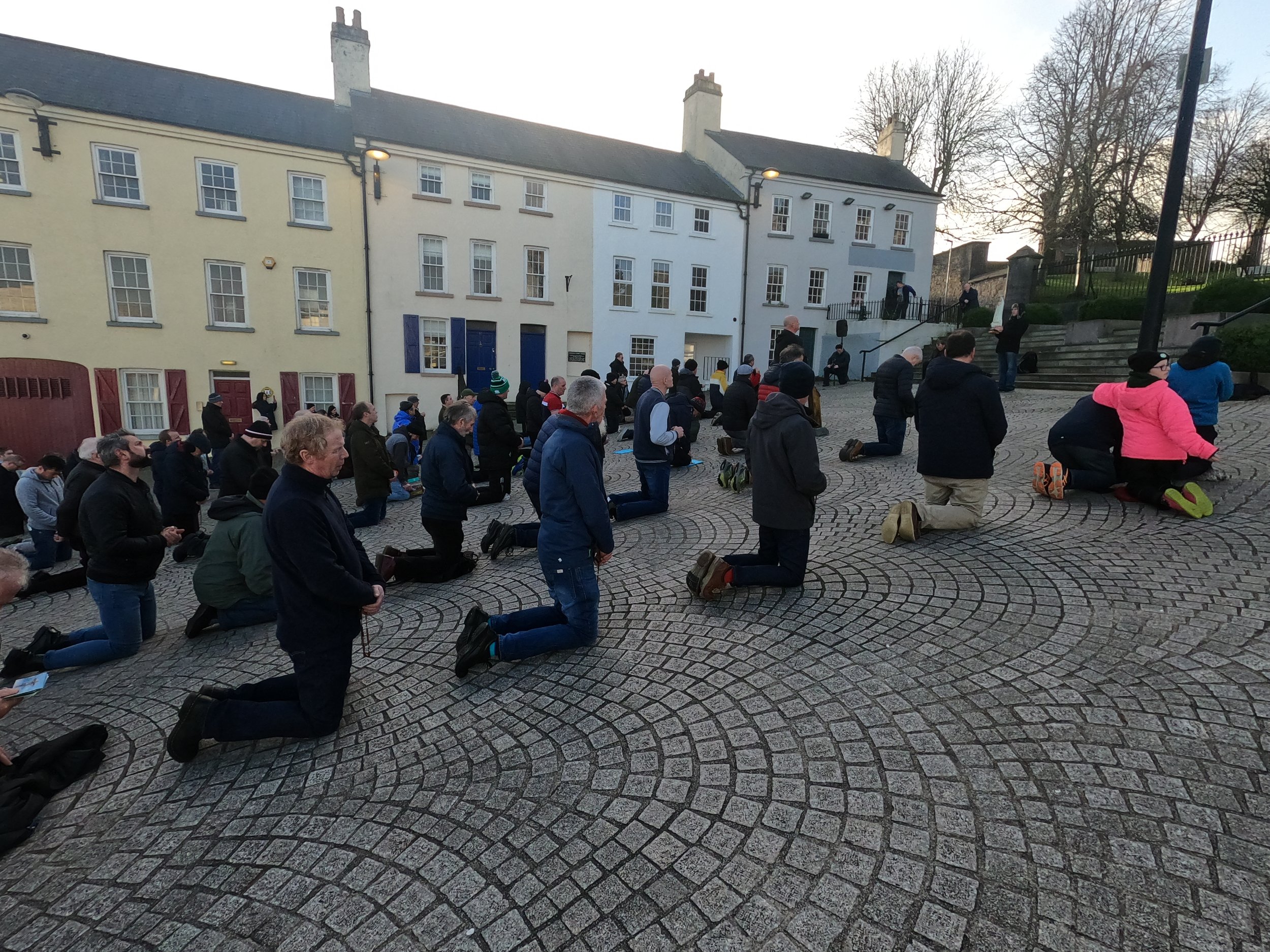
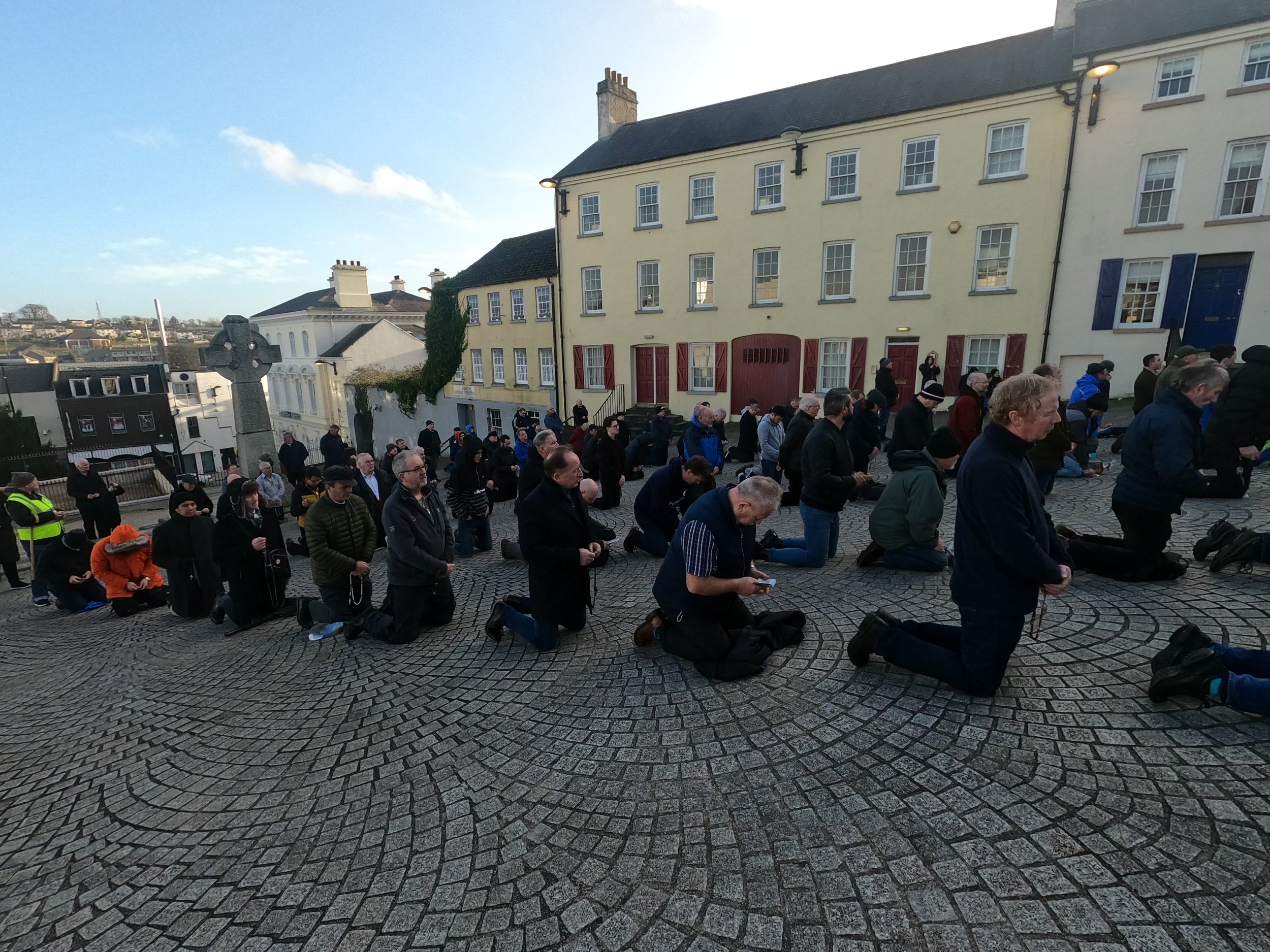
Starting in Poland, Men’s Rosary Rallies have instigated a unique and provocative reclaiming of the church’s place in the public sphere in Europe. The events typically involve men (mostly laymen) meeting in busy public streets or town squares and praying the Rosary in rows of anywhere from 10 to 30 depending on the size of the crowd, normally this will involve kneeling.

Since October, these rallies have also taken place in Ireland, mostly in the North. So far there have been events in Derry, Belfast and Newry and now Armagh.

The organisers have now set up a website www.mensrosaryireland.com in order to promote the events, the next one of which will take place in Omagh on Saturday the 5th of February at 1pm.

You can watch our footage of yesterday’s event below:

Humanum Genus: Pope Leo XIII on Freemasonry

This is the full text of Pope Leo XIII’s famous encyclical condemning the Freemasons, who have hated and persecuted Catholics across the world for centuries now.

To the Patriarchs, Primates, Archbishops, and
Bishops of the Catholic World in Grace and
Communion with the Apostolic See.

The race of man, after its miserable fall from God, the Creator and the Giver of heavenly gifts, "through the envy of the devil," separated into two diverse and opposite parts, of which the one steadfastly contends for truth and virtue, the other of those things which are contrary to virtue and to truth. The one is the kingdom of God on earth, namely, the true Church of Jesus Christ; and those who desire from their heart to be united with it, so as to gain salvation, must of necessity serve God and His only-begotten Son with their whole mind and with an entire will. The other is the kingdom of Satan, in whose possession and control are all whosoever follow the fatal example of their leader and of our first parents, those who refuse to obey the divine and eternal law, and who have many aims of their own in contempt of God, and many aims also against God.

2. This twofold kingdom St. Augustine keenly discerned and described after the manner of two cities, contrary in their laws because striving for contrary objects; and with a subtle brevity he expressed the efficient cause of each in these words: "Two loves formed two cities: the love of self, reaching even to contempt of God, an earthly city; and the love of God, reaching to contempt of self, a heavenly one."(1) At every period of time each has been in conflict with the other, with a variety and multiplicity of weapons and of warfare, although not always with equal ardour and assault. At this period, however, the partisans of evil seems to be combining together, and to be struggling with united vehemence, led on or assisted by that strongly organized and widespread association called the Freemasons. No longer making any secret of their purposes, they are now boldly rising up against God Himself. They are planning the destruction of holy Church publicly and openly, and this with the set purpose of utterly despoiling the nations of Christendom, if it were possible, of the blessings obtained for us through Jesus Christ our Saviour. Lamenting these evils, We are constrained by the charity which urges Our heart to cry out often to God: "For lo, Thy enemies have made a noise; and they that hate Thee have lifted up the head. They have taken a malicious counsel against Thy people, and they have consulted against Thy saints. They have said, 'come, and let us destroy them, so that they be not a nation.'(2)

3. At so urgent a crisis, when so fierce and so pressing an onslaught is made upon the Christian name, it is Our office to point out the danger, to mark who are the adversaries, and to the best of Our power to make head against their plans and devices, that those may not perish whose salvation is committed to Us, and that the kingdom of Jesus Christ entrusted to Our charge may not stand and remain whole, but may be enlarged by an ever-increasing growth throughout the world.

4. The Roman Pontiffs Our predecessors, in their incessant watchfulness over the safety of the Christian people, were prompt in detecting the presence and the purpose of this capital enemy immediately it sprang into the light instead of hiding as a dark conspiracy; and , moreover, they took occasion with true foresight to give, as it were on their guard, and not allow themselves to be caught by the devices and snares laid out to deceive them.

5. The first warning of the danger was given by Clement XII in the year 1738,(3) and his constitution was confirmed and renewed by Benedict XIV(4) Pius VII followed the same path;(5) and Leo XII, by his apostolic constitution, Quo Graviora,(6) put together the acts and decrees of former Pontiffs on this subject, and ratified and confirmed them forever. In the same sense spoke Pius VIII,(7) Gregory XVI,(8) and, many times over, Pius IX.(9)

6. For as soon as the constitution and the spirit of the masonic sect were clearly discovered by manifest signs of its actions, by the investigation of its causes, by publication of its laws, and of its rites and commentaries, with the addition often of the personal testimony of those who were in the secret, this apostolic see denounced the sect of the Freemasons, and publicly declared its constitution, as contrary to law and right, to be pernicious no less to Christiandom than to the State; and it forbade any one to enter the society, under the penalties which the Church is wont to inflict upon exceptionally guilty persons. The sectaries, indignant at this, thinking to elude or to weaken the force of these decrees, partly by contempt of them, and partly by calumny, accused the sovereign Pontiffs who had passed them either of exceeding the bounds of moderation in their decrees or of decreeing what was not just. This was the manner in which they endeavoured to elude the authority and the weight of the apostolic constitutions of Clement XII and Benedict XIV, as well as of Pius VII and Pius IX.(10) Yet, in the very society itself, there were to be found men who unwillingly acknowledged that the Roman Pontiffs had acted within their right, according to the Catholic doctrine and discipline. The Pontiffs received the same assent, and in strong terms, from many princes and heads of governments, who made it their business either to delate the masonic society to the apostolic see, or of their own accord by special enactments to brand it as pernicious, as, for example, in Holland, Austria, Switzerland, Spain, Bavaria, Savoy, and other parts of Italy.

7. But, what is of highest importance, the course of events has demonstrated the prudence of Our predecessors. For their provident and paternal solicitude had not always and every where the result desired; and this, either because of the simulation and cunning of some who were active agents in the mischief, or else of the thoughtless levity of the rest who ought, in their own interest, to have given to the matter their diligent attention. In consequence, the sect of Freemasons grew with a rapidity beyond conception in the course of a century and a half, until it came to be able, by means of fraud or of audacity, to gain such entrance into every rank of the State as to seem to be almost its ruling power. This swift and formidable advance has brought upon the Church, upon the power of princes, upon the public well-being, precisely that grievous harm which Our predecessors had long before foreseen. Such a condition has been reached that henceforth there will be grave reason to fear, not indeed for the Church - for her foundation is much too firm to be overturned by the effort of men - but for those States in which prevails the power, either of the sect of which we are speaking or of other sects not dissimilar which lend themselves to it as disciples and subordinates.

8. For these reasons We no sooner came to the helm of the Church than We clearly saw and felt it to be Our duty to use Our authority to the very utmost against so vast an evil. We have several times already, as occasion served, attacked certain chief points of teaching which showed in a special manner the perverse influence of Masonic opinions. Thus, in Our encyclical letter, Quod Apostolici Muneris, We endeavoured to refute the monstrous doctrines of the socialists and communists; afterwards, in another beginning "Arcanum," We took pains to defend and explain the true and genuine idea of domestic life, of which marriage is the spring and origin; and again, in that which begins ''Diuturnum,"(11) We described the ideal of political government conformed to the principles of Christian wisdom, which is marvellously in harmony, on the one hand, with the natural order of things, and, in the other, with the well-being of both sovereign princes and of nations. It is now Our intention, following the example of Our predecessors, directly to treat of the masonic society itself, of its whole teaching, of its aims, and of its manner of thinking and acting, in order to bring more and more into the light its power for evil, and to do what We can to arrest the contagion of this fatal plague.

9. There are several organized bodies which, though differing in name, in ceremonial, in form and origin, are nevertheless so bound together by community of purpose and by the similarity of their main opinions, as to make in fact one thing with the sect of the Freemasons, which is a kind of center whence they all go forth, and whither they all return. Now, these no longer show a desire to remain concealed; for they hold their meetings in the daylight and before the public eye, and publish their own newspaper organs; and yet, when thoroughly understood, they are found still to retain the nature and the habits of secret societies. There are many things like mysteries which it is the fixed rule to hide with extreme care, not only from strangers, but from very many members, also; such as their secret and final designs, the names of the chief leaders, and certain secret and inner meetings, as well as their decisions, and the ways and means of carrying them out. This is, no doubt, the object of the manifold difference among the members as to right, office, and privilege, of the received distinction of orders and grades, and of that severe discipline which is maintained.

Candidates are generally commanded to promise - nay, with a special oath, to swear - that they will never, to any person, at any time or in any way, make known the members, the passes, or the subjects discussed. Thus, with a fraudulent external appearance, and with a style of simulation which is always the same, the Freemasons, like the Manichees of old, strive, as far as possible, to conceal themselves, and to admit no witnesses but their own members. As a convenient manner of concealment, they assume the character of literary men and scholars associated for purposes of learning. They speak of their zeal for a more cultured refinement, and of their love for the poor; and they declare their one wish to be the amelioration of the condition of the masses, and to share with the largest possible number all the benefits of civil life. Were these purposes aimed at in real truth, they are by no means the whole of their object. Moreover, to be enrolled, it is necessary that the candidates promise and undertake to be thenceforward strictly obedient to their leaders and masters with the utmost submission and fidelity, and to be in readiness to do their bidding upon the slightest expression of their will; or, if disobedient, to submit to the direst penalties and death itself. As a fact, if any are judged to have betrayed the doings of the sect or to have resisted commands given, punishment is inflicted on them not infrequently, and with so much audacity and dexterity that the assassin very often escapes the detection and penalty of his crime.

10. But to simulate and wish to lie hid; to bind men like slaves in the very tightest bonds, and without giving any sufficient reason; to make use of men enslaved to the will of another for any arbitrary act ; to arm men's right hands for bloodshed after securing impunity for the crime - all this is an enormity from which nature recoils. Wherefore, reason and truth itself make it plain that the society of which we are speaking is in antagonism with justice and natural uprightness. And this becomes still plainer, inasmuch as other arguments, also, and those very manifest, prove that it is essentially opposed to natural virtue. For, no matter how great may be men's cleverness in concealing and their experience in lying, it is impossible to prevent the effects of any cause from showing, in some way, the intrinsic nature of the cause whence they come. "A good tree cannot produce bad fruit, nor a bad tree produce good fruit."(12) Now, the masonic sect produces fruits that are pernicious and of the bitterest savour. For, from what We have above most clearly shown, that which is their ultimate purpose forces itself into view - namely, the utter overthrow of that whole religious and political order of the world which the Christian teaching has produced, and the substitution of a new state of things in accordance with their ideas, of which the foundations and laws shall be drawn from mere naturalism.

11. What We have said, and are about to say, must be understood of the sect of the Freemasons taken generically, and in so far as it comprises the associations kindred to it and confederated with it, but not of the individual members of them. There may be persons amongst these, and not a few who, although not free from the guilt of having entangled themselves in such associations, yet are neither themselves partners in their criminal acts nor aware of the ultimate object which they are endeavoring to attain. In the same way, some of the affiliated societies, perhaps, by no means approve of the extreme conclusions which they would, if consistent, embrace as necessarily following from their common principles, did not their very foulness strike them with horror. Some of these, again, are led by circumstances of times and places either to aim at smaller things than the others usually attempt or than they themselves would wish to attempt. They are not, however, for this reason, to be reckoned as alien to the masonic federation; for the masonic federation is to be judged not so much by the things which it has done, or brought to completion, as by the sum of its pronounced opinions.

12. Now, the fundamental doctrine of the naturalists, which they sufficiently make known by their very name, is that human nature and human reason ought in all things to be mistress and guide. Laying this down, they care little for duties to God, or pervert them by erroneous and vague opinions. For they deny that anything has been taught by God; they allow no dogma of religion or truth which cannot be understood by the human intelligence, nor any teacher who ought to be believed by reason of his authority. And since it is the special and exclusive duty of the Catholic Church fully to set forth in words truths divinely received, to teach, besides other divine helps to salvation, the authority of its office, and to defend the same with perfect purity, it is against the Church that the rage and attack of the enemies are principally directed.

13. In those matters which regard religion let it be seen how the sect of the Freemasons acts, especially where it is more free to act without restraint, and then let any one judge whether in fact it does not wish to carry out the policy of the naturalists. By a long and persevering labor, they endeavor to bring about this result - namely, that the teaching office and authority of the Church may become of no account in the civil State; and for this same reason they declare to the people and contend that Church and State ought to be altogether disunited. By this means they reject from the laws and from the commonwealth the wholesome influence of the Catholic religion; and they consequently imagine that States ought to be constituted without any regard for the laws and precepts of the Church.

14. Nor do they think it enough to disregard the Church - the best of guides - unless they also injure it by their hostility. Indeed, with them it is lawful to attack with impunity the very foundations of the Catholic religion, in speech, in writing, and in teaching; and even the rights of the Church are not spared, and the offices with which it is divinely invested are not safe. The least possible liberty to manage affairs is left to the Church; and this is done by laws not apparently very hostile, but in reality framed and fitted to hinder freedom of action. Moreover, We see exceptional and onerous laws imposed upon the clergy, to the end that they may be continually diminished in number and in necessary means. We see also the remnants of the possessions of the Church fettered by the strictest conditions, and subjected to the power and arbitrary will of the administrators of the State, and the religious orders rooted up and scattered.

15. But against the apostolic see and the Roman Pontiff the contention of these enemies has been for a long time directed. The Pontiff was first, for specious reasons, thrust out from the bulwark of his liberty and of his right, the civil princedom; soon, he was unjustly driven into a condition which was unbearable because of the difficulties raised on all sides; and now the time has come when the partisans of the sects openly declare, what in secret among themselves they have for a long time plotted, that the sacred power of the Pontiffs must be abolished, and that the papacy itself, founded by divine right, must be utterly destroyed. If other proofs were wanting, this fact would be sufficiently disclosed by the testimony of men well informed, of whom some at other times, and others again recently, have declared it to be true of the Freemasons that they especially desire to assail the Church with irreconcilable hostility, and that they will never rest until they have destroyed whatever the supreme Pontiffs have established for the sake of religion.

16. If those who are admitted as members are not commanded to abjure by any form of words the Catholic doctrines, this omission, so far from being adverse to the designs of the Freemasons, is more useful for their purposes. First, in this way they easily deceive the simple-minded and the heedless, and can induce a far greater number to become members. Again, as all who offer themselves are received whatever may be their form of religion, they thereby teach the great error of this age-that a regard for religion should be held as an indifferent matter, and that all religions are alike. This manner of reasoning is calculated to bring about the ruin of all forms of religion, and especially of the Catholic religion, which, as it is the only one that is true, cannot, without great injustice, be regarded as merely equal to other religions.

17. But the naturalists go much further; for, having, in the highest things, entered upon a wholly erroneous course, they are carried headlong to extremes, either by reason of the weakness of human nature, or because God inflicts upon them the just punishment of their pride. Hence it happens that they no longer consider as certain and permanent those things which are fully understood by the natural light of reason, such as certainly are - the existence of God, the immaterial nature of the human soul, and its immortality. The sect of the Freemasons, by a similar course of error, is exposed to these same dangers; for, although in a general way they may profess the existence of God, they themselves are witnesses that they do not all maintain this truth with the full assent of the mind or with a firm conviction. Neither do they conceal that this question about God is the greatest source and cause of discords among them; in fact, it is certain that a considerable contention about this same subject has existed among them very lately. But, indeed, the sect allows great liberty to its votaries, so that to each side is given the right to defend its own opinion, either that there is a God, or that there is none; and those who obstinately contend that there is no God are as easily initiated as those who contend that God exists, though, like the pantheists, they have false notions concerning Him: all which is nothing else than taking away the reality, while retaining some absurd representation of the divine nature.

18. When this greatest fundamental truth has been overturned or weakened, it follows that those truths, also, which are known by the teaching of nature must begin to fall - namely, that all things were made by the free will of God the Creator; that the world is governed by Providence; that souls do not die; that to this life of men upon the earth there will succeed another and an everlasting life.

19. When these truths are done away with, which are as the principles of nature and important for knowledge and for practical use, it is easy to see what will become of both public and private morality. We say nothing of those more heavenly virtues, which no one can exercise or even acquire without a special gift and grace of God; of which necessarily no trace can be found in those who reject as unknown the redemption of mankind, the grace of God, the sacraments, and the happiness to be obtained in heaven. We speak now of the duties which have their origin in natural probity. That God is the Creator of the world and its provident Ruler; that the eternal law commands the natural order to be maintained, and forbids that it be disturbed; that the last end of men is a destiny far above human things and beyond this sojourning upon the earth: these are the sources and these the principles of all justice and morality. If these be taken away, as the naturalists and Freemasons desire, there will immediately be no knowledge as to what constitutes justice and injustice, or upon what principle morality is founded. And, in truth, the teaching of morality which alone finds favor with the sect of Freemasons, and in which they contend that youth should be instructed, is that which they call "civil," and "independent," and "free," namely, that which does not contain any religious belief. But, how insufficient such teaching is, how wanting in soundness, and how easily moved by every impulse of passion, is sufficiently proved by its sad fruits, which have already begun to appear. For, wherever, by removing Christian education, this teaching has begun more completely to rule, there goodness and integrity of morals have begun quickly to perish, monstrous and shameful opinions have grown up, and the audacity of evil deeds has risen to a high degree. All this is commonly complained of and deplored; and not a few of those who by no means wish to do so are compelled by abundant evidence to give not infrequently the same testimony.

20. Moreover, human nature was stained by original sin, and is therefore more disposed to vice than to virtue. For a virtuous life it is absolutely necessary to restrain the disorderly movements of the soul, and to make the passions obedient to reason. In this conflict human things must very often be despised, and the greatest labors and hardships must be undergone, in order that reason may always hold its sway. But the naturalists and Freemasons, having no faith in those things which we have learned by the revelation of God, deny that our first parents sinned, and consequently think that free will is not at all weakened and inclined to evil.(13) On the contrary, exaggerating rather the power and the excellence of nature, and placing therein alone the principle and rule of justice, they cannot even imagine that there is any need at all of a constant struggle and a perfect steadfastness to overcome the violence and rule of our passions.

Wherefore we see that men are publicly tempted by the many allurements of pleasure; that there are journals and pamphlets with neither moderation nor shame; that stage-plays are remarkable for license; that designs for works of art are shamelessly sought in the laws of a so called verism; that the contrivances of a soft and delicate life are most carefully devised; and that all the blandishments of pleasure are diligently sought out by which virtue may be lulled to sleep. Wickedly, also, but at the same time quite consistently, do those act who do away with the expectation of the joys of heaven, and bring down all happiness to the level of mortality, and, as it were, sink it in the earth. Of what We have said the following fact, astonishing not so much in itself as in its open expression, may serve as a confirmation. For, since generally no one is accustomed to obey crafty and clever men so submissively as those whose soul is weakened and broken down by the domination of the passions, there have been in the sect of the Freemasons some who have plainly determined and proposed that, artfully and of set purpose, the multitude should be satiated with a boundless license of vice, as, when this had been done, it would easily come under their power and authority for any acts of daring.

21. What refers to domestic life in the teaching of the naturalists is almost all contained in the following declarations: that marriage belongs to the genus of commercial contracts, which can rightly be revoked by the will of those who made them, and that the civil rulers of the State have power over the matrimonial bond; that in the education of youth nothing is to be taught in the matter of religion as of certain and fixed opinion; and each one must be left at liberty to follow, when he comes of age, whatever he may prefer. To these things the Freemasons fully assent; and not only assent, but have long endeavoured to make them into a law and institution. For in many countries, and those nominally Catholic, it is enacted that no marriages shall be considered lawful except those contracted by the civil rite; in other places the law permits divorce; and in others every effort is used to make it lawful as soon as may be. Thus, the time is quickly coming when marriages will be turned into another kind of contract - that is into changeable and uncertain unions which fancy may join together, and which the same when changed may disunite.

With the greatest unanimity the sect of the Freemasons also endeavours to take to itself the education of youth. They think that they can easily mold to their opinions that soft and pliant age, and bend it whither they will; and that nothing can be more fitted than this to enable them to bring up the youth of the State after their own plan. Therefore, in the education and instruction of children they allow no share, either of teaching or of discipline, to the ministers of the Church; and in many places they have procured that the education of youth shall be exclusively in the hands of laymen, and that nothing which treats of the most important and most holy duties of men to God shall be introduced into the instructions on morals.

22. Then come their doctrines of politics, in which the naturalists lay down that all men have the same right, and are in every respect of equal and like condition; that each one is naturally free; that no one has the right to command another; that it is an act of violence to require men to obey any authority other than that which is obtained from themselves. According to this, therefore, all things belong to the free people; power is held by the command or permission of the people, so that, when the popular will changes, rulers may lawfully be deposed and the source of all rights and civil duties is either in the multitude or in the governing authority when this is constituted according to the latest doctrines. It is held also that the State should be without God; that in the various forms of religion there is no reason why one should have precedence of another; and that they are all to occupy the same place.

23. That these doctrines are equally acceptable to the Freemasons, and that they would wish to constitute States according to this example and model, is too well known to require proof. For some time past they have openly endeavoured to bring this about with all their strength and resources; and in this they prepare the way for not a few bolder men who are hurrying on even to worse things, in their endeavor to obtain equality and community of all goods by the destruction of every distinction of rank and property.

24. What, therefore, sect of the Freemasons is, and what course it pursues, appears sufficiently from the summary We have briefly given. Their chief dogmas are so greatly and manifestly at variance with reason that nothing can be more perverse. To wish to destroy the religion and the Church which God Himself has established, and whose perpetuity He insures by His protection, and to bring back after a lapse of eighteen centuries the manners and customs of the pagans, is signal folly and audacious impiety. Neither is it less horrible nor more tolerable that they should repudiate the benefits which Jesus Christ so mercifully obtained, not only for individuals, but also for the family and for civil society, benefits which, even according to the judgment and testimony of enemies of Christianity, are very great. In this insane and wicked endeavor we may almost see the implacable hatred and spirit of revenge with which Satan himself is inflamed against Jesus Christ. - So also the studious endeavour of the Freemasons to destroy the chief foundations of justice and honesty, and to co-operate with those who would wish, as if they were mere animals, to do what they please, tends only to the ignominious and disgraceful ruin of the human race.

The evil, too, is increased by the dangers which threaten both domestic and civil society. As We have elsewhere shown,(14) in marriage, according to the belief of almost every nation, there is something sacred and religious; and the law of God has determined that marriages shall not be dissolved. If they are deprived of their sacred character, and made dissoluble, trouble and confusion in the family will be the result, the wife being deprived of her dignity and the children left without protection as to their interests and well being.-To have in public matters no care for religion, and in the arrangement and administration of civil affairs to have no more regard for God than if He did not exist, is a rashness unknown to the very pagans; for in their heart and soul the notion of a divinity and the need of public religion were so firmly fixed that they would have thought it easier to have city without foundation than a city without God. Human society, indeed for which by nature we are formed, has been constituted by God the Author of nature; and from Him, as from their principle and source, flow in all their strength and permanence the countless benefits with which society abounds. As we are each of us admonished by the very voice of nature to worship God in piety and holiness, as the Giver unto us of life and of all that is good therein, so also and for the same reason, nations and States are bound to worship Him; and therefore it is clear that those who would absolve society from all religious duty act not only unjustly but also with ignorance and folly.

25. As men are by the will of God born for civil union and society, and as the power to rule is so necessary a bond of society that, if it be taken away, society must at once be broken up, it follows that from Him who is the Author of society has come also the authority to rule; so that whosoever rules, he is the minister of God. Wherefore, as the end and nature of human society so requires, it is right to obey the just commands of lawful authority, as it is right to obey God who ruleth all things; and it is most untrue that the people have it in their power to cast aside their obedience whensoever they please.

26. In like manner, no one doubts that all men are equal one to another, so far as regards their common origin and nature, or the last end which each one has to attain, or the rights and duties which are thence derived. But, as the abilities of all are not equal, as one differs from another in the powers of mind or body, and as there are very many dissimilarities of manner, disposition, and character, it is most repugnant to reason to endeavor to confine all within the same measure, and to extend complete equality to the institutions of civic life. Just as a perfect condition of the body results from the conjunction and composition of its various members, which, though differing in form and purpose, make, by their union and the distribution of each one to its proper place, a combination beautiful to behole, firm in strength, and necessary for use; so, in the commonwealth, there is an almost infinite dissimilarity of men, as parts of the whole. If they are to be all equal, and each is to follow his own will, the State will appear most deformed; but if, with a distinction of degrees of dignity, of pursuits and employments, all aptly conspire for the common good, they will present the image of a State both well constituted and conformable to nature.

27. Now, from the disturbing errors which We have described the greatest dangers to States are to be feared. For, the fear of God and reverence for divine laws being taken away, the authority of rulers despised, sedition permitted and approved, and the popular passions urged on to lawlessness, with no restraint save that of punishment, a change and overthrow of all things will necessarily follow. Yea, this change and overthrow is deliberately planned and put forward by many associations of communists and socialists; and to their undertakings the sect of Freemasons is not hostile, but greatly favours their designs, and holds in common with them their chief opinions. And if these men do not at once and everywhere endeavour to carry out their extreme views, it is not to be attributed to their teaching and their will, but to the virtue of that divine religion which cannot be destroyed; and also because the sounder part of men, refusing to be enslaved to secret societies, vigorously resist their insane attempts.

28. Would that all men would judge of the tree by its fruit, and would acknowledge the seed and origin of the evils which press upon us, and of the dangers that are impending! We have to deal with a deceitful and crafty enemy, who, gratifying the ears of people and of princes, has ensnared them by smooth speeches and by adulation. Ingratiating themselves with rulers under a pretense of friendship, the Freemasons have endeavoured to make them their allies and powerful helpers for the destruction of the Christian name; and that they might more strongly urge them on, they have, with determined calumny, accused the Church of invidiously contending with rulers in matters that affect their authority and sovereign power. Having, by these artifices, insured their own safety and audacity, they have begun to exercise great weight in the government of States; but nevertheless they are prepared to shake the foundations of empires, to harass the rulers of the State, to accuse, and to cast them out, as often as they appear to govern otherwise than they themselves could have wished. In like manner, they have by flattery deluded the people. Proclaiming with a loud voice liberty and public prosperity, and saying that it was owing to the Church and to sovereigns that the multitude were not drawn out of their unjust servitude and poverty, they have imposed upon the people, and, exciting them by a thirst for novelty, they have urged them to assail both the Church and the civil power. Nevertheless, the expectation of the benefits which was hoped for is greater than the reality; indeed, the common people, more oppressed than they were before, are deprived in their misery of that solace which, if things had been arranged in a Christian manner, they would have had with ease and in abundance. But, whoever strive against the order which Divine Providence has constituted pay usually the penalty of their pride, and meet with affliction and misery where they rashly hoped to find all things prosperous and in conformity with their desires.

29. The Church, if she directs men to render obedience chiefly and above all to God the sovereign Lord, is wrongly and falsely believed either to be envious of the civil power or to arrogate to herself something of the rights of sovereigns. On the contrary, she teaches that what is rightly due to the civil power must be rendered to it with a conviction and consciousness of duty. In teaching that from God Himself comes the right of ruling, she adds a great dignity to civil authority, and on small help towards obtaining the obedience and good will of the citizens. The friend of peace and sustainer of concord, she embraces all with maternal love, and, intent only upon giving help to mortal man, she teaches that to justice must be joined clemency, equity to authority, and moderation to lawgiving; that no one's right must be violated; that order and public tranquility are to be maintained; and that the poverty of those are in need is, as far as possible, to be relieved by public and private charity. "But for this reason," to use the words of St. Augustine, "men think, or would have it believed, that Christian teaching is not suited to the good of the State; for they wish the State to be founded not on solid virtue, but on the impunity of vice."(15) Knowing these things, both princes and people would act with political wisdom,(16) and according to the needs of general safety, if, instead of joining with Freemasons to destroy the Church, they joined with the Church in repelling their attacks.

30 .Whatever the future may be, in this grave and widespread evil it is Our duty, venerable brethren, to endeavour to find a remedy. And because We know that Our best and firmest hope of a remedy is in the power of that divine religion which the Freemasons hate in proportion to their fear of it, We think it to be of chief importance to call that most saving power to Our aid against the common enemy. Therefore, whatsoever the Roman Pontiffs Our predecessors have decreed for the purpose of opposing the undertakings and endeavours of the masonic sect, and whatsoever they have enacted to enter or withdraw men from societies of this kind, We ratify and confirm it all by our apostolic authority: and trusting greatly to the good will of Christians, We pray and beseech each one, for the sake of his eternal salvation, to be most conscientiously careful not in the least to depart from what the apostolic see has commanded in this matter.

31. We pray and beseech you, venerable brethren, to join your efforts with Ours, and earnestly to strive for the extirpation of this foul plague, which is creeping through the veins of the body politic. You have to defend the glory of God and the salvation of your neighbour; and with the object of your strife before you, neither courage nor strength will be wanting. It will be for your prudence to judge by what means you can best overcome the difficulties and obstacles you meet with. But, as it befits the authority of Our office that We Ourselves should point out some suitable way of proceeding, We wish it to be your rule first of all to tear away the mask from Freemasonry, and to let it be seen as it really is; and by sermons and pastoral letters to instruct the people as to the artifices used by societies of this kind in seducing men and enticing them into their ranks, and as to the depravity of their opinions and the wickedness of their acts. As Our predecessors have many times repeated, let no man think that he may for any reason whatsoever join the masonic sect, if he values his Catholic name and his eternal salvation as he ought to value them. Let no one be deceived by a pretense of honesty. It may seem to some that Freemasons demand nothing that is openly contrary to religion and morality; but, as the whole principle and object of the sect lies in what is vicious and criminal, to join with these men or in any way to help them cannot be lawful.

32. Further, by assiduous teaching and exhortation, the multitude must be drawn to learn diligently the precepts of religion; for which purpose we earnestly advise that by opportune writings and sermons they be taught the elements of those sacred truths in which Christian philosophy is contained. The result of this will be that the minds of men will be made sound by instruction, and will be protected against many forms of error and inducements to wickedness, especially in the present unbounded freedom of writing and insatiable eagerness for learning.

33. Great, indeed, is the work; but in it the clergy will share your labours, if, through your care, they are fitted for it by learning and a well-turned life. This good and great work requires to be helped also by the industry of those amongst the laity in whom a love of religion and of country is joined to learning and goodness of life. By uniting the efforts of both clergy and laity, strive, venerable brethren, to make men thoroughly know and love the Church; for, the greater their knowledge and love of the Church, the more will they be turned away from clandestine societies.

34. Wherefore, not without cause do We use this occasion to state again what We have stated elsewhere, namely, that the Third Order of St. Francis, whose discipline We a little while ago prudently mitigated,(16) should be studiously promoted and sustained; for the whole object of this Order, as constituted by its founder, is to invite men to an imitation of Jesus Christ, to a love of the Church, and to the observance of all Christian virtues; and therefore it ought to be of great influence in suppressing the contagion of wicked societies. Let, therefore, this holy sodality be strengthened by a daily increase. Amongst the many benefits to be expected from it will be the great benefit of drawing the minds of men to liberty, fraternity, and equality of right; not such as the Freemasons absurdly imagine, but such as Jesus Christ obtained for the human race and St. Francis aspired to: the liberty, We mean, of sons of God, through which we may be free from slavery to Satan or to our passions, both of them most wicked masters; the fraternity whose origin is in God, the common Creator and Father of all; the equality which, founded on justice and charity, does not take away all distinctions among men, but, out of the varieties of life, of duties, and of pursuits, forms that union and that harmony which naturally tend to the benefit and dignity of society.

35. In the third place, there is a matter wisely instituted by our forefathers, but in course of time laid aside, which may now be used as a pattern and form of something similar. We mean the associations of guilds of workmen, for the protection, under the guidance of religion, both of their temporal interests and of their morality. If our ancestors, by long use and experience, felt the benefit of these guilds, our age perhaps will feel it the more by reason of the opportunity which they will give of crushing the power of the sects. Those who support themselves by the labour of their hands, besides being, by their very condition, most worthy above all others of charity and consolation, are also especially exposed to the allurements of men whose ways lie in fraud and deceit. Therefore, they ought to be helped with the greatest possible kindness, and to be invited to join associations that are good, lest they be drawn away to others that are evil. For this reason, We greatly wish, for the salvation of the people, that, under the auspices and patronage of the bishops, and at convenient times, these gilds may be generally restored. To Our great delight, sodalities of this kind and also associations of masters have in many places already been established, having, each class of them, for their object to help the honest workman, to protect and guard his children and family, and to promote in them piety, Christian knowledge, and a moral life. And in this matter We cannot omit mentioning that exemplary society, named after its founder, St. Vincent, which has deserved so well of the lower classes. Its acts and its aims are well known. Its whole object is to give relief to the poor and miserable. This it does with singular prudence and modesty; and the less it wishes to be seen, the better is it fitted for the exercise of Christian charity, and for the relief of suffering.

36. In the fourth place, in order more easily to attain what We wish, to your fidelity and watchfulness We commend in a special manner the young, as being the hope of human society. Devote the greatest part of your care to their instruction; and do not think that any precaution can be great enough in keeping them from masters and schools whence the pestilent breath of the sects is to be feared. Under your guidance, let parents, religious instructors, and priests having the cure of souls use every opportunity, in their Christian teaching, of warning their children and pupils of the infamous nature of these societies, so that they may learn in good time to beware of the various and fraudulent artifices by which their promoters are accustomed to ensnare people. And those who instruct the young in religious knowledge will act wisely if they induce all of them to resolve and to undertake never to bind themselves to any society without the knowledge of their parents, or the advice of their parish priest or director.

37. We well know, however, that our united labors will by no means suffice to pluck up these pernicious seeds from the Lord's field, unless the Heavenly Master of the vineyard shall mercifully help us in our endeavours. We must, therefore, with great and anxious care, implore of Him the help which the greatness of the danger and of the need requires. The sect of the Freemasons shows itself insolent and proud of its success, and seems as if it would put no bounds to its pertinacity. Its followers, joined together by a wicked compact and by secret counsels, give help one to another, and excite one another to an audacity for evil things. So vehement an attack demands an equal defence-namely, that all good men should form the widest possible association of action and of prayer. We beseech them, therefore, with united hearts, to stand together and unmoved against the advancing force of the sects; and in mourning and supplication to stretch out their hands to God, praying that the Christian name may flourish and prosper, that the Church may enjoy its needed liberty, that those who have gone astray may return to a right mind, that error at length may give place to truth, and vice to virtue. Let us take our helper and intercessor the Virgin Mary, Mother of God, so that she, who from the moment of her conception overcame Satan may show her power over these evil sects, in which is revived the contumacious spirit of the demon, together with his unsubdued perfidy and deceit. Let us beseech Michael, the prince of the heavenly angels, who drove out the infernal foe; and Joseph, the spouse of the most holy Virgin, and heavenly patron of the Catholic Church; and the great Apostles, Peter and Paul, the fathers and victorious champions of the Christian faith. By their patronage, and by perseverance in united prayer, we hope that God will mercifully and opportunely succor the human race, which is encompassed by so many dangers.

38. As a pledge of heavenly gifts and of Our benevolence, We lovingly grant in the Lord, to you, venerable brethren, and to the clergy and all the people committed to your watchful care, Our apostolic benediction.

Given at St. Peter's in Rome, the twentieth day of April, 1884, the sixth year of Our pontificate. 

2021: A Bleak Year For the Irish Unborn

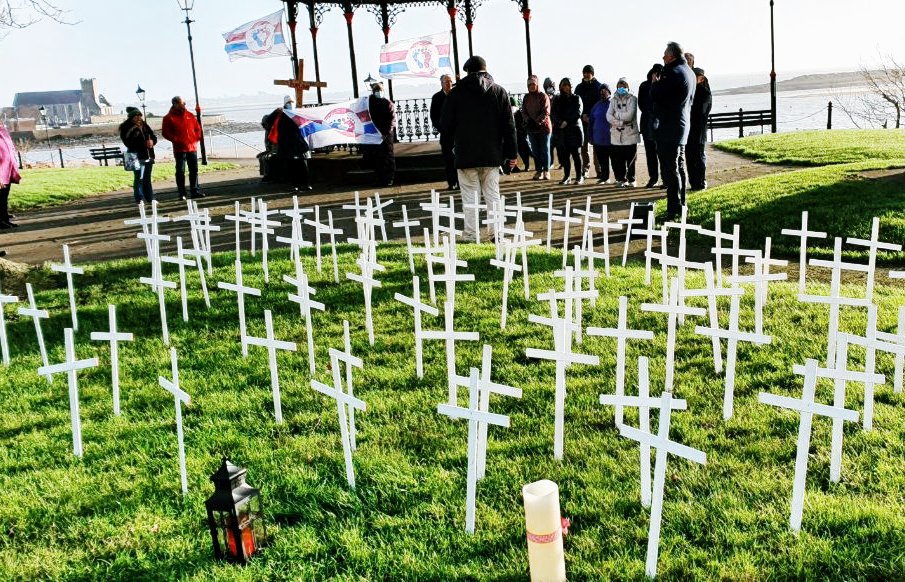
Just three years ago, On New Year’s Day 2019, abortion on demand became legal after the deletion of the RIGHT TO LIFE, contained in the 8th Amendment of our Irish constitution.
Three years later, we gather to remember those unborn boys and girls who have been aborted since REPEAL. According to The Irish abortion clock, almost 20 thousand unborn children have lost their lives since REPEAL.

According to www.irishabortionclock.com, almost 20,000 unborn children have been aborted since the introduction of laws allowing elective abortions in Ireland.

Today, we will be laying 100 white crosses to represent those children’s lives. Our brothers, sisters, nephews, nieces, cousins, sons and daughters.

As we lay each White Cross, please remember that each single cross represents 200 lost lives. Some unwanted, some disabled, some wanted but aborted for social or economic reasons.

As we lay each White Cross, please remember the mothers and fathers who suffer the loss of their child and those parents who regret the abortion of their child.

Last Year, pro-abortion political parties and abortion organisations started calling for a start to the promised Three Year Review of abortion legislation. These groups don’t want to reduce abortion by providing a child friendly environment, they want MORE child abortions. These groups use words like “Reproductive Rights” and “pro-choice” to market more abortions in Ireland.

We have been told that this Three year Review will be held independently of Government, but the Pro Life Campaign has reported that the Minister for Health is approaching the abortion review with a view to “radically expanding” abortions in Ireland.

Ms Eilis Mulroy of the Prolife Campaign said that the minister’s “one-sided” approach means the review could be a “cold house” for those who hold a pro-life viewpoint.

The main campaign by the pro-choice activists during this review is to have the 3 day reflection period removed. These abortion activists think it’s a bad idea to have expectant mothers reflect on aborting their child. However, Gript News reported that this 3 day reflection period led to an estimated 870 expectant mothers changing their minds and not carrying out an abortion in 2019. Yet, the abortion activists want to remove this life saving process?

As we stand here today, In Ireland, there is a major legal and media push to implement exclusion zones around premises where abortion doctors carry out child abortions. Any future legislation will make criminals of any participants who hold peaceful vigils outside premises committing abortions.

Organisations such as Together for Safety, Abortion Rights Campaign, political parties such as Fine Gael, Labour, People before Profit, Green Party, Sinn Fein and Fianna Fáil all want exclusion zones around premises where abortions and performed.

These groups tell us that it’s to protect the rights of mothers. They tell us that prolife people who take part in prolife vigils intimidate and harass mothers entering abortion premises.

Their allegations against prolife people go unchallenged in the Dáil and in the mainstream, mostly pro abortion media.

However allegations by pro abortion politicians, media organisations and the reasons given to introduce legislation to ban prolife vigils near abortion premises do not stack up to scrutiny.

Back in September 2019, GRIPT.ie reported

“The (Garda) Commissioner confirmed his “satisfaction with existing public order legislation to adequately deal with any reasonable public order incident that may arise at such centres. I re-confirm my views expressed at our recent meeting that protests to date at such centres have not contravened the law and are peaceful.”

There was “no evidence to suggest that there is threatening, abusive or insulting behaviour directed towards persons utilising those services,” the Commissioner added in his letter to the Minister for Health.

More recently in December 2021 Limerick Hospital joined the exclusion zone debate saying “The UL (University Hospital) Hospitals Group has said it is has not received any complaints from patients or their families or staff relating to safe access to University Maternity Hospital Limerick, despite a number of politicians calling for a “safe access zone” to be organised at the hospital claiming anti-abortion protestors have regularly been intimidating patients going in and out of the hospital throughout 2021 reported the Limerick Post.

Yet, for the first time in modern Irish history, a minority group will be banned from peaceful protest near the vicinity of abortion premises.

The minority pro-life community will be censored and criminalised. Imagine the backlash if the minority LGBT parades were targeted and banned.

In pro-life countries like Hungary, their government encourages couples and families. Hungarians are encouraged to marry, have children and receive financial supports and housing. The Hungarian parliament has a minister for the Family, not just a minister for Children like we have here in Ireland. All legislation implemented in Hungary goes through a rigorous analysis to measure the positive and negative impacts on Families living in Hungary

That’s the opposite to what our government do here in Ireland. In some ways, families are discouraged. The lack of affordable Housing for couples looking to start a family being one blatant anti-family policy. Another is the tax position for mothers who choose to stay at home to have a family.

Also in 2021, some brave Irish politicians in the Life and dignity Group drafted a Bill to provide pain relief for the unborn child in certain cases of abortion.

The first stage of the Bill stated the following;

“The infliction of unnecessary or avoidable pain on human beings, especially those with no capacity to resist, is something that all compassionate societies should seek to avoid.”

“Thankfully, in most areas of modern medicine, this principle is routinely adopted in practice.”

“This is why medical ethics require that surgical procedures, both routine and major, are carried out with the use of anaesthetics and analgesics, except in extreme circumstances where this is not possible.”

“These values also inform our attitudes to the treatment of animals. Under the Animal Health and Welfare Act 2013, vets and farmers are required to use anaesthetics when carrying out any procedure on an animal.”

The Foetal Pain Relief Bill was debated in December 2021 and we had Deputy Holly Cairns, a TD in the Social Democrats Party tweeted:

"The 'Foetal Pain Relief' Bill is an attempt to drag us backwards.

The women of Ireland who have had to endure patriarchal control for generations, will not put up with it.

The days of middle-aged men trying to control the bodies of young women are over."

The Bill was supported by two Waterford TD’s Independent TD, Matt Shanahan and Fianna Fails TD and Minister Mary Butler. We thank both of these Deputies for their compassionate support.

We also invited all Waterford TD’s and County councillors to this White Cross Memorial today.

We received email acknowledgments from Deputies Mary Butler, Matt Shanahan and David Cullinane.

As of last week, we received no responses from any Waterford based county councillors.

We are saddened that child abortion is now a political football used to gain votes for liberal politicians.

2021 also saw the launch of the International Prolife Flag. This is a major positive move for prolife advocates around the world. We finally have a universal symbol we can rally around and increase our voice.

Today, is the first time we will unfurl the new Prolife flag in Waterford.

On behalf of DeiseForLife, Thank you all for attending and participating and keeping the Prolife message alive in our communities, workplaces and homes.

May you all have a Happy and Peaceful 2022.

The Deise4Life Committee

Top 10 Catholic Images of 2021

2021 was a strange year for Catholicism.

The Latin Mass was suppressed, every Sacrament was suppressed for much of the year here in Ireland (even as government officials jetted around the world) and yet, there were many scenes of Catholics proudly defending their churches from secular attacks.

Here are 10 images that defined the year.

10. Pope Francis sitting in the ruins of Mosul, Iraq.

The city was home to the worst of the persecutions and crucifixions by ISIS, after the illegal war of the UK and the USA unleashed hell for Christians in the Middle East. 81% of Christians in Iraq were killed or expelled because of the results of the war crimes of the UK and USA.

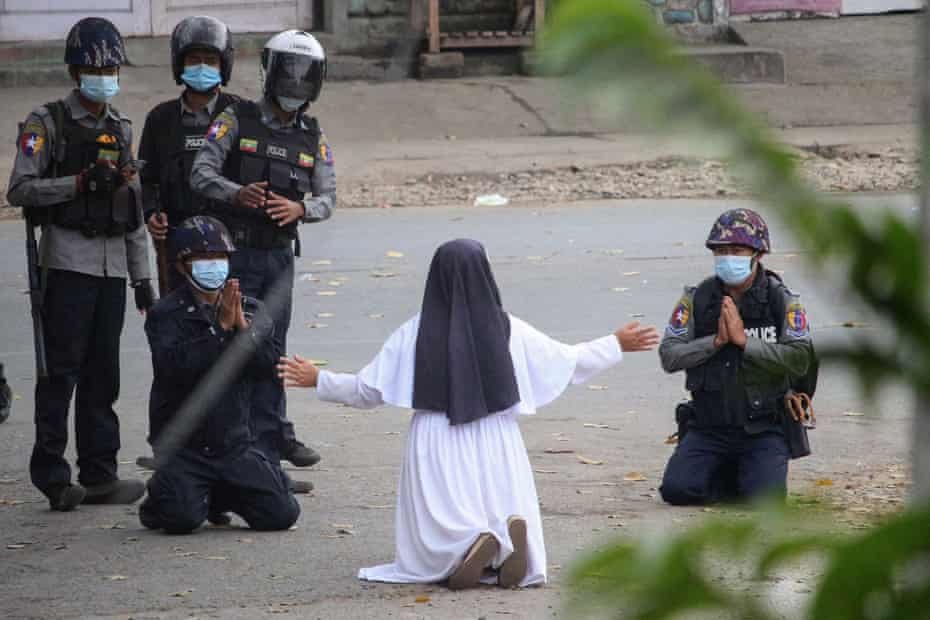
9. Myanmar nun calls for end to violence.

This image went viral in 2021 as a Catholic nun begged police and soldiers to stop targeting civilians in Myanmar.

8. Sydney Catholic Defend Church.

St. Mary’s Cathedral was home to a deliberate attack on the Catholic faith earlier this year, with an anti Catholic concert scheduled for outside its grounds. A number of Catholics rallied to defend the beautiful building and successfully repelled any would be attackers.

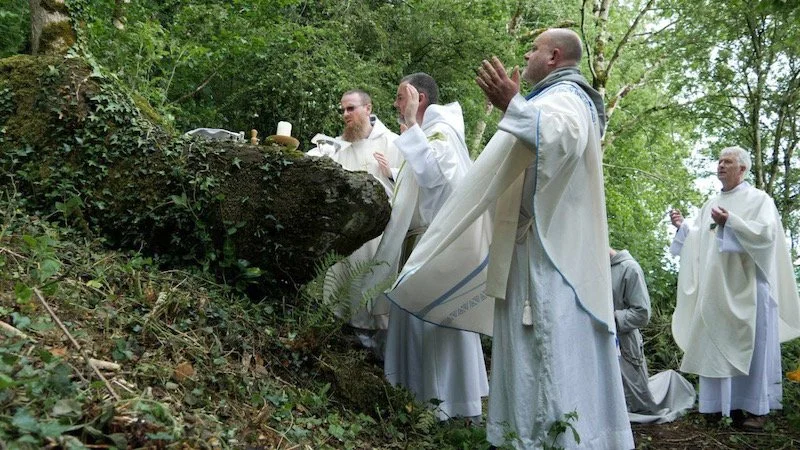
7. Mass Rock

The Franciscan Friars of the Renewal were among a number of Irish priests who answered the unjust persecution of the Globalist government with a return to Ireland’s Mass Rocks, where the faith was said in secret for centuries.

6. Irish Men’s Rosary Rally

Newry was one of a number of locations where Irish men drew large crowds at Rosary Rallies.

5. Irish State Stages Siege Against Mass

Fr. PJ Hughes had his whole village swarmed by Gardai in order to stop individuals from attending Mass, even as government officials partied hard into the long hours to celebrate Ireland being named on the UN Security Council. An interesting anecdote is that one local newspaper published this story, right beside the curious republishing of an historic article celebrating Freemasonry in the town.

The image sent shockwaves throughout the world, with the rest of the world marvelling at the deep seethed hatred for the Catholic faith that was held by the Irish government.

4. French police watch Nanterre church.

After a procession was attacked with priests spat on and threats of beheadings, this church in Nanterre was among many watched by police and soldiers in France in December as the once great country continued to come apart at the seems.

3. Locked out Irish Catholics Pray Outside Church

As the Irish government worked hard to clamp down on the worship of Catholics in 2021, not everyone took it lying down. With thousands eventually lining up outside their churches each Sunday to pray when they were barred from Mass.

2. Latin Mass Pilgrimage in Rome

Despite bullying from a number of clerics and Anglo-American commentators, huge numbers travelled to Rome for the Summorum Pontificum pilgrimage once more this year.

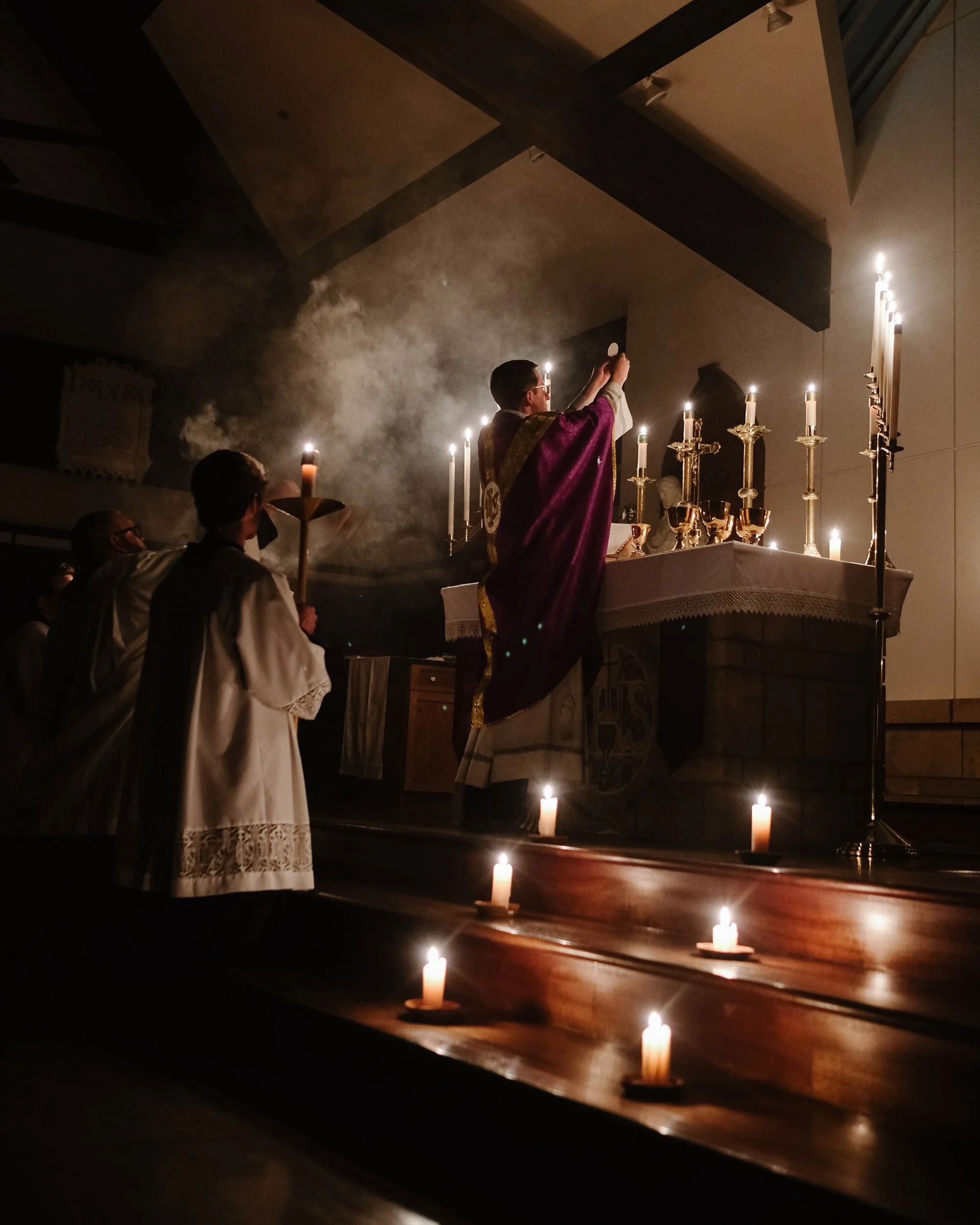
  1. Gardai STORM Latin Mass in Athlone.

Garda Commissioner Drew Harris, who is a Northern Irish Protestant, came under severe criticism for this devastating attack on the faith, when his force dared to enter the sanctuary of the Catholic faith. It was a disgusting mistake, which the Garda Commissioner has still refused to publicly apologise for.

On God Becoming Man

During the Christmas season, I am always reminded of how God came down to Earth and became man like us, and for us.

This truth is scandalous to some religions, but a beautiful and powerful one to us Christians. A being, not just any being, but the infinite one, creator of heaven and earth, God Himself, lovingly and willingly made himself known to us by making himself small and fragile - a baby, just like how all of us once were.

The King of the Universe allowed Himself to be born in an insignificant town, in a poor manger, as a fragile little baby of two poor parents. I have never seen any other religion with a God like this, and this really begs some awe, admiration, contemplation, and praise.

Other religions and spiritual systems always speak of how man reaches up to an infinite and supreme being, but it is only in Christianity where God reaches down to man. With other gods and religions, you always see how it’s man having to pray a certain amount of times, or not eating a certain type of food, or having to go to some special place in order to pile up efforts in the hopes of being able to reach God one day.

But not with our God!

Our God came down first and made Himself known to us. Because of that, we live out our faith because of love for Him and not just because we are trying to reach Him. God has already extended His hand towards us, and He waits for us to either say yes or no. The only action He requires is for us to reach back towards his hand and grab it. - To love Him back because He first loved us.

Do not think that our going to mass to fulfill obligations, lenten fasts, and Friday penances are done just out of the spirit of “having to do them.” If we feel like we just have to do them without an ounce of love for the One we are doing it for, then we have reduced ourselves into being one of the pagans. God is already within reach. He already took care of that part for us! There is nothing else we should do in order to reach Him because He is already here.

All we have to do is simply have faith, say yes, and reach back for His hand.

Stevie Rojas

Follow Stevie on Twitter Stevie Rojas J.M.J (@steviesrojas) / Twitter

See more of his writings at stevierojas.com

Newsweek Links BLM and Pro Aborts To Attacks on Catholic Churches

In 2020, Black Lives Matter leader and Protestant Pastor Shaun King put out the closest thing that that movement had to a fatwa. The target of his ire? The Catholic faith.

In frightening echoes of how Irish and other European Catholics were treated by the Ku Klux Klan and other Anglo Protestant groups, King unleashed his frightening tirade on social media, writing:

Yes, I think the statues of the white European they claim is Jesus should also come down.

They are a form of white supremacy.

Always have been.

In the Bible, when the family of Jesus wanted to hide, and blend in, guess where they went?

EGYPT!

Not Denmark.

Tear them down.

In a brave article, Newsweek have pointed out the absurd nature of the BLM movement’s antipathy towards the Catholic faith:

In 2019, before the societal breakdown that happened with the start of the pandemic and the Black Lives Matter riots in the first half of 2020, 37 cases of vandalism or arson on Catholic property were reported to the FBI, according to the National Catholic Register. This was about the same amount as anti-Muslim vandalism (31 cases) but minuscule compared with antisemitic vandalism (684 cases).

All this changed in May 2020, when demonstrators protesting the death of George Floyd went after Catholic churches, such as Our Lady of Mount Lebanon–St. Peter Cathedral in Los Angeles, defacing it with graffiti that said, "Make America pay for its crimes against black lives." They also tore down statues of St. Junípero Serra.

During an orgy of violence in the second week of July, multiple Catholic sites across the country were hit, including an arson-related fire that destroyed much of the interior of the 249-year-old Mission San Gabriel Arcángel in San Gabriel, California. In October, protestors pulled down and defaced a statue of Serra at the nearby Mission San Rafael Arcángel, a move that infuriated San Francisco Archbishop Salvatore Cordileone, who called for the perpetrators to be punished to deter others from defacing Catholic property.

Commenting on the article, Thomas Reese SJ claims that ‘What we have here is not so much anti-Catholicism as anti-clericalism’, which seems strange given the attacks on statues of Our Lady.

The article then states that abortion is the most common reason for attacks on churches.

It then points out that the current violence against Catholics in the United States is not dissimilar from the treatment of Jews prior to the Holocaust:

Some worry that increased vandalism of a religious group unused to such treatment is the first sign of a society ripping apart at the seams. Before German Jews got shipped off to concentration camps, there was the infamous Kristallnacht on November 9-10, 1938, when Nazi thugs, aided by civilians, destroyed or ransacked some 7,000 Jewish-owned businesses, along with hospitals, schools, homes and synagogues.

Two very important things are then pointed out:

  • The reluctance of mainstream media to cover the violence

  • The fact that most violence is taking place in states controlled by the Democratic Party

It compares this situation to France, where Catholics had to attend religious services under armed protection this Christmas, after recent beheadings and attacks on processions.

Christianity is the most persecuted religion in the world, because it is the most true, there is no reason to think that this persecution should be geographically confined.

Arson, Graffiti and More: Vandals Increasingly Target Catholic Churches (newsweek.com)

Irish Times Praises Frank Duff But Gets One Thing Wrong

Such was the great work of Legion of Mary founder Frank Duff that now even The Irish Times has praised his contribution to Irish society in the early Twentieth Century.

Although the clumsy headline 'Mother and Baby Home Controversy Overshadows Work of Frank Duff’ appears to bizarrely suggest that Frank Duff has been dragged into debates over Mother and Baby Homes, the rest of the article by Paddy Murray is surprisingly quite honest and fair.

Murray’s article starts brightly by mentioning that the Legion’s Centenary deserves more media coverage in Ireland, owing to its 10 million members around the world.

He then refers to the Regina Coeli Hostel, by stating that the Legion of Mary, ‘was behind the establishment of a Mother and Haby home in central Dublin’. The Regina Coeli

The opening line of the Irish Government’s Mother and Baby Home Report recently stated:

Regina Coeli was not a conventional mother and baby home.

The report also states:

There is no indication that Regina Coeli was originally planned as a mother and baby home.

And also:

The arguments against establishing large mother and baby homes did not receive serious consideration, and the only institution that came close to providing a hostel where mothers could work and keep their child was Regina Coeli, which was run by the Legion of Mary

It is universally recognised that the Legion of Mary established a system that was very different to the mainstream concept of ‘Mother and Baby Homes’ (as inherited from the Anglo Protestant system that preceded the Irish State. It is also universally recognised that it was a far more visibly Catholic manifestation of how women and children should be treated than those run by the government.

Not only were the Mother and Baby Homes not uniquely Irish, but they were in fact British, having been recommended and initiated under British rule. As the Commission reports:

Mother and baby homes were not an Irish solution to an Irish problem; Ireland was late in establishing mother and baby homes and the initial recommendation in favour of these special homes came from the 1906 Vice-Regal Commission on the Irish Poor Law.

Proposals for establishing special mother and baby homes emerged as part of a wider review of the Irish poor law that was initiated when Ireland was part of the United Kingdom.

Duff’s kindness and proactive approaches were Irish solutions to Irish problems, indeed, Catholic solutions.

Murray’s article rightly points out:

Duff believed that mothers and their babies should be together and not separated. It wasn’t a popular opinion in 1930 when he established the home.

The article also gives a fine example from Gordon Lewis, who was raised in the hostel and who says he greatly admires Duff for his work and for the difference that he made to his life and to others.

Yet, there can be no getting away from the bizarre claim of the headline that Duff’s work has been somehow ‘overshadowed by mother and baby home controversy’.

It simply has not.

Duff’s work has been ignored for the opposite reason, because his kindness, compassion and deep faith are an affront to Angela’s Ashes revisionism that claims all Irish people lived miserable and unhappy lives until Leo Varadkar led them in a celebration of abortion in Dublin Castle in 2018.

There are at least 10 million people around the world who know and appreciate the greatness of Duff on a weekly basis, it would be wonderful if the Legion of Mary were better understood and more appreciated in their home country, but some things are more important than the praise of others and a sign of a prophet is being left unappreciated in their hometown.

It is a positive thing that Legion of Mary has not sought the approval of the Irish mainstream media during this Centenary Year, it should instead continue its mission in helping those seeking material need, the homeless, sick and destitute as well as those in spiritual need, those who have lost their faith or who need to return to prayer.

Leaders Criticise 'Systematic Attempt' To Drive Christians from Holy Land

In a powerful statement , Christian leaders in the Holy Land have heavily criticised increasing violence against their people in the region.

The hard hitting message criticised ‘frequent and sustained attacks by fringe radical groups’. This included attacks at Easter at the Mount of Olives and elsewhere. They then mentioned Holy Sites being ‘regularly vandalised and desecrated’. This, they said, was part of a ‘systematic attempt to drive the Christian community out of Jerusalem and other parts of the Holy Land’.

The statement also pointed out that the Israeli government had failed to stop those who ‘regularly initimidate local Christians, assault priests and clergy, and desecrate Holy Sites and church properties’.

Worryingly, they stated that although the Jewish Quarter had special protection under law, there was no such protections for the Christian areas of the city. They pointed out that these ‘radical groups’ were not acquiring ‘strategic property in the Christian Quarter, with the aim of diminishing the Christian presence, often using underhanded dealings and intimidation tactics to evict residents from their homes, dramatically decreasing the Christian presence and further disrupting the historic pilgrim routes between Bethlehem and Jerusalem’.

They made a call for dialogue with an aim to establishing two things:

  • To deal with radical ultra Jewish violence against Christians

  • To ensure the maintenance and safety of the presence of the Christian Quarter and its heritage

The Spokesperson for the Israeli Ministry for Foreign Affairs called the claims ‘baseless’.

Lior Haiat stated that the Christian community in Israel is growing, which is true overall, but in East Jerusalem they are not, this is what the church leaders were trying to address. He then called the message ‘infuriating’ and warned that it ‘could lead to violence and bring harm to innocent people’.

Many of the attacks that the Christian leaders were referring to have been led by Bentzi Gopshtain and his organisation Lehava. Lehava are opposed to allowing anyone other than Israeli Jews to be allowed to assimilated within Jerusalem and surround regions. In 2015, the church filed an official complaint against Lehava after he appeared to call for Catholic churches to be burnt to the ground, stating:

The law is straightforward: Maimonides’ interpretation is that one must burn idolatry. There’s not a single rabbi that would deliberate that fact. I expect the government of Israel to carry that out

In 2015, they organised a violent protest against a Christian event at an Armenian Church in the city.

Israeli settlers have also regularly been caught on CCTV spitting on the Armenian Church in Jerusalem.

The Armenian Christian community have repeatedly been victims of these targets, once having to report of constant spitting being sent in their direction.

Last Christmas, it was the church at Gethsemene which faced an arson attack from these extremists.

One Jewish media outlet, JWire responded to the calls by Christian leaders by stating that it was an:

anti-Israel political ploy that should be rejected by Israel.

They also published this cartoon that criticised the Christian leaders and referred to them as ‘weasles’.

St. Joseph and the Holy Family by Garrigou Lagrange

On this Feast of the Holy Family, we present Reginald Garrigou Lagrange OP’s reflection on the Holy Family and on the role of Saint Joseph within it.

We also publish this by means of response to an article in the National Catholic Reporter which referred to Our Lady as a ‘single mom’ and which stated ‘Jesus is the son of Mary, not Joseph’. It also states ‘we have an elaborate and painstaking genealogy created to prove Jesus' ancestral links to the male kings and patriarchs of Israel when in fact, as verse 19 explains, he was born to Mary through the power of the Holy Spirit. Not through Joseph. Not through patriarchal potency. It is enough to make any self-respecting feminist laugh’.

In the essay below, Garrigou Lagrange refutes this by pointing out the special nature of Joseph’s mission:

those whom God Himself chooses directly and immediately to be His exceptional ministers in the work of redemption receive from Him grace proportionate to their vocation. This was the case with St. Joseph. He must have received a relative fulness of grace proportionate to his mission since he was chosen not by men nor by any creature but by God Himself and by God alone to fulfil a mission unique in the world. We cannot say at what precise moment St. Joseph’s sanctification took place. But we can say that, from the time of his marriage to Our Lady, he was confirmed in grace, because of his special mission.

THE PREDESTINATION OF ST. JOSEPH AND HIS EMINENT SANCTITY

He that is lesser among you all, he is the greater.”
—Luke 9:48

One cannot write a book on Our Lady without referring to the predestination of St. Joseph, his eminent perfection, the character of his special mission, his virtues, and his role in the sanctification of souls.

HIS PRE-EMINENCE OVER THE OTHER SAINTS

The opinion that St. Joseph is the greatest of the saints after Our Lady is one which is becoming daily more commonly held in the Church. We do not hesitate to look on the humble carpenter as higher in grace and eternal glory than the patriarchs and the greatest of the prophets—than St. John the Baptist, the apostles, the martyrs and the great doctors of the Church. He who is least in the depth of his humility is, because of the interconnection of the virtues, the greatest in the height of his charity: “He that is the lesser among you all, he is the greater.”

St. Joseph’s pre-eminence was taught by Gerson and St. Bernardine of Siena. It became more and more common in the course of the 16th century. It was admitted by St. Teresa, by the Dominican Isidore de Isolanis, who appears to have written the first treatise on St. Joseph, by St. Francis de Sales, by Suarez, and later by St. Alphonsus Liguori, Ch. Sauve, Cardinal Lepicier and Mgr Sinibaldi; it is very ably treated of in the article “Joseph” in the Diet, de Theol. Cath. by M. A. Michel.

The doctrine of St. Joseph’s pre-eminence received the approval of Leo XIII in his encyclical Quamquam pluries, August 15th, 1899, written to proclaim St. Joseph patron of the universal Church. “The dignity of the Mother of God is so elevated that there can be no higher created one. But since St. Joseph was united to the Blessed Virgin by the conjugal bond, there is no doubt that he approached nearer than any other to that super-eminent dignity of hers by which the Mother of God surpasses all created natures. Conjugal union is the greatest of all; by its very nature it is accompanied by a reciprocal communication of the goods of the spouses. If then God gave St. Joseph to Mary to be her spouse He certainly did not give him merely as a companion in life, a witness of her virginity, a guardian of her honor, but He made him also participate by the conjugal bond in the eminent dignity which was hers.” When Leo XIII said that Joseph came nearest of all to the super-eminent dignity of Mary, did his words imply that Joseph is higher in glory than all the angels? We cannot give any certain answer to the question. We must be content to restate the doctrine which is becoming more and more commonly taught: of all the saints Joseph is the highest after Jesus and Mary; he is among the angels and the archangels. The Church mentions him immediately after Mary and before the Apostles in the prayer A cunctis. Though he is not mentioned in the Canon of the Mass, he has a proper preface, and the month of March is consecrated to him as protector and defender of the universal Church.

The multitude of Christians in all succeeding generations are committed to him in a real though hidden manner. This idea is expressed in the litanies approved by the Church: ‘St. Joseph, illustrious descendant of David, light of the Patriarchs, Spouse of the Mother of God, guardian of her virginity, foster-father of the Son of God, vigilant defender of Christ, head of the Holy Family; Joseph most just, most chaste, most prudent, most strong, most obedient, most faithful, mirror of patience, lover of poverty, model of workers, glory of domestic life, guardian of virgins, support of families, consolation of the afflicted, hope of the sick, patron of the dying, terror of demons, protector of the Holy Church.” He is the greatest after Mary.

THE REASON FOR ST. JOSEPH’S PRE-EMINENCE

What is the justification of this doctrine which has been more and more accepted in the course of five centuries? The principle invoked more or less explicitly by St. Bernard, St. Bernardine of Siena, Isidore de Isolanis, Suarez, and more recent authors is the one, simple and sublime, formulated by St. Thomas when treating of the fulness of grace in Jesus and of holiness in Mary: “An exceptional divine mission calls for a corresponding degree of grace.” This principle explains why the holy soul of Jesus, being united personally to the Word, the Source of all grace, received the absolute fulness of grace. It explains also why Mary, called to be Mother of God, received from the instant of her conception an initial fulness of grace which was greater than the initial fulness of all the saints together: since she was nearer than any other to the Source of grace she drew grace more abundantly. It explains also why the Apostles who were nearer to Our Blessed Lord than the saints who followed them had more perfect knowledge of the mysteries of faith. To preach the gospel infallibly to the world they received at Pentecost the gift of a most eminent, most enlightened, and most firm faith as the principle of their apostolate.

The same truth explains St. Joseph’s pre-eminence. To understand it we must add one remark: all works which are to be referred immediately to God Himself are perfect. The work of creation, for example, which proceeded entirely and directly from the hand of God was perfect. The same must be said of His great servants, whom He has chosen exceptionally and immediately—not through a human instrument—to restore the order disturbed by sin. God does not choose as men do. Men often choose incompetent officials for the highest posts. But those whom God Himself chooses directly and immediately to be His exceptional ministers in the work of redemption receive from Him grace proportionate to their vocation. This was the case with St. Joseph. He must have received a relative fulness of grace proportionate to his mission since he was chosen not by men nor by any creature but by God Himself and by God alone to fulfil a mission unique in the world. We cannot say at what precise moment St. Joseph’s sanctification took place. But we can say that, from the time of his marriage to Our Lady, he was confirmed in grace, because of his special mission.

TO WHAT ORDER DOES ST. JOSEPH’S EXCEPTIONAL MISSION BELONG?

St. Joseph’s mission is evidently higher than the order of nature—even by angelic nature. But is it simply of the order of grace, as were that of St. John the Baptist who prepared the way of salvation, and that the Apostles had in the Church for the sanctification of souls, and that more particular mission of the founders of religious orders? If we examine the question carefully we shall see that St. Joseph’s mission surpassed the order of grace. It borders, by its term, on the hypostatic order, which is constituted by the mystery of the Incarnation. But it is necessary to avoid both exaggeration and understatement in this matter.

Mary’s unique mission, her divine motherhood, has its term in the hypostatic order. So also, in a sense, St. Joseph’s hidden mission. This is the teaching of many saints and other writers. St. Bernard says of St. Joseph: “He is the faithful and prudent servant whom the Lord made the support of His Mother, the foster-father of His flesh, and the sole most faithful co-operator on earth in His great design.”

St. Bernardine of Siena writes: “When God chooses a person by grace for a very elevated mission, He gives all the graces required for it. This is verified in a specially outstanding manner in the case of St. Joseph, Foster-father of Our Lord Jesus Christ and Spouse of Mary . . .” Isidore de Isolanis places St. Joseph’s vocation above that of the Apostles. He remarks that the vocation of the apostles is to preach the gospel, to enlighten souls, to reconcile them with God, but that the vocation of St. Joseph is more immediately in relation with Christ Himself since he is the Spouse of the Mother of God, the Foster-father and Protector of the Saviour. Suarez teaches to the same effect: “Certain offices pertain to the order of sanctifying grace, and among them that of the apostles holds the highest place; thus they have need of more gratuitous gifts than other souls, especially gratuitous gifts of wisdom. But there are other offices which touch upon or border on the order of the Hypostatic Union . . . as can be seen clearly in the case of the divine maternity of the Blessed Virgin, and it is to that order that the ministry of St. Joseph pertains.”

Some years ago Mgr Sinibaldi, titular Bishop of Tiberias and secretary of the Sacred Congregation of Studies, treated the question very ably. He pointed out that the ministry of St. Joseph belonged, in a sense, because of its term, to the hypostatic order: not that St. Joseph co-operated intrinsically as physical instrument of the Holy Ghost in the realization of the mystery of the Incarnation—for under that respect his role is very much inferior to that of Mary—but that he was predestined to be, in the order of moral causes, the protector of the virginity and the honor of Mary at the same time as foster-father and protector of the Word made flesh. “His mission pertains by its term to the hypostatic order, not through intrinsic physical and immediate cooperation, but through extrinsic moral and mediate (through Mary) co-operation, which is, however, really and truly co-operation.”

ST. JOSEPH’S PREDESTINATION IS ONE WITH THE DECREE OF THE INCARNATION

St. Joseph’s pre-eminence becomes all the clearer if we consider that the eternal decree of the Incarnation covered not merely the Incarnation in abstraction from circumstances of time and place but the Incarnation here and now—that is to say, the Incarnation of the Son of God who by the operation of the Holy Ghost was to be conceived at a certain moment of time by the Virgin Mary, espoused to a man of the family of David whose name was Joseph: “The angel Gabriel was sent from God into a city of Galilee, called Nazareth, to a virgin espoused to a man whose name was Joseph, of the house of David.” (Luke 1:26–27).

All the indications are therefore that St. Joseph was predestined to be foster-father of the Incarnate Word before being predestined to glory; the ultimate reason being that Christ’s predestination as man to the natural divine sonship precedes the predestination of all the elect, since Christ is the first of the predestined. The predestination of Christ to the natural divine sonship is simply the decree of the Incarnation, which, as we have seen, includes Mary’s predestination to the divine motherhood and Joseph’s to be foster-father and protector of the Incarnate Son of God.

As the predestination of Christ to the natural divine sonship is superior to His predestination to glory and precedes it, and as the predestination of Mary to the divine motherhood precedes (in signo priori) her predestination to glory, so also the predestination of St. Joseph to be foster-father of the Incarnate Word precedes his predestination to glory and to grace. In other words, the reason why he was predestined to the highest degree of glory after Mary, and in consequence to the highest degree of grace and of charity, is that he was called to be the worthy foster-father and protector of the Man-God.

The fact that St. Joseph’s first predestination was one with the decree of the Incarnation shows how elevated his unique mission was. This is what people mean when they say that St. Joseph was made and put into the world to be the foster-father of the Incarnate Word and that God willed for him a high degree of glory and grace to fit him for his task.

THE SPECIAL CHARACTER OF ST. JOSEPH’S MISSION

This point is explained admirably by Bossuet in his first panegyric of the saint: “Among the different vocations, I notice two in the Scriptures which seem directly opposed to each other: the first is that of the Apostles, the second that of St. Joseph. Jesus was revealed to the Apostles that they might announce Him throughout the world; He was revealed to St. Joseph who was to remain silent and keep Him hidden. The Apostles are lights to make the world see Jesus. Joseph is a veil to cover Him; and under that mysterious veil are hidden from us the virginity of Mary and the greatness of the Saviour of souls . . . He who makes the Apostles glorious with the glory of preaching, glorifies Joseph by the humility of silence.” The hour for the manifestation of the mystery of the Incarnation had not yet struck: it was to be preceded by the thirty years of the hidden life.

Perfection consists in doing God’s will, each one according to his vocation; St. Joseph’s vocation of silence and obscurity surpassed that of the Apostles because it bordered more nearly on the redemptive Incarnation. After Mary, Joseph was nearest to the Author of grace, and in the silence of Bethlehem, during the exile in Egypt, and in the little home of Nazareth he received more graces than any other saint.

His mission was a dual one.

As regards Mary, he preserved her virginity by contracting with her a true but altogether holy marriage. The angel of the Lord said to him: “Joseph, son of David, fear not to take unto thee Mary thy wife, for that which is conceived of her is of the Holy Ghost.” (Matt. 1:20; Luke 2:5). Mary is truly his wife. The marriage was a true one, as St. Thomas explains (Ilia, q. 29, a. 2) when showing its appropriateness. There should be no room for doubt, however light, regarding the honor of the Son and the Mother: if ever doubt did arise Joseph, the most informed and the least suspect witness, would be there to defend it. Besides, Mary would find help and protection in St. Joseph. He loved her with a pure and devoted love, in God and for God. Their union was stainless, and most respectful on the side of St. Joseph. Thus he was nearer than any other saint to the Mother of God and the spiritual Mother of men—and he too was a man. The beauty of the whole universe was nothing compared with that of the union of Mary and Joseph, a union created by the Most High, which ravished the angels and gave joy to the Lord.

As regards the Incarnate Word, Joseph watched over Him, protected Him, and contributed to His human education. He is called His foster-father, but the term does not express fully the mysterious supernatural relation between the two. A man becomes foster-father of a child normally as a result of an accident. But it was no accident in the case of St. Joseph: he had been created and put into the world for that purpose: it was the primary reason of his predestination and the reason for all the graces he received. Bossuet expressed this well: “If nature does not give a father’s heart, where will it be found? In other words, since Joseph was not Jesus’ father, how could he have a father’s heart in His regard?

“Here we must recognise the action of God. It is by the power of God that Joseph has a father’s heart, and if nature fails God gives one with His own hand; for it is of God that it is written that He directs our inclinations where he wills. . . . He gives some a heart of flesh when He softens their nature by charity. . . . Does He not give all the faithful the hearts of children when He sends to them the Spirit of His Son? The Apostles feared the least danger, but God gave them a new heart and their courage became undaunted. . . . The same hand gave Joseph the heart of a father and Jesus the heart of a son. That is why Jesus obeys and Joseph does not fear to command. How has he the courage to command his Creator? Because the true Father of Jesus Christ, the God who gives Him birth from all eternity, having chosen Joseph to be the father of His only Son in time, sent down into his bosom some ray or some spark of His own infinite love for His Son; that is what changed his heart, that is what gave him a father’s love, and Joseph the just man who feels that father’s heart within him feels also that God wishes him to use his paternal authority, so that he dares to command Him who he knows is his Master.” That is equivalent to saying that Joseph was predestined first to take the place of a father in regard to the Saviour who could have no earthly father, and in consequence to have all the gifts which were given him that he might be a worthy Protector of the Incarnate Word.

Is it necessary to say with what fidelity St. Joseph guarded the triple deposit confided to him: the virginity of Mary, the Person of Jesus Christ, and the secret of the Eternal Father, that of the Incarnation of His Son, a secret to be guarded faithfully till the hour appointed for its revelation?

In a discourse delivered in the Consistorial Hall on the 19th of March, 1928, Pope Pius XI said, after having spoken on the missions of St. John the Baptist and St. Peter: “Between these two missions there appears that of St. Joseph, one of recollection and silence, one almost unnoticed and destined to be lit up only many centuries afterwards, a silence which would become a resounding hymn of glory, but only after many years. But where the mystery is deepest it is there precisely that the mission is highest and that a more brilliant cortege of virtues is required with their corresponding echo of merits. It was a unique and sublime mission, that of guarding the Son of God, the King of the world, that of protecting the virginity of Mary, that of entering into participation in the mystery hidden from the eyes of ages and so to co-operate in the Incarnation and the Redemption.” That is equivalently to state that Divine Providence conferred on St. Joseph all the graces he received in view of his special mission: in other words, St. Joseph was predestined first of all to be as a father to the Saviour, and was then predestined to the glory and the grace which were becoming in one favored with so exceptional a vocation.

THE VIRTUES AND GIFTS OF ST. JOSEPH

St. Joseph’s virtues are those especially of the hidden life, in a degree proportioned to that of his sanctifying grace: virginity, humility, poverty, patience, prudence, fidelity, simplicity, faith enlightened by the gifts of the Holy Ghost, confidence in God and perfect charity. He preserved what had been confided to him with a fidelity proportioned to its inestimable value.

Bossuet makes this general observation about the virtues of the hidden life: “It is a common failing of men to give themselves entirely to what is outside and to neglect what is within; to work for mere appearances and to neglect what is solid and lasting; to think often of the impression they make and little of what they ought to be. That is why the most highly esteemed virtues are those which concern the conduct and direction of affairs. The hidden virtues, on the contrary, which are practised away from the public view and under the eye of God alone, are not only neglected but hardly even heard of. And yet this is the secret of true virtue . . . a man must be built up interiorly in himself before he deserves to be given rank among others; and if this foundation is lacking, all the other virtues, however brilliant, will be mere display . . . they will not make the man according to God’s heart. Joseph sought God in simplicity; Joseph found God in detachment; Joseph enjoyed God’s company in obscurity.”

St. Joseph’s humility must have been increased by the thought of the gratuity of his exceptional vocation. He must have said to himself: why has the Most High given me, rather than any other man, His Son to watch over? Only because that was His good pleasure. Joseph was freely preferred from all eternity to all other men to whom the Lord could have given the same gifts and the same fidelity to prepare them for so exceptional a vocation. We see in St. Joseph’s predestination a reflection of the gratuitous predestination of Jesus and Mary. The knowledge of the value of the grace he received and of its absolute gratuitousness, far from injuring his humility, would strengthen it. He would think in his heart: “What have you that you have not received?”

Joseph appears the most humble of the saints after Mary—more humble than any of the angels. If he is the most humble he is by that fact the greatest, for the virtues are all connected and a person’s charity is as elevated as his humility is profound. “He that is lesser among you all, he is the greater.” (Luke 9:48).

Bossuet says well: “Though by an extraordinary grace of the Eternal Father he possessed the greatest treasure, it was far from Joseph’s thought to pride himself on his gifts or to make them known, but he hid himself as far as possible from mortal eyes, enjoying with God alone the mystery revealed to him and the infinite riches of which he was the custodian. Joseph has in his house what could attract the eyes of the whole world, and the world does not know him; he guards a God-Man, and breathes not a word of it; he is the witness of so great a mystery, and he tastes it in secret without divulging it abroad.”

His faith cannot be shaken in spite of the darkness of the unexpected mystery. The word of God communicated to him by the angel throws light on the virginal conception of the Saviour: Joseph might have hesitated to believe a thing so wonderful, but he believes it firmly in the simplicity of his heart. By his simplicity and his humility, he reaches up to divine heights.

Obscurity follows once more. Joseph was poor before receiving the secret of the Most High. He becomes still poorer when Jesus is born, for Jesus comes to separate men from everything so as to unite them to God. There is no room for the Saviour in the last of the inns of Bethlehem. Joseph must have suffered from having nothing to offer to Mary and her Son.

His confidence in God was made manifest in trials. Persecution came soon after Jesus’ birth. Herod tried to put Him to death, and the head of the Holy Family was forced to conceal the child, to take refuge in a distant country where he was unknown and where he did not know how he could earn a living. But he set out on the journey relying on Divine Providence.

His love of God and of souls did not cease to increase during the hidden life of Nazareth; the Incarnate Word is an unfailing source of graces, ever newer and more choice, for docile souls who oppose no obstacle to His action. We have said already, when speaking of Mary, that the progress of such docile souls is one of uniform acceleration, that is to say, they are carried all the more powerfully to God the nearer they approach Him. This law of spiritual gravitation was realized in Joseph; his charity grew up to the time of his death, and the progress of his latter years was more rapid than that of his earlier years, for finding himself nearer to God he was more powerfully drawn by Him.

Along with the theological virtues the gifts of the Holy Ghost, which are connected with charity, grew continuously. Those of understanding and of wisdom made his living faith more penetrating and more attuned to the divine. In a simple but most elevated way his contemplation rose to the infinite goodness of God. In its simplicity his contemplation was the most perfect after Mary’s.

His loving contemplation was sweet, but it demanded of him the most perfect spirit of abnegation and sacrifice when he recalled the words of Simeon: “This child will be . . . a sign that will be contradicted” and “Thy own soul a sword shall pierce.” He needed all his generosity to offer to God the Infant Jesus and His Mother Mary whom he loved incomparably more than himself. St. Joseph’s death was a privileged one; St. Francis de Sales writes that it was a death of love. The same holy doctor teaches with Suarez that St. Joseph was one of the saints who rose after the Resurrection of the Lord (Matt. 27:52 sqq.) and appeared in the city of Jerusalem; he holds also that these resurrections were definitive and that Joseph entered Heaven then, body and soul. St. Thomas is much more reserved regarding this point. Though his first opinion was that the resurrections were definitive he taught later, after an examination of St. Augustine’s arguments in the opposed sense, that this was not the case.

ST. JOSEPH’S ROLE IN THE SANCTIFICATION OF SOULS

The humble carpenter is glorified in Heaven to the extent to which he was hidden on earth. He to whom the Incarnate Word was subject has now an incomparable power of intercession. Leo XIII, in his encyclical Quamquam pluries finds in St. Joseph’s mission in regard to the Holy Family “the reasons why he is Patron and Protector of the universal Church. . . . Just as Mary, Mother of the Saviour, is spiritual mother of all Christians . . . Joseph looks on all Christians as having been confided to himself. . . . He is the defender of the Holy Church which is truly the house of God and the kingdom of God on earth.”

What strikes us most in St. Joseph’s role till the end of time is that there are united in it in an admirable way apparently opposed prerogatives. His influence is universal over the whole Church, and yet, like Divine Providence, it descends to the least details; “model of workmen,” he takes an interest in everyone who turns to him. He is the most universal of the saints, and yet he helps a poor man in his ordinary daily needs. His action is primarily of the spiritual order, and yet it extends to temporal affairs; he is the support of families and of communities, the hope of the sick. He watches over Christians of all conditions, of all countries, over fathers of families, husbands and wives, consecrated virgins; over the rich to inspire them to distribute their possessions charitably, and over the poor so as to help them. He is attentive to the needs of great sinners and of souls advanced in virtue. He is the patron of a happy death, of lost causes; he is terrible to the demon, and St. Teresa tells us that he is the guide of interior souls in the ways of prayer. His influence is a wonderful reflection of that of Divine Wisdom which “reacheth from end to end mightily, and ordereth all things sweetly.” (Wis. 8:1).

He has been clothed and will remain clothed in Divine splendor. Grace has become fruitful in him and he will share its fruit with all who strive to attain to the life which is “hid with Christ in God.” (Col. 3:3).

Pope Benedict XVI on the Peace of Christmas

The following is Pope Benedict XVI’s homily on the solemnity of the Nativity of Our Lord, Christmas Eve 2005.

"The Lord said to me: You are my son; this day I have begotten you". With these words of the second Psalm, the Church begins the Vigil Mass of Christmas, at which we celebrate the Birth of Jesus Christ our Redeemer in a stable in Bethlehem. This Psalm was once a part of the coronation rite of the kings of Judah. The People of Israel, in virtue of its election, considered itself in a special way a son of God, adopted by God. Just as the king was the personification of the people, his enthronement was experienced as a solemn act of adoption by God, whereby the King was in some way taken up into the very mystery of God. At Bethlehem night, these words, which were really more an expression of hope than a present reality, took on new and unexpected meaning. The Child lying in the manger is truly God’s Son. God is not eternal solitude but rather a circle of love and mutual self-giving. He is Father, Son and Holy Spirit.

But there is more: in Jesus Christ, the Son of God, God himself, God from God, became man. To him the Father says: "You are my son". God’s everlasting "today" has come down into the fleeting today of the world and lifted our momentary today into God’s eternal today. God is so great that he can become small. God is so powerful that he can make himself vulnerable and come to us as a defenceless child, so that we can love him. God is so good that he can give up his divine splendour and come down to a stable, so that we might find him, so that his goodness might touch us, give itself to us and continue to work through us. This is Christmas: "You are my son, this day I have begotten you". God has become one of us, so that we can be with him and become like him. As a sign, he chose the Child lying in the manger: this is how God is. This is how we come to know him. And on every child shines something of the splendour of that "today", of that closeness of God which we ought to love and to which we must yield – it shines on every child, even on those still unborn.

Let us listen to a second phrase from the liturgy of this holy Night, one taken from the Book of the Prophet Isaiah: "Upon the people who walked in darkness a great light has shone" (Is 9:1). The word "light" pervades the entire liturgy of tonight’s Mass. It is found again in the passage drawn from Saint Paul’s letter to Titus: "The grace of God has appeared" (2:11). The expression "has appeared", in the original Greek says the same thing that was expressed in Hebrew by the words "a light has shone": this "apparition" – this "epiphany" – is the breaking of God’s light upon a world full of darkness and unsolved problems. The Gospel then relates that the glory of the Lord appeared to the shepherds and "shone around them" (Lk 2:9). Wherever God’s glory appears, light spreads throughout the world. Saint John tells us that "God is light and in him is no darkness" (1 Jn 1:5). The light is a source of life.

But first, light means knowledge; it means truth, as contrasted with the darkness of falsehood and ignorance. Light gives us life, it shows us the way. But light, as a source of heat, also means love. Where there is love, light shines forth in the world; where there is hatred, the world remains in darkness. In the stable of Bethlehem there appeared the great light which the world awaits. In that Child lying in the stable, God has shown his glory – the glory of love, which gives itself away, stripping itself of all grandeur in order to guide us along the way of love. The light of Bethlehem has never been extinguished. In every age it has touched men and women, "it has shone around them". Wherever people put their faith in that Child, charity also sprang up – charity towards others, loving concern for the weak and the suffering, the grace of forgiveness. From Bethlehem a stream of light, love and truth spreads through the centuries. If we look to the Saints – from Paul and Augustine to Francis and Dominic, from Francis Xavier and Teresa of Avila to Mother Teresa of Calcutta – we see this flood of goodness, this path of light kindled ever anew by the mystery of Bethlehem, by that God who became a Child. In that Child, God countered the violence of this world with his own goodness. He calls us to follow that Child.

Along with the Christmas tree, our Austrian friends have also brought us a small flame lit in Bethlehem, as if to say that the true mystery of Christmas is the inner brightness radiating from this Child. May that inner brightness spread to us, and kindle in our hearts the flame of God’s goodness; may all of us, by our love, bring light to the world! Let us keep this light-giving flame, lit in faith, from being extinguished by the cold winds of our time! Let us guard it faithfully and give it to others! On this night, when we look towards Bethlehem, let us pray in a special way for the birthplace of our Redeemer and for the men and women who live and suffer there. We wish to pray for peace in the Holy Land: Look, O Lord, upon this corner of the earth, your Homeland, which is so very dear to you! Let your light shine upon it! Let it know peace!

The word "peace" brings us to a third key to the liturgy of this holy Night. The Child foretold by Isaiah is called "Prince of Peace". His kingdom is said to be one "of endless peace". The shepherds in the Gospel hear the glad tidings: "Glory to God in the highest" and "on earth, peace...". At one time we used to say: "to men of good will". Nowadays we say "to those whom God loves". What does this change mean? Is good will no longer important? We would do better to ask: who are those whom God loves, and why does he love them? Does God have favourites? Does he love only certain people, while abandoning the others to themselves? The Gospel answers these questions by pointing to some particular people whom God loves. There are individuals, like Mary, Joseph, Elizabeth, Zechariah, Simeon and Anna. But there are also two groups of people: the shepherds and the Wise Men from the East, the "Magi". Tonight let us look at the shepherds. What kind of people were they? In the world of their time, shepherds were looked down upon; they were considered untrustworthy and not admitted as witnesses in court. But really, who were they? To be sure, they were not great saints, if by that word we mean people of heroic virtue. They were simple souls. The Gospel sheds light on one feature which later on, in the words of Jesus, would take on particular importance: they were people who were watchful. This was chiefly true in a superficial way: they kept watch over their flocks by night. But it was also true in a deeper way: they were ready to receive God’s Word through the Angel's proclamation. Their life was not closed in on itself; their hearts were open. In some way, deep down, they were waiting for something; they were waiting for God. Their watchfulness was a kind of readiness – a readiness to listen and to set out. They were waiting for a light which would show them the way. That is what is important for God. He loves everyone, because everyone is his creature. But some persons have closed their hearts; there is no door by which his love can enter. They think that they do not need God, nor do they want him. Other persons, who, from a moral standpoint, are perhaps no less wretched and sinful, at least experience a certain remorse. They are waiting for God. They realize that they need his goodness, even if they have no clear idea of what this means. Into their expectant hearts God’s light can enter, and with it, his peace. God seeks persons who can be vessels and heralds of his peace. Let us pray that he will not find our hearts closed. Let us strive to be active heralds of his peace – in the world of today.

Among Christians, the word "peace" has taken on a very particular meaning: it has become a word to designate communion in the Eucharist. There Christ’s peace is present. In all the places where the Eucharist is celebrated, a great network of peace spreads through the world. The communities gathered around the Eucharist make up a kingdom of peace as wide as the world itself. When we celebrate the Eucharist we find ourselves in Bethlehem, in the "house of bread". Christ gives himself to us and, in doing so, gives us his peace. He gives it to us so that we can carry the light of peace within and give it to others. He gives it to us so that we can become peacemakers and builders of peace in the world. And so we pray: Lord, fulfil your promise! Where there is conflict, give birth to peace! Where there is hatred, make love spring up! Where darkness prevails, let light shine! Make us heralds of your peace! Amen.

Pope Pius XII on Christmas and Unity

The following was the Christmas message of Pope Pius XII in 1942. It dwells upon the need for societies that are peaceful from top to bottom in order to bring about a true representation of the incarnation.

As the Holy Christmas Season comes round each year, the message of Jesus, Who is light in the midst of darkness, echoes once more from the Crib of Bethlehem in the ears of Christians and re-echoes in their hearts with an ever new freshness of joy and piety. It is a message which lights up with heavenly truth a world that is plunged in darkness by fatal errors. It infuses exuberant and trustful joy into mankind, torn by the anxiety of deep, bitter sorrow. It proclaims liberty to the sons of Adam, shackled with the chains of sin and guilt. It promises mercy, love, peace to the countless hosts of those in suffering and tribulation who see their happiness Shattered and their efforts broken in the tempestuous strife and hate of our stormy days.

The church bells, which announce this message in every continent, not only recall the gift which God made to mankind at the dawn of the Christian Era; they also announce and proclaim a consoling reality of the present, a reality which is eternally young, living and lifegiving; it is the reality of the “True Light which enlighteneth every man that cometh into this World,” and which knows no setting. The Eternal Word, Who is the Way, the Truth and the Life, began His mission of saving and redeeming the human race by being born in the squalor of a stable and by thus ennobling and hallowing poverty.

He thus proclaimed and consecrated a message which is still, today, the Word of Eternal Life. That message can solve the most tortuous questions, unsolved and insoluble for those who bring to their investigations a mentality and an apparatus which are ephemeral and merely human; and those questions stand up, bleeding, imperiously demanding an answer, before the thought and the feeling of embittered and exasperated mankind.

The watchword “I have compassion on the multitude” is for Us a sacred trust which may not be abused; it remains strong, and impelling in all times and in all human situations, as it was the distinguishing mark of Jesus.

The Church would be untrue to herself, ceasing to be a mother, if she turned a deaf ear to her children’s anguished cries, which reach her from every class of the human family. She does not intend to take sides for any of the particular forms in which the several peoples and States strive to solve the gigantic problems of domestic order or international collaboration, as long as these forms conform to the law of God. But on the other hand, as the “Pillar and Ground of Truth” and guardian, by the will of God and the mandate of Christ, of the natural and supernatural order, the Church cannot renounce her right to proclaim to her sons and to the whole world the unchanging basic laws, saving them from every perversion, frustration, corruption, false interpretation and error.

This is all the more necessary for the fact that from the exact maintenance of these laws, and not merely by the effort of noble and courageous wills, depends in the last analysis the solidity of any national and international order, so fervently desired by all peoples. We know the qualities of courage and sacrifice of those peoples, and We also know their straitened conditions and their sorrow; and in this hour of unspeakable trial and strife We feel Ourselves bound to each and every one of them without exception, by a deep, all-embracing, unmovable affection, and by an immense desire to bring them every solace and help which is in any way at Our command.

Primary Elements of Social Life

In our last Christmas Message, We expounded the principles- which Christian thought suggests, for the establishment of an international order of friendly relations and collaboration such as to conform to the demands of God’s Law. Today We shall, with the consent, We feel, and the interested attention of all upright men, pause to consider very carefully and with equal impartiality, the fundamental laws of the internal order of the States and peoples.

International relations and internal order are intimately related. International equilibrium and harmony depend on the internal equilibrium and development of the individual States in the material, social and intellectual spheres. A firm steady peace policy towards other nations is, in fact, impossible without a spirit of peace within the nation which inspires trust. It is only, then, by striving for an integral peace, a peace in both fields, that people will be freed from the cruel nightmare of war, and the material and psychological causes of further discord and disorder will be diminished in a desire for peace, and hence aims at attaining peace, that “tranquil living together in order” in which St. Thomas finds the essence of peace. Two primary elements, then, regulate social life, a living together in order, and a living together in tranquillity.

Order

Order, which is fundamental in an association of men (of beings, that is, who strive to attain an end appropriate to their nature) is not merely external linking up of parts which are numerically distinct. It is rather, and must be, a tendency and an ever more perfect approach to an internal union; and this does not exclude differences founded in fact and sanctioned by the will of God or by supernatural standard.

A clear understanding of the genuine fundamentals of all social life has a capital importance today as never before, when mankind, impregnated by the poison of error and social aberrations, tormented by the fever of discordant desires, doctrines, and aims, is excitedly tossing about in the disorder which it has itself created, and is experiencing the destructive force of false ideas that disregard the Law of God or are opposed to it. And since disorder can only be overcome by an order which is not merely superimposed and fictitious (just as darkness with its fearful and depressing effects can only be driven away by light and not by will o’ the wisps); so security, reorganizations, progressive improvement cannot be expected and cannot be brought about unless by a return of large and influential sections to correct notions about security.

It is a return which calls for the Grace of God in large measure, and for a resolute will, ready and prepared for sacrifice on the part of good farseeing men. From these influential circles who are more capable of penetrating and appreciating the beauty of just social norms, there will pass on and infiltrate into the masses the clear knowledge of the true, divine, spiritual origin of social life. Thus the way will be cleared for the reawakening, the growth and fixing of those moral principles without which even the proudest achievements create but a babel in which the citizens, though they live inside the same walls, speak different and incoherent languages.

From individual and social life we should rise to God, the First Cause and Ultimate Foundation, as He is the Creator of the first conjugal society, from which we have the society which is the family, and the society of peoples and of nations. As an image, albeit imperfect, of its Exemplar, the One and Triune God, Who through the Mystery of the Incarnation, redeemed and raised human nature, life in society, in its ideals and in its end, possesses by the light of reason and of revelation a moral authority and an absoluteness which transcend every temporal change. It has a power of attraction that, far from being weakened or lessened by delusions, errors, failures, draws irresistibly the noblest and most faithful souls to the Lord, to take up with renewed energy, with added knowledge, with new studies, methods and means, the enterprises which in other times and circumstances were tried in vain.

The origin and the primary scope of social life is the conservation, development and perfection of the human person, helping him to realize accurately the demands and values of religion and culture set by the Creator for every man and for all mankind, both as a whole and in its natural ramifications.

A social teaching or a social reconstruction program which denies or prescinds from this internal essential relation to God of everything that regards men, is on a false course; and while it builds up with one hand, it prepares with the other the materials which sooner or later will undermine and destroy the whole fabric. And when it disregards the respect due to the human person and to the life which is proper to that person, and gives no thought to it in its organization, in legislative and executive activity, then instead of serving society, it harms it; instead of encouraging and stimulating social thought, instead of realizing its hopes and expectations, it strips it of all real value and reduces it to a utilitarian formula which is openly rejected by constantly increasing groups.

If social life implies intrinsic unity, it does not, at the same time, exclude differences which are founded in fact and nature. When we hold fast to God, the Supreme Controller of all that relates to man, then the similarities no less than the differences of men find their allotted place in the fixed order of being, of values, and hence also of morality. When, however, this foundation is removed, there is a dangerous lack of cohesion in the various spheres of culture; the frontier of true value becomes uncertain and shifting, even to the point where mere external factors, and often blind instincts, come to determine, according to the prevalent fashion of the day, who is to have control of this or that direction.

After the fateful economy of the past decades, during which the lives of all citizens were subordinated to the stimulus of gain, there now succeeds another and no less fateful policy which, while it considers everybody with reference to the State, excludes all thought of ethics or religion. This is a fatal travesty, a fatal error. It is calculated to bring about far-reaching consequences for social life, which is never nearer to losing its noblest prerogatives than when it thinks it can deny or forget with impunity the external source of its own dignity: God.

Reason, enlightened by faith, assigns to individuals and to particular societies in the social organization a definite and exalted place. It knows, to mention only the most important, that the whole political and economic activity of the State is directed to the permanent realization of the common good.

In a conception of society which is pervaded and sanctioned by religious thought, the influence of economics and of every other sphere of cultural activity represents a universal and most exalted center of activity, very rich in its variety and coherent in its harmony, in which men’s intellectual equality and diversity of occupation come into their own and secure adequate expression. When this is not so, work is depreciated and the worker is belittled.

That social life, such as God willed it, may attain its scope, it needs a juridical order to support it from without, to defend and protect it. The function of this juridical order is not to dominate but to serve, to help the development and increase of society’s vitality in the rich multiplicity of its ends, leading all the individual energies to their perfection in peaceful completion, and defending them with appropriate and honest means against all that may militate against those who only by this means can be held within the noble discipline of social life. But in the just fulfillment of this right, an authority which is truly worthy of the name will always be painfully conscious of its responsibility in the sight of the Eternal Judge, before Whose Tribunal every wrong judgment, and especially every revolt against the order established by God, will receive without fail its sanction and its condemnation.

The precise, bedrock, basic rules that govern society cannot be prejudiced by the intervention of human agency. They can be denied, overlooked, despised, transgressed, but they can never be overthrown with legal validity. It is true indeed that, as time goes on, conditions of life change. But there is never a complete break or a complete discontinuity between the law of yesterday and that of today, between the disappearance of old powers and constitutions and the appearance of a new order. In any case, whatever be the change or transformation, the scope of every social life remains identical, sacred, obligatory; it is the development of the personal values of man as the image of God; and the obligation remains with every member of the human family to realize his unchangeable destiny, whosoever be the legislator and the authority whom he obeys.

In consequence, there always remains, too, his inalienable right, which no opposition can nullify — a right which must be respected by friend and foe — to a legal order and practice which appreciate and understand that it is their essential duty to serve the common good.

The juridical order has, besides, the high and difficult scope of insuring harmonious relations both between individuals and between societies, and within these. This scope will be reached if legislators will abstain from following those perilous theories and practices, so harmful to communities to their spirit of union, which derive their origin and promulgation from false postulates. Among such postulates We must count the juridical positivism which attributes a deceptive majesty to the setting up of purely human laws, and which leaves the way open for a fatal divorce of law from morality.

There is, besides, the conception which claims for particular nations, or classes, the juridical instinct as the final imperative and the norm from which there is no appeal; finally, there are those various theories which, differing among themselves, and deriving from opposite ideologies, agree in considering the State, or a group which represents it, as an absolute and supreme entity, exempt from control and from criticism even when its theoretical and practical postulates result in and offend by, their open denial of essential tenets of the human Christian conscience.

Anyone who considers with an open and penetrating mind the vital connection between social order and a genuine juridical order, and who is conscious of the fact that internal order in all its complexity depends on the predominance of spiritual forces, on the respect of human dignity in oneself and in others, on the love of society and of its God-given ends, cannot wonder at the sad effects of juridical conceptions which, far from the royal road of truth, proceed on the insecure ground of materialistic postulates. But he will realize at once the urgent need of a return to a conception of law which is spiritual and ethical, serious and profound, vivified by the warmth of true humanity and illumined by the splendor of the Christian Faith, which bids us seek in the juridical order an outward refraction of the social order willed by God, a luminous product of the spirit of man which is in turn the image of the Spirit of God.

On this organic conception which alone is living, in which the noblest humanity and the most genuine Christian spirit flourish in harmony, there is marked the Scripture thought, expounded by the great Aquinas: [Opus Justitiae Pax] — The work of justice shall be peace — a thought which is applicable to the internal as to the external aspect of social life. It admits of neither contrast nor alternative such as expressed in the disjunction, love or right, but of the fruitful synthesis, love and right. In the one as in the other, since both radiate from the same Spirit of God, We read the program and the seal of the human spirit; they complement one another, give each other life and support, walk hand in hand along the road of concord and pacification, while right clears the way for love and love makes right less stern, and gives it a higher meaning. Both elevate human life to that social atmosphere where, even amid the failings, the obstacles and the difficulties of this earth a fraternal community of life is made possible.

But once let the baneful spirit of materialist ideas predominate; let the urge for power and for predominance take in its rough hands the direction of affairs; you shall then find its disruptive effects appearing daily in greater measure; you shall see love and justice disappear; all this as the sad foretaste of the catastrophes that menace society when it abandons God.

Tranquillity

The second fundamental element of peace, towards which every human society tends almost instinctively, is tranquillity.

O blessed tranquillity, thou has nothing in common with the spirit of holding fixedly and obstinately, unrelenting and with childish stubbornness, to things as they are; nor yet with the reluctance-child of cowardice and selfishness — to put one’s mind to the solution of problems and questions which the passage of time and the succession of generations, with their different needs and progress, make actual, and bring up a burning question of the day. But for a Christian who is conscious of his responsibilities even towards the least of his brethren, there is no such thing as slothful tranquillity; nor is there question of flight, but of struggle, of action against every inaction and desertion in the great spiritual combat where the stakes are the construction, nay the very soul, of the society of tomorrow.

In the mind of Aquinas, tranquillity and feverish activity are not opposed, but rather form a well-balanced pair for him who is inspired by the beauty and the urgency of the spiritual foundations of society, and of the nobility of its ideals. To you, young people, who are wont to turn your back on the past, and to rely on the future for your aspirations and your hopes, We address Ourselves with ardent love and fatherly anxiety; enthusiasm and courage do not of themselves suffice, if they be not, as they should be, placed in the service of good and of a spotless cause. It is vain to agitate, to weary yourselves, to bustle about without ever resting. You must be inspired with the conviction that you are fighting for truth, that you are sacrificing in the cause of truth your own tastes and energies wishes, and sacrifices; that you are fighting for the eternal laws of God, for the dignity of the human person, and for the attainment of its destiny.

When mature men and young men, while remaining always at anchor, in the sea of the eterna11y active tranquillity of God, coordinate their differences of temperament and activity in a genuine Christian spirit, then if the propelling element is joined to the refraining element, the natural differences between the generations will never become dangerous, and will even conduce vigorously to the enforcement of the eternal laws of God in the changing course of times and of conditions of life.

In one field of social life, where for a whole century there was agitation and bitter conflict, there is today a calm, at least on the surface. We speak of the vast and ever growing world of labor, of the immense army of workers, of breadwinners and dependents. If we consider the present with its wartime exigencies, as an admitted fact, then this calm may be called a necessary and reasonable demand; but if we look at the present situation in the light of justice, and with reference to a legitimately regulated labor movement, then the tranquillity will remain only apparent, until the scope of such a movement be attained.

Always moved by religious motives, the Church has condemned the various forms of Marxist Socialism; and she condemns them today, because it is her permanent right and duty to safeguard men from currents as thought and influences that jeopardize their external salvation. But the Church cannot ignore or overlook the fact that the worker in his efforts to better his lot, is opposed by a machinery which is not only not in accordance with nature, but is at variance with God’s plan and with the purpose He had in creating the goods of earth.

In spite of the fact that the ways they followed were and are false and to be condemned, what man, and especially what priest or Christian, could remain deaf to the cries that rise from the depths and call for justice and a spirit of brotherly collaboration in a world ruled by a just God? Such silence would be culpable and unjustifiable before God, and contrary to the inspired teaching of the Apostle, who, while he inculcates the need of resolution in the fight against error, also knows that we must be full of sympathy for those who err, and open-minded in our understanding of their aspirations, hopes and motives.

When He blessed our first parents, God said: “Increase and multiply and fill the earth and subdue it.” And to the first father of a family, He said later: “In the sweat of thy face shalt thou eat bread.” The dignity of the human person, then, requires normally as a natural foundation of life the right to the use of the goods of the earth. To this right corresponds the fundamental obligation to grant private ownership of property, if possible, to all. Positive legislation regulating private ownership may change and more or less restrict its use. But if legislation is to play its part in the pacification of the community, it must prevent the worker, who is or will be a father of a family, from being condemned to an economic dependence and slavery which is irreconcilable with his rights as a person. Whether this slavery arises from the exploitation of private capital or from the power of the state, the result is the same. Indeed, under the pressure of a State which dominates all and controls the whole field of public and private life, even going into the realm of ideas and beliefs and of conscience, this lack of liberty can have the more serious consequences, as experience shows and proves.

Five Points for Ordering Society

Anyone who considers in the light of reason and of faith the foundations and the aims of social life, which we have traced in broad outline, and contemplates them in their purity and moral sublimity, and in their benefits in every sphere of life, cannot but be convinced of the powerful contribution to order and pacification which efforts directed towards great ideals and resolved to face difficulties, could present, or better, could restore to a world which is internally unhinged, when once they had thrown down the intellectual and juridical barriers, created by prejudice, errors, indifferences, and by a long tradition of secularization of thought, feeling, action which succeeded in detaching and subtracting the early city from the light and force of the City of God. Today, as never before, the hour has come for reparation, for rousing the conscience of the world from the heavy torpor into which the drugs of false ideas, widely diffused, have sunk it. This is all the more so because in this hour of material and moral disintegration the appreciation of the emptiness and inconsistency of every purely human order is beginning to disillusion even those who, in days of apparent happiness, were not conscious of the need of contact with the eternal in themselves or in society, and did not look upon its absence as an essential defect in their constitutions. What was clear to the Christian, who in his deeply founded faith was pained by the ignorance of others, is now presented to us in dazzling clearness by the din of appalling catastrophe which the present upheaval brings to man and which portrays all the terrifying lineaments of a general judgment even for the tepid, the indifferent, the frivolous. It is indeed, an old truth which comes out in ever new forms and thunders through the ages and through the nations from the mouth of the Prophet: “All that forsake thee shall be confounded; they who depart from thee, shall be written in the earth; because they have forsaken the Lord, the Vein of Living Waters.”

The call of the moment is not lamentation but action; not lamentation over what has been, but reconstruction of what is to arise and must arise for the good of society. It is for the best and most distinguished members of the Christian family, filled with the enthusiasm of Crusaders, to unite in the spirit of truth, justice and love to the call; God wills it, ready to serve, to sacrifice themselves, like the Crusaders of old.

If the issue was then the liberation of the land hallowed by the life of the Incarnate Word of God, the call today is, if We may so express Ourselves, to traverse the sea of errors of our day and to march on to free the holy land of the spirit, which is destined to sustain in its foundations the unchangeable norms and laws on which will rise a social construction of solid internal consistency. With this lofty purpose before Us, We turn from the crib of the Prince of Peace, confident that His grace is diffused in all hearts, to you, beloved children, who recognized and adore in Christ your Savior; We turn to all those who are united with Us at least by the bond of faith in God; We turn, finally to all those who would be free of doubt and error, and who desire light and guidance; and We exhort you with suppliant paternal insistence not only to realize fully the dreadful gravity of this hour, but also to meditate upon the vistas of good and supernatural benefit which it opens up, and to unite and collaborate towards the renewal of society in spirit and truth.

The essential aim of this necessary and holy crusade is that the Star of Peace, the Star of Bethlehem, may shine out again over the whole mankind in all its brilliant splendor and reassuring consolation as a pledge and augury of a future better, more fruitful and happier. It is true that the road from night to full day will be long; but of decisive importance are the first steps on the path, the first five mile-stones of which bear chiseled on them the following maxims:

1. Dignity of the Human Person. He who would have the Star of Peace shine out and stand over society should cooperate, for his part, in giving back to the human person the dignity given to it by God from the very beginning; should oppose the excessive herding of men, as if they were a mass without a soul; their economic, social, political, intellectual and moral inconsistency; their dearth of solid principles and strong convictions, their surfeit of instinctive sensible excitement and their fickleness.

He should favor, by every lawful means, in every sphere of life, social institutions in which a full personal responsibility is assured and guaranteed both in the early and the eternal order of things. He should uphold respect for and the practical realization of the following fundamental personal rights; the right to maintain and develop one’s corporal, intellectual and moral life and especially the right to religious formation and education; the right to worship God in private and public and to carry on religious works of charity; the right to marry and to achieve the aim of married life; the right to conjugal and domestic society; the right to work, as the indispensable means towards the maintenance of family life; the right to free choice of state of life, and hence, too, of the priesthood or religious life; the right to the use of material goods; in keeping with his duties and social limitations

2. Defense of Social Unity. He who would have the Star of Peace shine out and stand over society should reject every form of materialism which sees in the people only a herd of individuals who, divided and without any internal cohesion, are considered as a mass to be forded over and treated arbitrarily; he should strive to understand society as an intrinsic unity, which has grown up and matured under the guidance of Providence, a unity which within the bounds assigned to it and according to its own peculiar gifts — tends, with the collaboration of the various classes and professions, towards the eternal and ever new aims of culture and religion.

He should defend the indissolubility of matrimony; he should give to the family — that unique cell of the people — space, light and air so that it may attend to its mission of perpetuating new life, and of educating children in a spirit corresponding to its own true religious convictions, and that it may preserve, fortify and reconstitute, according to its powers, its proper economic, spiritual, moral and juridic unity. He should take care that the material and spiritual advantages of the family be shared by the domestic servants; he should strive to secure for every family a dwelling where a materially and morally healthy family life may be seen in all its vigor and worth; he should take care that the place of work be not so separated from the home as to make the head of the family and educator of the children a virtual stranger to his own household; he should take care above all that the bond of trust and mutual help should be reestablished between the family and the public school, that bond which in other times gave such happy results, but which now has been replaced by mistrust where the school, influenced and controlled by the spirit of materialism, corrupts and destroys what the parents have instilled into the minds of the children.

3. Dignity of Labor. He who would have the Star of Peace shine out and stand over society should give to work the place assigned to it by God from the beginning. As an indispensable means towards gaining over the world that mastery which God wishes, for His glory, all work has an inherent dignity and at the same time a close connection with the perfection of the person; this is the noble dignity and privilege of work which is not any way cheapened by the fatigue and the burden, which have to be borne as the effect of original sin, in obedience and submission to the will of God.

Those who are familiar with the great Encyclicals of Our predecessors and Our Own previous messages know well that the Church does not hesitate to draw the practical conclusions which are derived from the moral nobility of work, and to give them all the support of her authority. These exigencies include, besides a just wage which covers the needs of the worker and his family, the conservation and perfection of a social order which will make possible an assured, even if modest, private property for all classes of society, which will promote higher education for the children of the working class who are especially endowed with intelligence and good will, will promote the care and the practice of the social spirit in one’s immediate neighborhood, in the district, the province, the people and the nation, a spirit which, by smoothing over friction arising from privileges or class interests, removes from the workers the sense of isolation through the assuring experience of a genuinely human, and fraternally Christian, solidarity.

The progress and the extent of urgent social reforms depend on the economic possibilities of single Nations. It is only through an intelligent and generous sharing of forces between the strong and the weak that it will be possible to effect a universal pacification in such wise as not to leave behind centers of conflagration and infection from which new disasters may come. There are evident signs which go to show that, in the ferment of all the prejudices and feelings of hate, those inevitable but lamentable offspring of the war psychosis, there is still aflame in the people the consciousness of their intimate mutual dependence for good or for evil, nay, that this consciousness is more alive and active. It is not true that deep thinkers see ever more clearly in the renunciation of egoism and national isolation, the way to general salvation, ready as they are to demand of their peoples, a heavy participation in the sacrifices necessary for social well-being in other peoples?

May this Christmas Message of Ours, addressed to all those who are animated by a good and generous heart, encourage and increase the legions of these social crusades in every nation. And may God deign to give to their peaceful cause the victory of which their noble enterprise is worthy.

4. The Rehabilitation of Juridical Order. He who would have the Star of Peace shine out and stand over social life should collaborate towards a complete rehabilitation of the juridical order. The juridic sense of today is often altered and overturned by the profession and the practice of positivism and a utilitarianism which are subjected and bound to the service of determined groups, classes and movements, whose programs direct and determine the course of legislation and the practices of the courts. The cure of this situation becomes feasible when we awaken again the consciousness of a juridical order resting on the supreme dominion of God, and safeguarded from all human whims; a consciousness of an order which stretches forth its arm, in protection or punishment, over the unforgettable rights of man and protects them against the attacks of every human power.

From the juridic order, as willed by God, flows man’s inalienable right to juridical security, and by this very fact to a definite sphere of rights, immune from all arbitrary attack. The relations of man to man, of the individual to society, to authority, to civil duties; the relations of society and of authority to the individual, should be placed on a firm juridic footing and be guarded, when the need arises, by the authority of the courts. This supposes:

a) A tribunal and a judge who take their directions from a clearly formulated and defined right.

b) Clear juridical norms which may not be overturned by unwarranted appeals to a supposed popular sentiment or by merely utilitarian considerations.

c) The recognition of the principle that even the State and the functionaries and organizations depend on it are obliged to repair and to withdraw measures which are harmful to the liberty, property, honor, progress of health of the individuals.

5. Christian Conception of the State. He who would have the Star of Peace shine out and stand over human society should cooperate towards the setting up of a State conception and practice founded on reasonable discipline, exalted kindliness and responsible Christian spirit. He should help to restore the State and its power to the service of human society, to the full recognition of the respect due to the human person and his efforts to attain his eternal destiny. He should apply and devote himself to dispelling the errors which aim at causing the State and its authority to deviate from the path of morality, at severing them from the eminently ethical bond which links them to individual and social life, and at making them deny or in practice ignore their essential dependence on the will of the Creator. He should work for the recognition and diffusion of the truth which teaches, even in matters of this world, that the deepest meaning, the ultimate moral basis and the universal validity of “reigning” lies in “serving.”

Postwar Renovation of Society

Beloved Children, may God grant that while you listen to Our voice your heart may be profoundly stirred and moved by the deeply felt seriousness, the loving solicitude, the unremitting insistence, with which We drive home these thoughts, which are meant as an appeal to the conscience of the world, and a rallying-cry to all those who are ready to ponder and weigh the grandeur of their mission and responsibility by the vastness of this universal disaster.

A great part of mankind, and, let Us not shirk from saying it, not a few who call themselves Christians, have to some extent their share in the collective responsibility for the growth of error and for the harm and the lack of moral fiber in the society of today.

What is this world war, with all its attendant circumstances, whether they be remote or proximate causes, its progress and material, legal and moral effects? What is it but the crumbling process, not expected, perhaps, by the thoughtless but seen and depreciated by those whose gaze penetrated into the realities of a social order which hid its mortal weakness and its unbridled lust for gain and power? That which in peace-time lay coiled up, broke loose at the outbreak of war in a sad succession of acts at variance with the human and Christian sense. International agreements to make war less inhuman by confining it to the combatants to regulate the procedure of occupation and imprisonment of the conquered remained in various places a dead letter. And who can see the end of this progressive demoralization of the people, who can wish to watch helplessly this disastrous progress? Should they not rather, over the ruins of a social order which has given such tragic proof of its ineptitude as a factor for the good of the people, gather together the hearts of all those who are magnanimous and upright, in the solemn vow not to rest until in all peoples and all nations of the earth a vast legion shall be formed of those handfuls of men who, bent on bringing back society to its center of gravity, which is the law of God, aspire to the service of the human person and of his common life ennobled in God.

Mankind owes that vow to the countless dead who lie buried on the field of battle: The sacrifice of their lives in the fulfillment of their duty is a holocaust offered for a new and better social order. Mankind owes that vow to the innumerable sorrowing host of mothers, widows and orphans who have seen the light, the solace and the support of their lives wrenched from them. Mankind owes that vow to those numberless exiles whom the hurricane of war has torn from their native land and scattered in the land of the stranger; who can make their own the lament of the Prophet: “Our inheritance is turned to aliens; our house to strangers.” Mankind owes that vow to the hundreds of thousands of persons who, without any fault on their part, sometimes only because of their nationality or race, have been consigned to death or to a slow decline. Mankind owes that vow to the many thousands of non- combatants, women, children, sick and aged, from whom aerial war-fare — whose horrors we have from the beginning frequently denounced — has without discrimination or through inadequate precautions, taken life, goods, health, home, charitable refuge, or house of prayer. Mankind owes that vow to the flood of tears and bitterness, to the accumulation of sorrow and suffering, emanating from the murderous ruin of the dreadful conflict and crying to Heaven to send down the Holy Spirit to liberate the world from the inundation of violence and terror.

And where could you with greater assurance and trust and with more efficacious faith place this vow for the renewal of society than at the foot of the “Desired of all Nations” Who lies before us in the crib with all the charm of His sweet humanity as a Babe, but also in the dynamic attraction of His incipient mission as Redeemer? Where could this noble and holy crusade for the cleaning and renewal of society have a more significant consecration or find a more potent inspiration than at Bethlehem, where the new Adam appears in the adorable mystery of the Incarnation? For it is at His fountains of truth and grace that mankind should find the water of life if it is not to perish in the desert of this life; “Of His fullness we all have received.” His fullness of grace and truth cows as freely today as it has for twenty centuries on the world.

His light can overcome the darkness, the rays of His love can conquer the icy egoism which holds so many back from becoming great and conspicuous in their higher life. To you, crusader-volunteers of a distinguished new society, live up to the new call for moral and Christian rebirth, declare war on the darkness which comes from deserting God, of the coolness that comes from strife between brothers. It is a fight for the human race, which is gravely ill and must be healed in the name of conscience ennobled by Christianity.

May Our blessing and Our paternal good wishes and encouragement go with your generous enterprise, and may they remain with all those who do not shirk hard sacrifices — those weapons which are more potent than any steel to combat the evil from which society suffers. Over your crusade for a social, human and Christian ideal may there shine out as a consolation and an inspiration the star that stands over the Grotto of Bethlehem, the first and the perennial star of the Christian Era. From the sign of it every faithful heart drew, draws and ever will draw strength; “If armies in camp should stand against me, my heart shall not fear.” Where that star shines, there is Christ. “With Him for leader we shall not wander; through Him let us go to Him, that with the Child that is born today we may rejoice.

USA Allows Satanists to Install Mock Nativity Display

The United States of America has allowed sick Satanists to install a shrine to demons in mockery of Our Lord Jesus Christ at the Illinois State Capitol.

Citing so called ‘religious freedom’, cowardly politicians have refused to stop the sick display from being established.

The organisers of the demonic installation, the Satanic Temple, taunted local Bishop Thomas Paprocki by inviting him to witness the event.

The bishop stated that the Satanic filth:

should have no place in this Capitol or any other place

A spokesperson for the Diocese told the media:

Mocking the millions of Christians in the state of Illinois and billions around the world by depicting the baby Jesus this Christmas with the ‘satanic deity’ Baphomet is the very definition of evil and causing division, but that is to be expected from an organization that is in existence to troll people of faith

“Bishop Paprocki declines the invitation to associate with evil and urges all people of true religious faith to shun the devil

There is no other country in the world where this sort of behaviour would be tolerated by Christians. The United States of America is the only nation where open devil worship is permitted in such an important building at Christmas time. There is not a Muslim, Communist or atheistic country that excuses this behaviour, so why does the United States allow for it? Why has the nominally Catholic President of the Untied States said nothing?

Orange Order Flex Strength With Trinity College Branch

Buoyed by recent support from Sinn Fein leader Mary Lou McDonald and Fine Gael politician Neale Richmond, anti Catholic group the Orange Order have reopened a ‘dormant’ branch in the historic symbol of Anglo Protestant power in Dublin, Trinity College.

The group, who have complained about being compared to the Ku Klux Klan and other arch Protestant groups, have become more openly visible in the South of Ireland over the past number of years. Then Taoiseach Leo Varadkar, who was educated in a Protestant school and who celebrated abortion in a former seat of Protestant power at Dublin Castle in 2018, visited an Orange Lodge in an official capacity last year and was gifted with a glass obelisk as a thank you. Varadkar, who was Tanaiste when the Irish government surrounded Fr. PJ Hughes and his church earlier this year because he was saying Mass, has also said that he would love to an Orange Order march through Dublin.

His party compatriot Neale Richmond also refused to apologise after being photographed near a banner honouring Oliver Cromwell, who raped, murdered and enslaved tens of thousands of Irish Catholics as part of his ethnic cleansing campaign during the anti Catholic and anti Gaelic genocide of 1649.

Richmond’s refusal to apologise was trumped by ‘Republican’ Mary Lou McDonald, who has gone on record as stating that she wants to force the entire island of Ireland to celebrate the Orange Order’s hatred for Catholicism every 12th of July.

Now, as part of the their increasing arrogance, the Order have openly expressed their reopening of their lodge at Trinity College, which had not been used publicly since 1966. After holding a formal ceremony this past week, they stated that they hope for more lodges to be established around the country.

It is not hard to imagine that they will have a lot of interest, particularly from members of Fine Gael and Sinn Fein, who have showed immense interest in the legacy of the Orange Order recently. In the past decade, this has included shutting the Vatican Embassy as Fine Gael did or picketing Catholic churches as Sinn Fein have done.

In a 2000 article for The Guardian, Henry McDonald summed up the hatred that envelopes the dark heart of the Orange Order:

None the less, anti-Catholicism lies at the root of Orange thought and not unionism; it remains a potent force. Worst of all, its final logical terminus is eliminationist, just as anti-Semitism was in Germany.

After all, if you believe that Catholic men, women and children will burn in the fires of Hell if they do not convert to the true faith, what's wrong with petrol-bombing their homes and burning them out of your streets?

Medical Experts SLAM Assisted Suicide Plans

As the far left gains momentum in trying to provide a legal framework for disposing of those perceived as unwanted and burdensome, the College of Psychiatrists has strongly objected to the plans in a powerful new statement.

Read their press release here:

The College of Psychiatrists of Ireland (College of Psychiatrists) has warned that physician-assisted suicide and euthanasia (PAS-E) is not compatible with good medical care and that its introduction in Ireland could place vulnerable patients at risk.

PAS-E is also known as “assisted dying” and in the New Year the issue will be the focus of a Special Oireachtas Committee set up to examine the Dying with Dignity Bill (2020).

The College of Psychiatrists is the professional and training body for psychiatrists in Ireland and represents 1,000 professional psychiatrists (both specialists and trainees) across the country.  It has today published a position paper on this issue [see editors’ note below] which sets out some key issues regarding the introduction of assisted dying in Ireland.  These include:

  • Assisted dying is contrary to the efforts of psychiatrists, other mental health staff and the public to prevent deaths by suicide.

  • It is likely to place vulnerable people at risk – many requests for assisted dying stem from issues such as fear of being a burden or fear of death rather than from intractable pain. Improvements in existing services should be deployed to manage these issues.

  • While often introduced for patients with terminal illness, once introduced assisted dying is likely to be applied more broadly to other groups, such that the numbers undertaking the procedure grow considerably above expectations;

  • The introduction of assisted dying represents a radical change in Irish law and a long-standing tradition of medical practice, as exemplified in the prohibition of deliberate killing in the Irish Medical Council ethics guidelines;


Consultant Liaison Psychiatrist Dr Eric Kelleher is a member of the College of Psychiatrists and contributing author to the position paper on assisted dying.

Speaking today, he said: “We are acutely aware of the sensitivity of this subject, and understand and support the fact that dying with dignity is the goal of all end-of-life care. Strengthening our palliative care and social support networks makes this possible. Not only is assisted dying or euthanasia not necessary for a dignified death, but techniques used to bring about death can themselves result in considerable and protracted suffering”.

“Where assisted dying is available, many requests stem, not from intractable pain, but from such causes as fear, depression, loneliness, and the wish not to burden carers. With adequate resources, including psychiatric care, psychological care, palliative medicine, pain services, and social supports, good end-of-life care is possible,” he said.

Dr Siobhan MacHale, Consultant Liaison Psychiatrist, a member of the College of Psychiatrists and contributing author to the position paper on assisted dying, said: “Once permitted in a jurisdiction, experience has shown that more and more people die from assisted dying. This is usually the result of progressively broadening criteria through legal challenges because, if a right to assisted dying is conceded, there is no logical reason to restrict this to those with a terminal illness.”

She continued: “Both sides of this debate support the goal of dying with dignity, but neither the proposed legislation nor the status quo (as evidenced by both clinical experience and the power of this debate) is sufficient. It is imperative for the Irish people to continue to demonstrate leadership as a liberal and compassionate society in working together to achieve this.”

READ THE FULL STATEMENT HERE:

Physician-Assisted Suicide and Euthanasia – The College of Psychiatrists of Ireland (irishpsychiatry.ie)