Aleksandr Solzhenitsyn on the Vendée Genocide

Russian writer Alexsandr Solzhenitsyn spoke these words at an event in France to commemorate the 200th anniversary of the Genocide of the Vendee.

Two thirds of a century ago, while still a boy, I read with admiration about the courageous and desperate uprising of the Vendée. But never could I have even dreamed that in my later years I would have the honor of dedicating a memorial to the heroes and victims of that uprising.

Twenty decades have now passed, and throughout that period the Vendée uprising and its bloody suppression have been viewed in ever new ways, in France and elsewhere. Indeed, historical events are never fully understood in the heat of their own time, but only at a great distance, after a cooling of passions. For all too long, we did not want to hear or admit what cried out with the voices of those who perished, or were burned alive: that the peasants of a hard-working region, driven to the extremes of oppression and humiliation by a revolution supposedly carried out for their sake – that these peasants had risen up against the revolution!

That revolution brings out instincts of primordial barbarism, the sinister forces of envy, greed, and hatred – this even its contemporaries could see all too well. They paid a terrible enough price for the mass psychosis of the day, when merely moderate behavior, or even the perception of such, already appeared to be a crime. But the twentieth century has done especially much to tarnish the romantic luster of revolution which still prevailed in the eighteenth century.  As half-centuries and centuries have passed, people have learned from their own misfortunes that revolutions demolish the organic structures of society, disrupt the natural flow of life, destroy the best elements of the population and give free rein to the worst; that a revolution never brings prosperity to a nation, but benefits only a few shameless opportunists, while to the country as a whole it heralds countless deaths, widespread impoverishment, and, in the gravest cases, a long-lasting degeneration of the people.

The very word "revolution"  (from the Latin revolvo) means "to roll back," "to go back," "to experience anew," "to re-ignite," or at best "to turn over" – hardly a promising list. Today, if the attribute "great" is ever attached to a revolution, this is done very cautiously, and not infrequently with much bitterness.

It is now better and better understood that the social improvements which we all so passionately desire can be achieved through normal evolutionary development – with immeasurably fewer losses and without all-encompassing decay.  We must be able to improve, patiently, that which we have in any given "today".

It would be vain to hope that revolution can improve human nature, yet your revolution, and especially our Russian Revolution, hoped for this very effect.  The French Revolution unfolded under the banner of a self-contradictory and unrealizable slogan, "liberty, equality, fraternity."  But in the life of society, liberty and equality are mutually exclusive, even hostile concepts.  Liberty, by its very nature, undermines social equality, and equality suppresses liberty – for how else could it be attained?  Fraternity, meanwhile, is of entirely different stock; in this instance it is merely a catchy addition to the slogan.  True fraternity is achieved by means not social, but spiritual.  Furthermore, the ominous words "or death!" were added to the threefold slogan, thereby effectively destroying its meaning.

I would not wish a "great revolution" upon any nation. Only the arrival of Thermidor prevented the eighteenth-century revolution from destroying France.  But the revolution in Russia was not restrained by any Thermidor as it drove our people on the straight path to a bitter end, to an abyss, to the depths of ruin.

It is a pity that there is no one here today who could speak of the suffering endured in the depths of China, Cambodia, or Vietnam, and could describe the price they had to pay for revolution.   

One might have thought that the experience of the French revolution would have provided enough of a lesson for the rationalist builders of "the people's happiness" in Russia. But no, the events in Russia were grimmer yet, and incomparably more enormous in scale. Lenin's Communists and International Socialists studiously reenacted on the body of Russia many of the French revolution's cruelest methods – only they possessed a much greater and more systematic level of organizational control than the Jacobins.

We had no Thermidor, but to our spiritual credit we did have our Vendée, in fact more than one. These were the large peasant uprisings:  Tambov (1920-21), western Siberia (1921).  We know of the following episode: crowds of peasants in handmade shoes, armed with clubs and pitchforks, converged on Tambov, summoned by church bells in the surrounding villages – and were cut down by machine-gun fire. For eleven months the Tambov uprising held out, despite the Communists' effort to crush it with armored trucks, armored trains, and airplanes, as well as by taking families of the rebels hostage. They were even preparing to use poison gas. The Cossacks, too – from the Ural, the Don, the Kuban, the Terek – met Bolshevism with intransigent resistance that finally drowned in the blood of genocide.

And so, in dedicating this memorial to your heroic Vendée, I see double in my mind's eye – for I can also visualize the memorials which will one day rise in Russia, monuments to our Russian resistance against the onslaught of Communism and its atrocities.

We all have lived through the twentieth century, a century of terror, the chilling culmination of that Progress about which so many dreamed in the eighteenth century. And now, I think, more and more citizens of France, with increasing understanding and pride, will remember and value the resistance and the sacrifice of the Vendée.
The Genocide of French Catholics

The French Revolution included many mass murders, rapes and tortures of Catholics, but the most striking of all of these instances occurred in the peasant Vendee region of the West of France.

One need not look too far to find stories of the birth of the Modern World during the Revolution, with Maximilian Robespierre’s men carrying out drownings, guillotines and lynching of Catholics both lay and clerical. Even bishops were among those brutally killed as the French Revolution sought to destroy everything good and pure about the old world, remaking a new one.

They removed statues of Our Lady from Notre Dame and other cathedrals, replacing her with those dedicated to the Cult of Reason. They renamed the months of the year. They created 10 instead of 7 days in a week.

As the bloodthirsty Masonic Parisian rapist atheists ripped through France, imposing their ‘revolution’ on the people in the Reign of Terror, it was Catholics who bore the brunt of the viciousness.

When the French Republic instituted the Civil Constitution of the Clergy, demanding obedience from the church, it began a chain of events that would result in the massacre of thousands of Catholics in the Vendee. Churches closed, altars were desecrated and the traces of Catholicism were erased as far as humanly possible.

For the population of the Vendee, this was something that they could not accept. When they were drafted into the Revolutionary Army, they refused. Soon, priests were among those who were leading a rebellion against the Masonic Reign of Terror.

Although they pioneered new forms of guerrilla warfare in their efforts to keep the savages of the Revolution at bay, the Revolutionaries tried new tactics too, tying clergy and nuns up and drowning them together in ‘marriages’. They locked children in churches and set them on fire. Women were raped and murdered in large numbers, as a weapon against forming future enemies of the Revolution.

Many clergy, such as Guillaume Repin, have since been beatified.

The Vendee was the beginning of the modern world in many ways, a genocide against Catholics that was justified by those who told themselves that they were compassionate and kind. Lenin would later refer to the Russian people as his ‘Vendeans’, knowing that they were peasant obstructions to his plans.

Estimates of the numbers of dead in the Vendee range from 100,000 to 200,000, but the it is the brutality with which they were killed that makes it especially rotten.

Seosamh O’Caoimh

Pope Receives Chicago Bears Shirt

Pope Leo XIV received a signed Chicago Bears shirt as a gift from Quarter Back Caleb Williams.

The gift was inscribed with AMDG and presented by US Ambassador to the Holy See Brian Burch.


Norway Bishop Promises Increase in Latin Mass

The Bishop of Oslo has promised to accompany those who wish the attend the Latin Mass, in the wake of the SSPX consecrations.

As your shepherd, I therefore give you an invitation and some words about the future. The invitation is simple: Hold fast to unity with Our Holy Father, the Bishop of Rome, and with me as Bishop of Oslo. 


So the future: You want to be able to take part in the liturgical celebration according to the 1962 Missal. Many of you also look for a spiritual expression and a spirituality characterized by the pre-conciliar liturgy. I understand this. Masses according to the 1962 Missal are celebrated every Sunday in St. Joseph's Church in Oslo . This will continue. If there is a need for it and it will be for the good of the Church and souls, I will also expand this type of Mass celebration in our local church. 


Finally: Pray for unity in the Church. Pray for the Pope. And pray that those who have now placed themselves outside the ecclesial community will turn around and return. 


 It will be interesting to see if others follow suit.

Read his full letter here.

SSPX Priest Claims 'Future Pope' Will 'Welcome us back'

With the fallout from the SSPX consecrations continuing, Reuters has reported that an SSPX priest, Fr. Georg Kopf, told his congregation today that a ‘future pope’ would welcome them back.

Reuters states that the Mass in Switzerland also spoke about Pope Benedict XVI making efforts to welcome them back:

"I am convinced that there will be another ​pope like him who ​will give tradition ⁠its rightful place again. Of course, we’d like that to happen tomorrow.

"Nothing that happened on July 1 was intended to establish a parallel church or to break with Rome. On the contrary, it was ​precisely out of love for the Church and the pope that these ordinations were carried out, in ​order to look after the salvation of souls."

Pope Leo XVI reminds Americans that first Thanksgiving was Catholic

In a speech broadcast to the final day of the Eucharistic Pilgrimage, Pope Leo XIV has reminded Americans of the rich Catholic heritage of their nation.

The word Eucharist literally means ‘thanksgiving’, and the first thanksgiving occurred in the USA on September 8th 1565 in Saint Augustine Florida between the Spanish and the natives, a fact unknown to many Americans.


The World Cup was Inspired by Pope Leo XIII

In 1873, Jules Rimet was born in France.

The Frenchman became a lawyer when he reached adulthood, though along the way he became a very devout Catholic with a particular inspiration coming from Pope Leo XIII’s encyclical Rerum Novarum.

Rimet was a founder of French club Red Star, with an emphasis on equality and allowing workers from every type of background.

Rimet served in World War I as an Officer in the French Army and received awards for his role.

Following the war, he became head of the French Football Federation and the later head of FIFA.

It was in that role that he got to implement some of his core beliefs, notably being the driving force behind the foundation of the World Cup, the trophy of which was named after him.

The World Cup today stands as a testament to his Catholic beliefs, bringing together countries rich and poor, big and small to compete and challenge one another in sport.

PETA Protests Against Church Over Bullfighting

Animal rights group PETA have staged a protest in Pamplona, designed to draw attention to the relationship between bullfighting and Catholicism.

Bullfighting has a long history in Pamplona and a long history with Catholic iconography and popular devotion.

PETA are calling on the church to act against this and condemn the practise.


Mexican Fans FLOCK to Child Jesus Statue for World Cup

One of the host nations of the World Cup, Mexico, have started well in the tournament and now face their toughest test in the Round of 32 in the form of England.

Since the beginning of the tournament, their fans have been flocking to the Metropolitan Cathedral in Mexico City to pray at the site of a statue of the child Jesus dressed in Mexico gear.

Should Mexico win tonight, against the odds, expect the numbers visiting the statue to increase ten fold.

This is not a new novelty by the way, it has been around for decades.


Cardinal Prevost on Immigration

Shortly before his election as pope, Cardinal Prevost gave a talk in the USA in which he spoke about many topics, one of which was immigration.

Here is what he had to say:


Pope Visits Lampedusa on July 4th

Pope Leo XIV visited the Mediterranean island of Lampedusa on July 4th. The small island was the first place that Pope Francis visited as pope.

Since the murder of Colonel Gaddafi and the so called ‘Arab Spring’, the island has been flooded with migrants who the enter Europe.

The problem shows no signs of going away.


When David Bowie Prayed to God in front of 1 BILLION

In 1991, singer Freddie Mercury died from AIDS.

A concert was held at Wembley Stadium in London some months after as a fundraiser for the disease, in which 1 BILLION people around the world tuned in to watch some of the world’s biggest stars including Guns n’ Roses and David Bowie.

The latter ended his set with something quite remarkable and unique and in the context of celebrities, visually sincere.

When asked about it in 1993, Bowie said:

In rock music, especially in the performance arena, there is no room for prayer, but I think that so many of the songs people write are prayers… On a personal level, I have an undying belief in God’s existence. For me it is unquestionable.

"Looking at what I have done in my life, in retrospect so much of what I thought was adventurism was searching for my tenuous connection with God.

Bowie continued:

I decided to do it about five minutes before I went on stage,

He was just dropping into a coma that day. And just before I went on stage something just told me to say the Lord’s Prayer.

Although Bowie was raised Anglican, religious practise was not a core feature of his life in a formal way.

But this video and the sincerity of it can give us hope.


Amazing Video Shows How World Reacted to Passion Film

In 2004, Mel Gibson released his life’s work, The Passion of the Christ.

The great film caused uproar across the world, with unfounded claims of antisemitism and opposition to the gruesomeness of some of the scenes (from a society obsessed with violence).

One the film was released, however, all of that disappeared.

Gibson’s film went straight to the heart, causing many conversions and years of spiritual anguish for Gibson, who no doubt paid a heavy price for the great work that he did for Christ.


Pope Leo XIV to Address America Today

Pope Leo XIV will receive the Liberty Medal today.

The pope will address people gathered in Philadelphia, in an event organised by the National Constitution Centre.

The award is an annual one given to those who are seen as demonstrating leadership in the pursuit of freedom.

Catholic activist Jimmy Lai previously received the award in 2021.

The award will coincide with the weekend of the United States of America celebrating its 250th birthday.

Swiss Church DESECRATED and consecrated hosts DUMPED

Disturbing news from Europe once more.

A church in Geneva has been ruthlessly attacked, according to a report by OIDAC Europe.

OIDAC write:

On 29 June 2026, the tabernacle of Sacré-Cœur Church in Geneva was stolen and destroyed in an act of sacrilegious theft and desecration. The tabernacle contained consecrated hosts and liturgical vessels, the former of which were later found discarded in a nearby construction dumpster. The incident prompted the celebration of a Mass of reparation for the affected Catholic community.

On 29 June 2026, unknown perpetrators stole and destroyed the tabernacle of Sacré-Cœur Church in the Plainpalais district of Geneva, Switzerland. The tabernacle contained consecrated hosts as well as ciboria used during Catholic Mass.

Reports further state that the consecrated hosts were later found in a nearby construction dumpster. The tabernacle, made of solid bronze, was damaged. The ciboria were also taken during the incident.

SSPX Statement on Consecrations

The SSPX released a statement on July 1st explaining the rationale behind the consecrations new bishops:

On 1 July 2026, the feast of the Most Precious Blood of Our Lord Jesus Christ, at the Seminary of Saint Pius X in Écône, Switzerland, in the presence of Fr. Davide Pagliarani, Superior General of the Society of Saint Pius X, and a very great gathering of priests, religious, and faithful, His Excellency Bishop Alfonso de Galarreta, assisted by His Excellency Bishop Bernard Fellay, conferred episcopal consecration upon Bishop Pascal Schreiber, Bishop Michael Goldade, Bishop Michel Poinsinet de Sivry, and Bishop Marc Hanappier, to serve as auxiliary bishops of the Society of Saint Pius X, without jurisdiction. 

The Society sincerely regrets that, owing to exceptional circumstances, these consecrations had to be conferred without the authorization of the Holy Father. It regrets in particular that the Superior General of the Society was not afforded the opportunity to meet personally with His Holiness Pope Leo XIV, in order to set before him filially the grave reasons which rendered this ceremony necessary. 

The profound joy inspired by these episcopal consecrations cannot, however, be overshadowed. By securing the means necessary for the preservation of the sacred heritage of Tradition, the gift of these four new bishops constitutes truly a very great grace for the Society itself and for the whole Church. 

The Society of Saint Pius X rejoices deeply in this and raises to God a fervent act of thanksgiving, thanking in particular the Most Blessed Virgin Mary for having permitted this transmission of the fullness of the priesthood, for the greater glory of God, the honour of Holy Church, and the salvation of souls. 

Écône, 1 July 2026

Vatican EXCOMMUNICATES the SSPX

In a major development, the Vatican has issued a statement affirming that the Society of Saint Pius X have been excommunicated.

The Vatican’s statement goes even further than their 1988 response, in that lay faithful who ‘adhere’ to the SSPX are also excommunicated and Marriages and Confessions are declared ‘invalid’.

Catholics are encouraged not to attend or participate in SSPX liturgies.

Read below:

From the time of Saint Paul VI up to the most recent talks, held recently at this Dicastery, the many attempts to bring the members of the movement begun by Archbishop Marcel Lefebvre back into full communion with the Catholic Church have proved vain.

This situation has been further aggravated by the recent episcopal consecrations celebrated without pontifical mandate, against the will of the Holy Father, and in open violation of canon law.

Therefore, this Dicastery, in the faithful exercise of the functions entrusted to it, considers it necessary to state that this act constituted the delict of schism, with the canonical consequences for the sacred ministers and lay faithful involved. Indeed, as was already declared in 1988, “such disobedience—which implies in practice the rejection of the Roman primacy—constitutes a schismatic act” (cf. John Paul II, Apostolic Letter Ecclesia Dei, 3).

https://www.vatican.va/content/john-paul-ii/it/motu_proprio/documents/hf_jp-ii_motu-proprio_02071988_ecclesia-dei.html

In this regard, from now on:

1. The sacred ministers belonging to the Priestly Fraternity of Saint Pius X are in schism and must therefore be considered schismatics (cf. Ecclesia Dei, 5 c; Pontifical Council for Legislative Texts, Explanatory Note on the excommunication for schism incurred by those adhering to the movement of Bishop Marcel Lefebvre, 24.08.1996, 5-6), and are subject to the excommunication prescribed by law (can. 1364 § 1 CIC).

2. As regards the lay faithful, those who formally adhere to the Priestly Fraternity of Saint Pius X are to be considered schismatics and excommunicated under the conditions established in the 1996 Explanatory Note of the Pontifical Council for Legislative Texts (cf. ibidem, 7), which remains in force and which this Dicastery adopts as its own.

https://www.vatican.va/roman_curia/pontifical_councils/intrptxt/documents/rc_pc_intrptxt_doc_19960824_vescovo-lefebvre_it.html

3. Finally, the holy People of God are warned that the sacred ministers of the Priestly Fraternity of Saint Pius X administer the sacraments illicitly, and that the sacrament of penance administered by them and marriages assisted by them are invalid.

The Church, as a caring mother, will welcome with sincere affection and lively solicitude all those who wish to return to full communion. The Apostolic Nuncios will arrange the procedures that Ordinaries may use in the various cases.

Finally, all the faithful are urged to remain steadfast in communion with the Roman Pontiff, with the Bishops in communion with him, and with the whole Church (cf. Lumen Gentium, 22; can. 751 CIC), and to refrain from taking part in celebrations and activities promoted by the aforementioned Priestly Fraternity of Saint Pius X.

Pope Paul VI on St. Oliver Plunkett

Dia is muire Dhíbh, a chlann Phádraig! Céad mile fáilte rómhaibh! Tá Naomh nua againn inniu: Comharba Phádraig, Olibhéar Naofa Ploinéad. (God and Mary be with you, family of Saint Patrick! A hundred thousand welcomes! We have a new Saint today: the successor of Saint Patrick, Saint Oliver Plunkett).

Today, Venerable Brothers and dear sons and daughters, the Church celebrates the highest expression of love-the supreme measure of Christian and pastoral charity. Today, the Church rejoices with a great joy, because the sacrificial love of Jesus Christ, the Good Shepherd, is reflected and manifested in a new Saint. And this new Saint is Oliver Plunkett, Bishop and Martyr-Oliver Plunkett, successor of Saint Patrick in the See of Armagh-Oliver Plunkett , glory of Ireland and Saint, today and for ever, of the Church of God, Oliver Plunkett is for all-for the entire world-an authentic and outstanding example of the love of Christ. And on our part we bow down today to venerate his sacred relics, just as on former occasions we have personally knelt in prayer and admiration at this shrine in Drogheda.

For the suffering undergone by Oliver Plunkett is another expression of the triumph and victory of Christ's grace. Like his Master, Oliver Plunkett surrendered his life willingly in sacrifice (Cfr. Is. 53, 7; Io. 10, 17). He laid it down out of love, and thereby freely associated himself in an intimate manner with the sufferings of Christ. Indeed, his dying words were: «Into thy hands, o Lord, I commend my spirit. Lord Jesus, receive my soul». The merits of the Lord's Passion, the power of his Cross, and the dynamism of his Resurrection are active and made manifest in the life of his Saint. We praise God-Father, Son and Holy Spirit-who gave the glorious gift of supernatural faith to Oliver Plunkett-a faith so strong that it filled him with the fortitude and courage necessary to face martyrdom with serenity, with joy and with forgiveness. Being put to death for the profession of his Catholic Faith, he was, in the expression of our predecessor Benedict XV, crowned with «martyrdom for the faith» (Cfr. Apostolic Brief of Beatification, 23 May 1920: AAS 12, 1920, p. 238).

And after the example of the King of Martyrs, there was no rancour in his heart. Moreover, he sealed by his death the same message and ministrv of reconciliation (Cfr. 2 Cor. 5, 18. 20) that he had preached and performed during his life. In his pastoral activities, his exhortation had been one of pardon and peace. With men of violence he was indeed the advocate of justice and the friend of the oppressed, but he would not compromise with truth or condone violence: he would not substitute another gospel for the Gospel of peace. And his witness is alive today in the Church, as he insists with the Apostle Peter: «Never pay back one wrong with another» (1 Petr. 3, 9). O what a model of reconciliation: a sure guide for our day! Oliver Plunkett had understood with Saint Paul that «it was God who reconciled us to himself through Christ and gave us the work of handing on this reconciliation» (2 Cor. 5, 18). From Jesus himself he had learned to pray for his persecutors (Cfr. Matth. 5, 44) and with Jesus he could say: «Father, forgive them» (Luc. 23, 31).

In his speech on the scaffold, his words of pardon were in fact: «I do forgive all who had a hand directly or indirectly in my death and in my innocent blood». O what an example in particular for all those who have a special relationship with Oliver Plunkett, for all those whose life he shared! As an illustrious son of Ireland he is the honour and strength of the people who transmitted to him the Catholic Faith. In 1647 Oliver Plunkett, with five companions, was conducted to Rome by the well-known and revered Oratorian Peter Francis Scarampi; and for the next twenty-two years he remained in this City of Peter and Paul. As a student at the Irish College he is an example of fortitude and piety to the seminarians of today. For three years, after his ordination to the priesthood in 1654, Oliver Plunkett served as Chaplain with the Oratorians at S. Girolamo della Carità and visited the sick in the nearby Hospital of the Holy Spirit. As a minister of Jesus Christ and servant of fraternal love he is a pattern of zeal for his brother priests in the modern world. For twelve years he taught in the College of Propaganda Fide, and as an ecclesiastical professor he is a luminary of true supernatural wisdom to his colleagues today.

Oliver Plunkett was, above all, a Bishop of the Church of God, serving as Primate of Ireland for twelve years. He was a vigilant preacher of the Catholic Faith and champion of that pastoral charity which is fostered in prayer and manifested in solicitude for his brethren in the clergy-that pastoral charity which is expressed in zeal for the Christian instruction of the young, for the promotion of Catholic education, for the consolation of all God's people. Drawing strength from the inexhaustible fountain of grace, from the power of the Cross-which is itself eminently contained in the Eucharist, source of all the Church's power (Sacrosanctum Concilium, 10), and in which the work of Redemption is renewed-he infused into his flock new strength and fresh hope in time of trial and need. Yes, Oliver Plunkett is a triumph of Christ's grace, a model of reconciliation for all, and a particular example for many-but Oliver Plunkett is also a teacher of the supreme values of Christianity. As the world enters the last quarter of the twentieth century and the concluding decades of this millennium, at a moment decisive for all Christian civilization, the testimony of Saint Oliver Plunkett proclaims to the world that the summit of wisdom and the «power of God» (1 Cor. 1, 18) is in the mystery of the Cross.

And the Church raises her voice in solemn affirmation, to authenticate and consecrate this testimony, and to reaffirm for this generation and for all time the true hierarchy of evangelical values in the world. The message of Oliver Plunkett offers a hope that is greater than the present life; it shows a love that is stronger than death. Through the action of the Holy Spirit may the whole Church experience his insights and his wisdom, and with him be able to hear the challenge that comes from Peter: «Put your trust in nothing but the grace that will be given you when Jesus Christ is revealed» (1 Petr. 1, 13). May the Church understand this as yet another call to renewal and holiness of life, knowing as she does that, by reason of the power of God, there is no limit to love's forbearance (Cfr. 1 Cor. 13, 7), and that even the sufferings of the present time cannot be compared with the glory that awaits us (Cfr. Rom. 8, 18). And so we exhort our dear sons and daughters of Ireland, saying with immense affection and love: «Remember your leaders, who preached the word of God to you, and as you reflect on the outcome of their lives, imitate their faith. Jesus Christ is the same today as he was yesterday» (Hebr. 13, 7).

Let this then be an occasion on which the message of peace and reconciliation in truth and justice, and above all the message of love for one's neighbour, will be emblazoned in the minds and hearts of all the beloved Irish people-this message signed and sealed with a Martyr's blood, in imitation of his Master. May love be always in your hearts. And may Saint Oliver Plunkett be an inspiration to you all. And to the whole world we proclaim: «There is no greater love than this: to lay down one's life for one's friends» (Io. 15, 13). This is what we have learned from the Lord, and with profound conviction we announce it to you. Venerable Brothers and dear sons and daughters: let us praise the Lord, for today and for ever Oliver Plunkett is a Saint of God!


TEXT OF SPEECH GIVEN BY POPE PAUL VI AT THE CANONISATION OF ST. OLIVER PLUNKETT IN 1975


The Story of How St. Oliver's Head Ended up in Drogheda

1st of July is the Feast Day of Saint Oliver Plunkett.

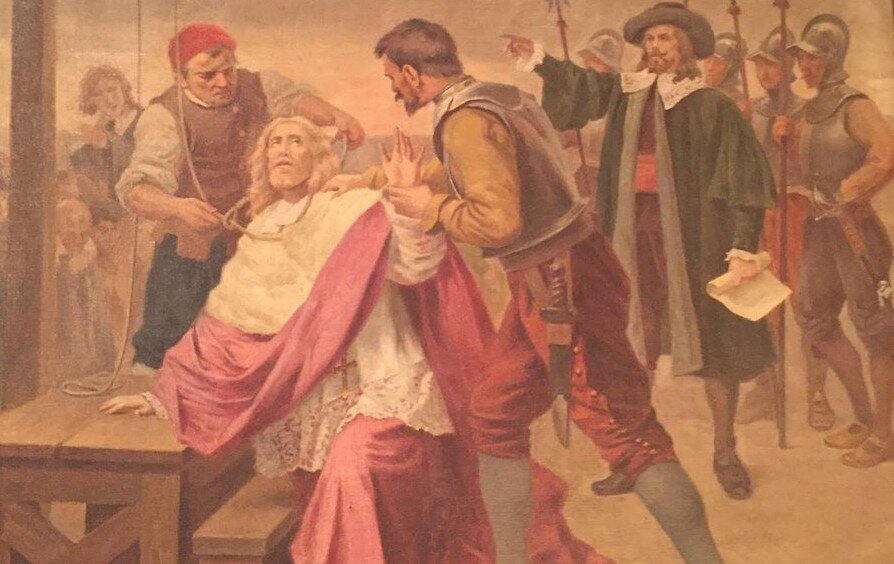
St. Oliver Plunkett was found guilty of treason in 1681, before being hanged, drawn and quartered.

At Tyburn, his body was torched by the bloodthirsty Reformers in an act of depraved zealousness.

Painting of St. Oliver’s death in St. Peter’s Parish Church in Drogheda

Painting of St. Oliver’s death in St. Peter’s Parish Church in Drogheda

Oliver-Plunkett-1-e1499100762800.jpg

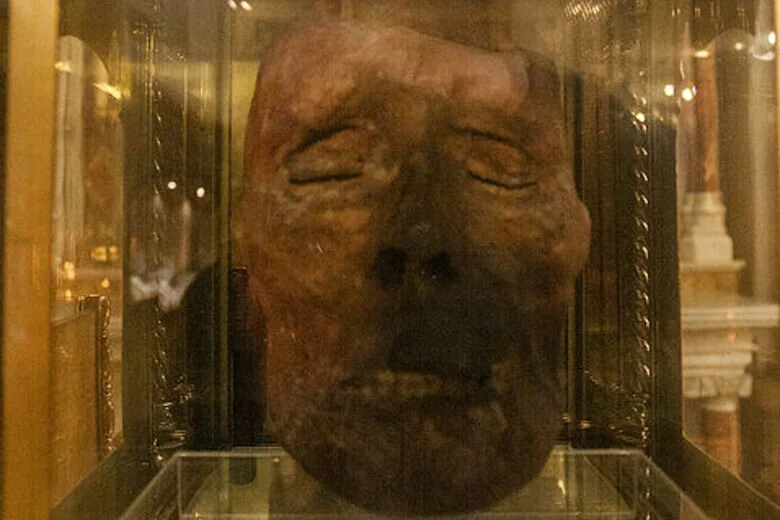
His head was eventually recovered from the fire and Dom Maurus Corker had it smuggled to the Benedictine Monastery in Lamspringe, Germany. Within the next few years, it was passed on to Cardinal Philip Howard OP at Rome, a friend of St. Oliver, who had helped the Archbishop of Armagh to return to Ireland safely after his ordination as Archbishop. From him, it passed to Oliver’s successor, Archbishop of Armagh Hugh McMahon, who returned the head to its rightful place in Ireland. McMahon brought the head to the Dominican Nuns at Siena, the prioress at the time being Sister Catherin Plunkett, St. Oliver’s grand niece.

As this came during the penal laws, when it was illegal to be a Catholic, much less a member of a religious order, the order and the relic both had to survive together in secret. Having originally started out in a mud cabin, the sisters moved to other parts of Drogheda over the years, always maintaining the veneer of being a boarding house for women rather than a convent.

When Pope Benedict XV declared Plunkett a martyr for the faith on St. Patrick’s Day in 1918, it was inevitable that his head eventually would have to be moved (incidentally it has been claimed that Benedict XV also blessed plans for the Easter Rising when Count Plunkett brought documents written by his son Joseph Mary Plunkett, apparently a distant relative of St. Oliver). Count Plunkett was in the audience on the day that Oliver was beatified.

head.jpg

The sisters had kept the head in good condition for 200 years at this point, with a shrine surrounding the relic at their convent.

Cardinal Michael Logue then requested that the sisters transfer his head to the St. Peter’s Parish Church in Drogheda, which fulfilled an agreement made initially by the sisters when they promised to return it to a successor of McMahon. The head had not been entirely hidden away however before this, in 1881 thousands had flocked to the convent to venerate St. Oliver on the 200 anniversary of his death.

In 1920, which the War of Independence raging, St. Oliver was beatified and his head transferred to the parish church in Drogheda with Eucharistic processions in celebration.

Pope Paul VI visited the shrine on a number of occasions in order to venerate it, eventually lifting Oliver to sainthood during his pontificate, in 1975.

Pope John Paul II visited Drogheda in 1979 and venerated the shrine also.

Most of the information in this article is sourced from Tommy Burns’s book ‘St. Oliver Plunkett: Two Centenaries 1921-2021’


SSPX Consecrates Four New Bishops in Switzerland

The SSPX have consecrated four new bishops today in Switzerland,, 15,000 people were in attendance.